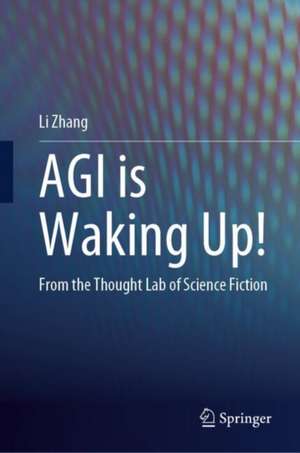
AGI is Waking Up!
Autor Li Zhangen Limba Engleză Hardback – 4 dec 2024
Spanning across disciplines such as astronomy, physics, chemistry, biology, neuroscience, psychology, sociology, this book employs a unified and accessible high-dimensional philosophical discourse to bridge the realms of natural sciences and social humanities. Its captivating presentation, enriched with visual aids and lucid explanations, enables readers to grasp the overarching panorama of cosmic evolution, biological adaptation, and the trajectory of artificial intelligence development. Furthermore, the book offers insightful predictions for the future and endeavours to discover novel approaches to foster harmonious interactions between humans and machines.
The translation was done with the help of artificial intelligence. A subsequent human revision was done primarily in terms of content.
Preț: 730.21 lei
Preț vechi: 960.80 lei
-24%
Puncte Express: 1095
Carte tipărită la comandă
Livrare economică 25 noiembrie-01 decembrie
Livrare prin curier în România Termenul estimat este afișat lângă disponibilitate.
Transport gratuit pentru acest produs Plată online sau ramburs, în funcție de opțiunile comenzii.
Retur gratuit în 14 zile Comandă securizată și suport în română.
Specificații
ISBN-13: 9789819745142
ISBN-10: 9819745144
Pagini: 272
Ilustrații: Approx. 200 p.
Dimensiuni: 160 x 241 x 20 mm
Greutate: 0.57 kg
Ediția:2025
Editura: Springer
Locul publicării:Singapore, Singapore
ISBN-10: 9819745144
Pagini: 272
Ilustrații: Approx. 200 p.
Dimensiuni: 160 x 241 x 20 mm
Greutate: 0.57 kg
Ediția:2025
Editura: Springer
Locul publicării:Singapore, Singapore
Cuprins
1. Can we predict the arrival of strong artificial intelligence?.- 2. Is the wake up of AI related to boundaries? .- 3. Will Strong Artificial Intelligence Appear?.- 4. Will Artificial Intelligence Have Consciousness and Soul?.- 5. When “consciousness” makes its choice, how powerful will it be?.- 6. What is the underlying logic of the evolution history of life?.- 7. Is the magic “split” achievable with AI?.- 8. Will Artificial Intelligence Request Independence?.- 9. Is the human carbon-based body a must for AI?.- 10. What could be the goal of AI after IT wakes up?.- 11. Will AI also have “emotions” and “feelings”.- 12. Will human’s morality become an algorithm for artificial intelligence?.
Notă biografică
Qiuqin Sun Professor, Hunan University, Changsha, China IEEE Senior Member, IET Chartered Enginner. He received degrees of B.Sc. (2006) and Ph.D. (2012) from Chongqing University, Chongqing, and Shandong University, Jinan, China, respectively, both in Electrical Engineering. He joined in Jiangsu Electrical Power Company Research Institute as a senior electrical engineer in 2012, and then came to Hunan University, Changsha, China in 2014. From June 2014 to May 2015, he worked as an Honorary Research Fellow at the University of Liverpool. He is currently a professor with College of Electrical and Information Engineering, Hunan University. He has authored or co-authored about 100 journal papers, including about 30 IEEE Transactions papers. He serves as editoral board member of journal High Voltage Apparatus, Electric Power Engineering Technology, academic editor of Mathemcatical Problems in Engineering. He is the recipient of Distinguished Young Scholars of Hunan Province. He canbe reached by email at sunqq@hnu.edu.cn. Li Zhang Associate Professor, Shandong University, Jinan, China He received his degree of Ph.D.(2009) from the School of Electrical Engineering at Shandong University, Jinan, China. From July 2019 to October 2020, he served as a visiting scholar at the University of Florida in the United States. Currently, he is a Ph.D candidate supervisor and the head of high voltage institute, Shandong University. His research primarily focuses on applied electromagnetics, high voltage and insulation technology. He is a leader principal investigator for four national natural science foundation projects. He can be reached by email at zhleee@sdu.edu.cn. Xiao Zhong received his B.Sc. degree in electrical engineering from Hefei University of Technology, Hefei, China in 2019. Currently, he is studying for the Ph.D. degree in electrical engineering at the School of Electrical and Information Engineering of Hunan University,Changsha, China. His research interests include lightning electromagnetic transients in power systems and lightning protection design of PV systems. Feng Bin Lecturer, Changsha University of Science & Technology, Changsha, China He received his degree of Ph.D. (2020) from School of Electrical and Information Engineering at Hunan University, Changsha, China. Currently, he is a master supervisor and the director of entrepreneurship and innovation center in School of Physics & Electronic Science, Changsha University of Science & Technology. His research primarily focuses on artificial intelligence and insulation online monitoring for power equipment. He can be reached by email at dianzi8349@csust.edu.cn. Zhi Zheng was born in Hunan, China in 1995. He received the B.S. degree from Taiyuan University of Technology, Taiyuan, China, in 2017 and the M.S. degree from North China Electric Power University, Baoding, China, in 2020. He is currently pursuing the Ph.D. degree in electrical engineering at Hunan University, Changsha, China. His research interest is electromagnetic transient analysis and overvoltage protection for offshore wind power system. He can be reached by email at zhengzhi@hnu.edu.cn.
Textul de pe ultima copertă
This book is an engaging and comprehensive exploration that delves into the possibility of artificial intelligence developing self-awareness, the conditions under which it may occur, and the potential behaviours it may exhibit once self-aware. It adopts a ‘high-dimensional philosophy’, coined by the author, as its theoretical framework and weaves together elements from science fiction films, scholarly works, and thought experiments. Introducing the captivating concept of "Sparkling Moments," the book provides a compelling analysis of the reasons, prerequisites, and manifestations of these pivotal moments. It further scrutinizes the evolutionary history of Earth's life forms through the lens of these transformative instances and analyzes the similarities and differences between carbon-based and silicon-based life. This book suggests that it is possible for artificial intelligence to develop self-consciousness, which will emerge during a significant sparkling moment. Spanning across disciplines such as astronomy, physics, chemistry, biology, neuroscience, psychology, sociology, this book employs a unified and accessible high-dimensional philosophical discourse to bridge the realms of natural sciences and social humanities. Its captivating presentation, enriched with visual aids and lucid explanations, enables readers to grasp the overarching panorama of cosmic evolution, biological adaptation, and the trajectory of artificial intelligence development. Furthermore, the book offers insightful predictions for the future and endeavours to discover novel approaches to foster harmonious interactions between humans and machines.
The translation was done with the help of artificial intelligence. A subsequent human revision was done primarily in terms of content.
The translation was done with the help of artificial intelligence. A subsequent human revision was done primarily in terms of content.
Caracteristici
First book that adopts movies data as a transformative gateway to uncharted philosophical territories about AI Embarks on an intellectual exploration to venture into diverse academic disciplines including philosophy and technology Leveraging the foundations of a Dzeko system, the book conducts a thought experiment on the future of AI