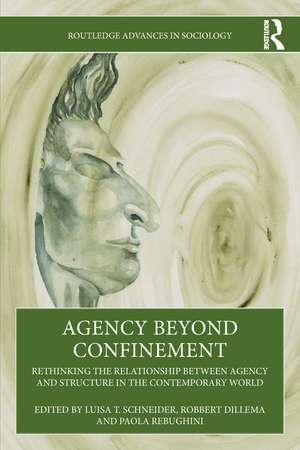
Agency Beyond Confinement: Rethinking the Relationship Between Agency and Structure in the Contemporary World: Routledge Advances in Sociology
Editat de Luisa T Schneider, Robbert Dillema, Paola Rebughinien Limba Engleză Hardback – 13 mar 2026
Across prisons, homes, gardens, seas, and cities, this volume explores how material, affective, and institutional confinement is shaped and reshaped through recursive processes of structure and agency. It argues that confinement appears not as total enclosure, but as a genre of design, narration, abandonment, and control that is written, inhabited, and rewritten by those it seeks to contain.
Bringing together case studies from Europe, Latin America, and Africa, this volume features an interdisciplinary group of scholars who refuse academic silos. Across methods, themes, and theoretical lineages, they examine how confinement takes shape, how it can be re-theorized, and how it might be undone. As such this book is essential reading for scholars, students, and practitioners in anthropology, carceral studies, cultural studies, critical legal theory, and related fields seeking to understand—and unmake—the conditions of confinement today.
Din seria Routledge Advances in Sociology
-
 Preț: 354.21 lei
 -
 Preț: 344.80 lei
 -
 Preț: 376.99 lei
 - 15%
 Preț: 454.12 lei
 -
 Preț: 392.92 lei
 - 18%
 Preț: 1203.70 lei
 -
 Preț: 446.00 lei
 - 18%
 Preț: 1197.62 lei
 - 18%
 Preț: 1198.39 lei
 - 18%
 Preț: 1068.62 lei
 -
 Preț: 399.59 lei
 - 18%
 Preț: 727.05 lei
 - 18%
 Preț: 1199.45 lei
 - 18%
 Preț: 1067.14 lei
 - 18%
 Preț: 1068.05 lei
 - 18%
 Preț: 1066.82 lei
 - 18%
 Preț: 1194.62 lei
 -
 Preț: 449.89 lei
 - 18%
 Preț: 1216.14 lei
 - 18%
 Preț: 1206.10 lei
 - 18%
 Preț: 735.84 lei
 - 18%
 Preț: 1075.31 lei
 - 18%
 Preț: 1206.44 lei
 - 18%
 Preț: 1021.97 lei
 - 18%
 Preț: 1197.62 lei
 - 18%
 Preț: 1298.53 lei
 - 18%
 Preț: 1208.53 lei
 - 15%
 Preț: 402.12 lei
 - 18%
 Preț: 1068.05 lei
 - 18%
 Preț: 1063.81 lei
 - 18%
 Preț: 1196.88 lei
 - 18%
 Preț: 1197.62 lei
 - 18%
 Preț: 1200.05 lei
 - 18%
 Preț: 1359.89 lei
 - 18%
 Preț: 1197.62 lei
 - 18%
 Preț: 1072.74 lei
 - 18%
 Preț: 1197.75 lei
 - 18%
 Preț: 1363.54 lei
 - 18%
 Preț: 1199.89 lei
 - 18%
 Preț: 1199.16 lei
 - 18%
 Preț: 1195.94 lei
 - 18%
 Preț: 1065.31 lei
 - 18%
 Preț: 1194.90 lei
 - 18%
 Preț: 1013.47 lei
 - 5%
 Preț: 1385.39 lei
 - 18%
 Preț: 1200.65 lei
 -
 Preț: 422.77 lei
 - 18%
 Preț: 1197.18 lei
Preț: 1228.34 lei
Preț vechi: 1595.25 lei
-23% Nou
Puncte Express: 1843
Carte tipărită la comandă
Livrare economică 02-08 iunie
Specificații
ISBN-13: 9781041134275
ISBN-10: 1041134274
Pagini: 252
Ilustrații: 16
Dimensiuni: 156 x 234 mm
Greutate: 0.54 kg
Ediția:1
Editura: Taylor & Francis
Colecția Routledge
Seria Routledge Advances in Sociology
Locul publicării:Oxford, United Kingdom
ISBN-10: 1041134274
Pagini: 252
Ilustrații: 16
Dimensiuni: 156 x 234 mm
Greutate: 0.54 kg
Ediția:1
Editura: Taylor & Francis
Colecția Routledge
Seria Routledge Advances in Sociology
Locul publicării:Oxford, United Kingdom
Public țintă
Academic and PostgraduateCuprins
Introduction. Recursive Composition. The Entanglement of Structure and Agency in a Confining World; Prelude. Out of Words; 1. Metamorphosis of the agency/structure debate; 2. Rethinking Structures and Agencies as Literature; 3. The expansion and multiplication of prisoner governance schemes in Latin American prisons. Towards an explanation; 4. Ghosts in the machine? Applying sonic theory to structure and agency; 5. Prison, Home, Garden: Carceral Idylls and (Re)Thinking Detention in Robert Glas’ Justice Beyond Revenge. Recalling Louk Hulsman (2024); 6. Negotiating power: structure and agency in Nepalese prisons’ system of inmate co-governance; 7. Neither rebels, nor ‘good boys.’ Anticipation Games, Professional Ethics and Prosecutorial Discretion in West Africa’s Special Courts; 8. Engaging the Prison as Intention, Effect, and Function. On the Incommensurability and Ethics of Prison Research; 9. Adding volume and technological flesh to the Mediterranean border zone: The Space-Eye-project as gateway to EU aerial surveillance infrastructures; 10. Dreams and aspirations at the calisthenics court: differentiating agency from ideology with young adults in Amsterdam’s Bijlmer district; Epilogue 1: Agency and Confined Lives; Epilogue 2: Thoughts on Something-to-be-done: Embracing the Otherwise Toward Abolitionist Futures
Recenzii
"This brilliant collection is breathtaking in theoretical scope and sensorial density. It plunges us into carceral worlds with an immediacy that is palpable. “The sound of keys carries.” These are the opening words of Schneider’s introduction.
The volume achieves something extraordinary: it reanimates the (over)saturated agency-structure debate in a highly original way. Chapter after chapter disturbs this binary by concretely demonstrating the unsettled entanglement of carceral structures with everyday life. There are no autonomous agents, no simple resistance stories, no totalizing institutions. Instead, there is, quoting again from the introduction, a ‘common murmur: structures are not inert. They breathe, mutate, and extend. They cling to bodies, buildings, and technologies, travel in fantasy, fear, and idyll, embed themselves in soil and sound, in algorithmic surveillance and judicial discretion.’ This imagistic rendering is given material weight as chapters take us to scenes of prison inmate governance, youth gymnastic bars, gardens.
This work is also an experiment in form. Authors engage with one another in a manner that is alive and unfinished, offering a dialogical adventure that performs and enacts what it argues: that life is not closed, even under the most oppressive conditions. Contributors, drawing inspiration from post-colonial and feminist thinkers, depict widely diverse spaces, especially in the Global South. This provides an expansive vista with which to rethink and reimagine the structure-agency binary.
This book will undoubtedly reach an audience that includes seasoned academic scholars, post-graduate and PhD students as well as masters level students. The theoretical proposals are sophisticated, even ground-breaking, but the vividness of the empirical material and the writing, which is often poetic, will guarantee broad appeal."
Cheryl Mattingly, Professor of Anthropology, Aarhus University and University of Southern California, author of The Paradox of Hope (2010) and co-author of Moral Engines (2018)
"This book smashes the intense tradition of thinkers like Freud, Durkheim and Foucault to explore existence through its purported aberration, only to gently repurpose this foundational questioning and put it together again – kintsugi style – in a truly innovative way. The authors breathe new life into seemingly threadbare debates about structure and agency by unpacking the everyday lives of confinement across a global register of grounded ethnographic analyses. The book combines a compelling editorial strategy of insightfully dismantling persisting binaries with a refreshing co-creative tactic of dialogical writing. In turn, the contributors open new pathways of sensing and critiquing the accelerating repertoire of brutally corporeal as well as insidiously ephemeral harms of confinement that impinge on human and non-human lives. It is a prime example of how risky, but conscientious theorizing and the tilling of empirical soil in prison-like life-worlds enables granular ethnography to revitalize perennial sociological debates and bring minor discourses of everyday life to bear on vital political questions in resounding ways."
Tomas Max Martin, Senior Researcher, DIGNITY, the Danish Institute against Torture, author of Sensing Prison Climates (2014), and co-editor of Prisons in Africa (2016)
"Criminological scholarship benefits enormously from proper engagement with social theory, and the context of confinement is fertile ground for consideration of the relationship between structure and agency. Through chapters covering a truly diverse range of topics, this highly original and hugely stimulating collection demonstrates the advantages of ambitious thinking, and shows how theory can be productively applied to empirical work in ways that allow the reader to see social and carceral phenomena in new ways’."
Ben Crewe, Professor of Criminology, Cambridge University, author of The Prisoner Society (2009) and co-author of Life Imprisonment from Young Adulthood (2024)
"Through a seductive intrigue between social theory, methodologies, and empirical studies, this book shows the great diversity of the dynamics between agency and structure in the most problematic field to achieve it: human confinement. Through case studies from different countries and a diversity of devices and apparatus (satellite images, artificial intelligence, prisoner governance, prison soundscapes, etc.), the success of the project makes it an amazing and real tour de force."
Danilo Martuccelli, Professor of Sociology, University of Paris Cité and University Diego Portales – Chile, author of La condition sociale modern, (2017), co-author of Controverses sur l’individualisme (2014)
"At a time when the world is increasingly understood through rigid binaries, this book offers a much-needed reimagining of the structure/agency debate. Grounded in rich ethnographic and interdisciplinary research, it uses confinement as both a conceptual and empirical entry point to explore how individuals navigate, resist, and reshape the structures that constrain them. This de-dualizing approach is hugely helpful to anyone who wishes to get a better analytical grasp of the complexities of the contemporary world. A must-read for scholars and students of social theory, as well as for those interested in the ethnographic study of confinement, resistance, and the lived politics of everyday life."
Prof. Insa Lee Koch, Professor of Brittish Culture, University St, Gallen. Author of Personalizing the State (2018) and Drugs, Race and the Politics of Modern Slavery Law (2026)
The volume achieves something extraordinary: it reanimates the (over)saturated agency-structure debate in a highly original way. Chapter after chapter disturbs this binary by concretely demonstrating the unsettled entanglement of carceral structures with everyday life. There are no autonomous agents, no simple resistance stories, no totalizing institutions. Instead, there is, quoting again from the introduction, a ‘common murmur: structures are not inert. They breathe, mutate, and extend. They cling to bodies, buildings, and technologies, travel in fantasy, fear, and idyll, embed themselves in soil and sound, in algorithmic surveillance and judicial discretion.’ This imagistic rendering is given material weight as chapters take us to scenes of prison inmate governance, youth gymnastic bars, gardens.
This work is also an experiment in form. Authors engage with one another in a manner that is alive and unfinished, offering a dialogical adventure that performs and enacts what it argues: that life is not closed, even under the most oppressive conditions. Contributors, drawing inspiration from post-colonial and feminist thinkers, depict widely diverse spaces, especially in the Global South. This provides an expansive vista with which to rethink and reimagine the structure-agency binary.
This book will undoubtedly reach an audience that includes seasoned academic scholars, post-graduate and PhD students as well as masters level students. The theoretical proposals are sophisticated, even ground-breaking, but the vividness of the empirical material and the writing, which is often poetic, will guarantee broad appeal."
Cheryl Mattingly, Professor of Anthropology, Aarhus University and University of Southern California, author of The Paradox of Hope (2010) and co-author of Moral Engines (2018)
"This book smashes the intense tradition of thinkers like Freud, Durkheim and Foucault to explore existence through its purported aberration, only to gently repurpose this foundational questioning and put it together again – kintsugi style – in a truly innovative way. The authors breathe new life into seemingly threadbare debates about structure and agency by unpacking the everyday lives of confinement across a global register of grounded ethnographic analyses. The book combines a compelling editorial strategy of insightfully dismantling persisting binaries with a refreshing co-creative tactic of dialogical writing. In turn, the contributors open new pathways of sensing and critiquing the accelerating repertoire of brutally corporeal as well as insidiously ephemeral harms of confinement that impinge on human and non-human lives. It is a prime example of how risky, but conscientious theorizing and the tilling of empirical soil in prison-like life-worlds enables granular ethnography to revitalize perennial sociological debates and bring minor discourses of everyday life to bear on vital political questions in resounding ways."
Tomas Max Martin, Senior Researcher, DIGNITY, the Danish Institute against Torture, author of Sensing Prison Climates (2014), and co-editor of Prisons in Africa (2016)
"Criminological scholarship benefits enormously from proper engagement with social theory, and the context of confinement is fertile ground for consideration of the relationship between structure and agency. Through chapters covering a truly diverse range of topics, this highly original and hugely stimulating collection demonstrates the advantages of ambitious thinking, and shows how theory can be productively applied to empirical work in ways that allow the reader to see social and carceral phenomena in new ways’."
Ben Crewe, Professor of Criminology, Cambridge University, author of The Prisoner Society (2009) and co-author of Life Imprisonment from Young Adulthood (2024)
"Through a seductive intrigue between social theory, methodologies, and empirical studies, this book shows the great diversity of the dynamics between agency and structure in the most problematic field to achieve it: human confinement. Through case studies from different countries and a diversity of devices and apparatus (satellite images, artificial intelligence, prisoner governance, prison soundscapes, etc.), the success of the project makes it an amazing and real tour de force."
Danilo Martuccelli, Professor of Sociology, University of Paris Cité and University Diego Portales – Chile, author of La condition sociale modern, (2017), co-author of Controverses sur l’individualisme (2014)
"At a time when the world is increasingly understood through rigid binaries, this book offers a much-needed reimagining of the structure/agency debate. Grounded in rich ethnographic and interdisciplinary research, it uses confinement as both a conceptual and empirical entry point to explore how individuals navigate, resist, and reshape the structures that constrain them. This de-dualizing approach is hugely helpful to anyone who wishes to get a better analytical grasp of the complexities of the contemporary world. A must-read for scholars and students of social theory, as well as for those interested in the ethnographic study of confinement, resistance, and the lived politics of everyday life."
Prof. Insa Lee Koch, Professor of Brittish Culture, University St, Gallen. Author of Personalizing the State (2018) and Drugs, Race and the Politics of Modern Slavery Law (2026)
Notă biografică
Luisa T. Schneider is an anthropologist whose work focuses on intimacy, violence, law, and everyday ethics. She is Assistant Professor at Vrije Universiteit Amsterdam, Netherlands, and a Research Partner at the Max Planck Institute for Social Anthropology, Germany. Drawing on over a decade of ethnographic research in Europe and West Africa, her work examines how carceral abandonment shapes personal relationships and institutional practices. Her recent publications include Love and Violence in Sierra Leone (2025), Let Me Take a Vacation in Prison Before the Streets Kill Me! (2021), and Sexual Violence During Research (2020).
Robbert Dillema is completing his PhD in Anthropology at the Vrije Universiteit Amsterdam, Netherlands. He works on urban segregation in neoliberal welfare states, particularly the so dubbed participatory state of the Netherlands. There, he conducts ethnographic research with young adults and their support networks in Southeast Amsterdam. His research engages with the phenomenology, ideo-pedagogy, and political economy of urban disenfranchisement. He published People don’t fall for it any longer (2025).
Paola Rebughini is Professor of Sociology and currently Director of the PhD program in Sociology and Methodology of Social Research at the University of Milan, Italy. Her main fields of expertise are social and cultural theory, sociology of youth, cultural pluralism, and agency in everyday practices. She is the author of more than 150 publications, including Framing Social Theory (2022) eds. with E. Colombo; Sociology of difference: Gender, Culture, Nature (2022) in Italian. Youth and the Politics of the Present (2019) eds. with E. Colombo.
Robbert Dillema is completing his PhD in Anthropology at the Vrije Universiteit Amsterdam, Netherlands. He works on urban segregation in neoliberal welfare states, particularly the so dubbed participatory state of the Netherlands. There, he conducts ethnographic research with young adults and their support networks in Southeast Amsterdam. His research engages with the phenomenology, ideo-pedagogy, and political economy of urban disenfranchisement. He published People don’t fall for it any longer (2025).
Paola Rebughini is Professor of Sociology and currently Director of the PhD program in Sociology and Methodology of Social Research at the University of Milan, Italy. Her main fields of expertise are social and cultural theory, sociology of youth, cultural pluralism, and agency in everyday practices. She is the author of more than 150 publications, including Framing Social Theory (2022) eds. with E. Colombo; Sociology of difference: Gender, Culture, Nature (2022) in Italian. Youth and the Politics of the Present (2019) eds. with E. Colombo.
Descriere
What does it mean to be confined—and what forms of life, resistance, and care emerge in response? Agency Beyond Confinement rethinks the social life of confinement by refusing binaries: structure vs. agency, reform vs. resistance, care vs. control.