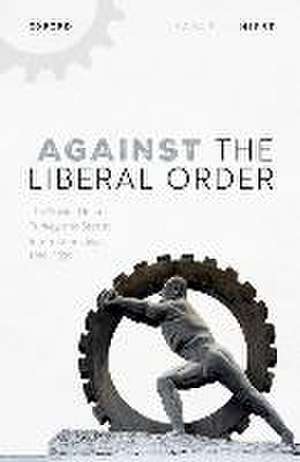
Against the Liberal Order: The Soviet Union, Turkey, and Statist Internationalism, 1919-1939
Autor Samuel J. Hirsten Limba Engleză Hardback – 4 iul 2024
Preț: 538.92 lei
Preț vechi: 752.89 lei
-28%
Puncte Express: 808
Carte tipărită la comandă
Livrare economică 29 octombrie-04 noiembrie
Livrare prin curier în România Termenul estimat este afișat lângă disponibilitate.
Transport gratuit pentru acest produs Plată online sau ramburs, în funcție de opțiunile comenzii.
Retur gratuit în 14 zile Comandă securizată și suport în română.
Specificații
ISBN-13: 9780198916628
ISBN-10: 0198916620
Pagini: 256
Ilustrații: 16 black-and-white figures/maps
Dimensiuni: 163 x 243 x 18 mm
Greutate: 0.56 kg
Editura: OUP OXFORD
Colecția OUP Oxford
Locul publicării:Oxford, United Kingdom
ISBN-10: 0198916620
Pagini: 256
Ilustrații: 16 black-and-white figures/maps
Dimensiuni: 163 x 243 x 18 mm
Greutate: 0.56 kg
Editura: OUP OXFORD
Colecția OUP Oxford
Locul publicării:Oxford, United Kingdom
Recenzii
In Against the Liberal Order, Hirst (Bilkent Univ., Turkey) provides a compelling addition to the small but growing reassessment of Soviet foreign relations in the 20th century. His presentation of Soviet-Turkish relations provides a fascinating case study of catch-up modernization across regime types, which constitutes the statist internationalism of his subtitle.
The book's most significant contribution is its reading-or, more precisely, its conceptualisation-of Soviet-Turkish co-operation as 'statist internationalism', a conceptualisation which transcends the traditional dichotomous categorisation of liberal and illiberal internationalisms and thus offers a novel and powerful perspective for rethinking inter-war history... Hirst's brilliant book is a solid work of scholarship and an essential read for anyone interested in the history of the Soviet Union, republican Turkey and modern Europe.
Against the Liberal Order is a persuasive and meticulously researched account of Soviet-Turkish relations. Rather than writing off this collaboration as confused and incoherent, Hirst draws out the ideological basis of this relationship, showing how it was developed and justified in the terms of those who carried it out.
One of the book's most significant strengths is its capacity to transcend simplistic dualisms, such as the dichotomy between the East and the West or that between communism and nationalism. Instead, Hirst situates the Soviet-Turkish relationship within a broader global context of underdevelopment, economic dependence, and resistance to Western hegemony.
This book offers a richly documented account of diplomatic and economic relations between the Soviet Union and Kemalist Turkey during the 1920s and 1930s.
A model monograph - short, deeply researched, elegantly written. It's also an exemplar of the best of the new international history, blending analysis of state-to-state relations with a careful appreciation for transnational actors, cultural interactions, and global interconnectedness.
The book's most significant contribution is its reading-or, more precisely, its conceptualisation-of Soviet-Turkish co-operation as 'statist internationalism', a conceptualisation which transcends the traditional dichotomous categorisation of liberal and illiberal internationalisms and thus offers a novel and powerful perspective for rethinking inter-war history... Hirst's brilliant book is a solid work of scholarship and an essential read for anyone interested in the history of the Soviet Union, republican Turkey and modern Europe.
Against the Liberal Order is a persuasive and meticulously researched account of Soviet-Turkish relations. Rather than writing off this collaboration as confused and incoherent, Hirst draws out the ideological basis of this relationship, showing how it was developed and justified in the terms of those who carried it out.
One of the book's most significant strengths is its capacity to transcend simplistic dualisms, such as the dichotomy between the East and the West or that between communism and nationalism. Instead, Hirst situates the Soviet-Turkish relationship within a broader global context of underdevelopment, economic dependence, and resistance to Western hegemony.
This book offers a richly documented account of diplomatic and economic relations between the Soviet Union and Kemalist Turkey during the 1920s and 1930s.
A model monograph - short, deeply researched, elegantly written. It's also an exemplar of the best of the new international history, blending analysis of state-to-state relations with a careful appreciation for transnational actors, cultural interactions, and global interconnectedness.
Notă biografică
Samuel J. Hirst teaches the history of international relations at Bilkent University. Since receiving a PhD in history from the University of Pennsylvania in 2012, he has lived and taught in St. Petersburg and Ankara. He is fluent in Russian and Turkish, and his research draws on extensive work in multiple archives.