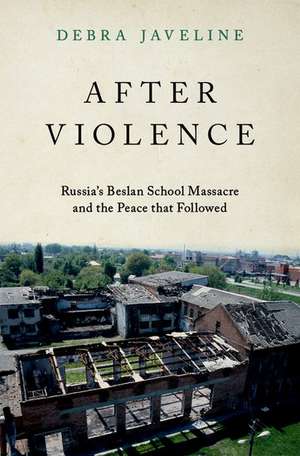
After Violence: Russia's Beslan School Massacre and the Peace that Followed
Autor Debra Javelineen Limba Engleză Hardback – iun 2023
Preț: 797.81 lei
Preț vechi: 1181.87 lei
-32%
Puncte Express: 1197
Carte disponibilă
Livrare economică 13-18 noiembrie
Livrare prin curier în România Termenul estimat este afișat lângă disponibilitate.
Transport gratuit pentru acest produs Plată online sau ramburs, în funcție de opțiunile comenzii.
Retur gratuit în 14 zile Comandă securizată și suport în română.
Specificații
ISBN-13: 9780197683347
ISBN-10: 0197683347
Pagini: 600
Ilustrații: 12 b/w photographs; 29 b/w line drawings; 53 tables; 1 map
Dimensiuni: 237 x 164 x 40 mm
Greutate: 1 kg
Editura: Oxford University Press
Colecția OUP USA
Locul publicării:New York, United States
ISBN-10: 0197683347
Pagini: 600
Ilustrații: 12 b/w photographs; 29 b/w line drawings; 53 tables; 1 map
Dimensiuni: 237 x 164 x 40 mm
Greutate: 1 kg
Editura: Oxford University Press
Colecția OUP USA
Locul publicării:New York, United States
Recenzii
Debra Javeline has made a major contribution to the study of ethnic killing and its aftermath. Meticulously researched, After Violence elucidates the parts played by political efficacy and involvement, anger, and prejudice in determining the very different reactions of individuals to a major violent episode and their disposition to retaliate. This is a highly significant work of political psychology.
Javeline dissects the individual responses to a horrific massacre in order to identify, explore, and explicate the transformation of grievance and anger into peaceful political activism rather than retaliatory ethnic violence. Thorough, rigorous, and deeply human, this is an exemplary piece of research on the politics of violence, carrying important and wide-ranging implications.
Focusing on individual responses to the unspeakable violence committed against them, Debra Javeline's magnificent study of how victims of the Beslan tragedy responded with sustained nonviolent activism demonstrates that the reaction to bloodshed need not be more bloodshed, defying expectations and inspiring hope in a world seemingly dominated by headlines of revenge and ethnic hatreds.
This intensely moving book explores the 2004 Beslan school terrorist siege in Russia's North Ossetia region in vivid detail, describing how Russian authorities first bungled a rescue attempt and then ignored or harassed the surviving victims and families who searched for answers. Javeline explores the political choices victims made in the aftermath, focusing on how and why anger spawned the most sustained peaceful political protests in Putin's Russia, rather than the retaliatory ethno-religious violence that many expected. Javeline uses multiple methods, including on-the-ground focus groups and the words of many involved individuals, to draw out emotions and motivations, while paying meticulous attention to social science research design. This book is destined to become a classic in the literature on political violence.
After Violence does the unexpected—and does it consummately! Unlike most studies of mass violence, which focus on its 'upstream' causes, Javeline looks 'downstream'—at the reactions of the victims, their neighbors, and the authorities. The strategy pays off magnificently: in contrast to the common focus on escalation, she finds peaceful protest. This is a book I that scholars of violence and of peaceful protest will want to read and reflect on.
Javeline poses a 'murder mystery': why in spite of all theories and evidence pointing toward the Beslan school massacre generating interethnic warfare, did it result in a large-scale nonviolent social movement? In particular, what was it about the individuals involved that led to this outcome? A fascinating read.
Over 3 days in early September 2004, some 1200 students, teachers and parents were taken hostage in School No. 1 in Beslan, North Ossetia, Russia. Over 330 would die in the school seizure, but nearly 900 would survive. How would the experience shape their subsequent attitudes and behavior? In this extraordinary book, Javeline draws on direct data from nearly all survivors to answer the question. Her findings are illuminating and surprising in equal measure. This is engaged social science at its very best.
The hostage taking at School No. 1 in Beslan, in Russia's multinational North Caucasus, in 2004, was a horrendous act of terrorism, brought to an end by security forces with heavy casualties. Many expected the siege to be followed by a wave of intercommunal violence, but the wave did not materialize. Debra Javeline's exhaustively researched and elegantly written study explains why this was so and draws lessons for broader understandings of life and politics after conflict.
Javeline dissects the individual responses to a horrific massacre in order to identify, explore, and explicate the transformation of grievance and anger into peaceful political activism rather than retaliatory ethnic violence. Thorough, rigorous, and deeply human, this is an exemplary piece of research on the politics of violence, carrying important and wide-ranging implications.
Focusing on individual responses to the unspeakable violence committed against them, Debra Javeline's magnificent study of how victims of the Beslan tragedy responded with sustained nonviolent activism demonstrates that the reaction to bloodshed need not be more bloodshed, defying expectations and inspiring hope in a world seemingly dominated by headlines of revenge and ethnic hatreds.
This intensely moving book explores the 2004 Beslan school terrorist siege in Russia's North Ossetia region in vivid detail, describing how Russian authorities first bungled a rescue attempt and then ignored or harassed the surviving victims and families who searched for answers. Javeline explores the political choices victims made in the aftermath, focusing on how and why anger spawned the most sustained peaceful political protests in Putin's Russia, rather than the retaliatory ethno-religious violence that many expected. Javeline uses multiple methods, including on-the-ground focus groups and the words of many involved individuals, to draw out emotions and motivations, while paying meticulous attention to social science research design. This book is destined to become a classic in the literature on political violence.
After Violence does the unexpected—and does it consummately! Unlike most studies of mass violence, which focus on its 'upstream' causes, Javeline looks 'downstream'—at the reactions of the victims, their neighbors, and the authorities. The strategy pays off magnificently: in contrast to the common focus on escalation, she finds peaceful protest. This is a book I that scholars of violence and of peaceful protest will want to read and reflect on.
Javeline poses a 'murder mystery': why in spite of all theories and evidence pointing toward the Beslan school massacre generating interethnic warfare, did it result in a large-scale nonviolent social movement? In particular, what was it about the individuals involved that led to this outcome? A fascinating read.
Over 3 days in early September 2004, some 1200 students, teachers and parents were taken hostage in School No. 1 in Beslan, North Ossetia, Russia. Over 330 would die in the school seizure, but nearly 900 would survive. How would the experience shape their subsequent attitudes and behavior? In this extraordinary book, Javeline draws on direct data from nearly all survivors to answer the question. Her findings are illuminating and surprising in equal measure. This is engaged social science at its very best.
The hostage taking at School No. 1 in Beslan, in Russia's multinational North Caucasus, in 2004, was a horrendous act of terrorism, brought to an end by security forces with heavy casualties. Many expected the siege to be followed by a wave of intercommunal violence, but the wave did not materialize. Debra Javeline's exhaustively researched and elegantly written study explains why this was so and draws lessons for broader understandings of life and politics after conflict.
Notă biografică
Debra Javeline is Associate Professor in the Department of Political Science at the University of Notre Dame and a fellow of the Kroc Institute for International Peace Studies, Kellogg Institute for International Studies, Nanovic Institute for European Studies, Russian and East European Studies Program, and Environmental Change Initiative. Her research interests include mass political behavior, survey research, Russian politics, sustainability, environmental politics, and climate change. She focuses on the decisions of ordinary citizens, whether in response to violence or climate impacts, and she is currently exploring coastal homeowner motivations to take action to reduce their risk from rising seas, hurricanes, and other hazards.