Cantitate/Preț
Produs

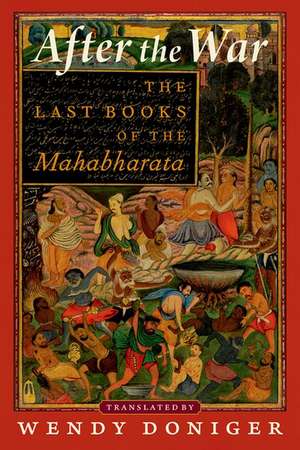
After the War: The Last Books of the Mahabharata

Autor Wendy Doniger
en Limba Engleză Paperback – 15 noi 2022

Remarcăm în After the War o abordare profundă a temei reconcilierii, centrată pe evenimentele care urmează devastatorului conflict din epopeea sanscrită Mahabharata. Această ediție publicată de Oxford University Press nu este doar o traducere, ci o recalibrare a sensului suferinței și al supraviețuirii. Spre deosebire de episoadele de glorie militară, volumul de față se concentrează pe momentele de vulnerabilitate: moartea eroilor prin meditație, transportul magic spre cer sau iad și noaptea glorioasă în care văduvele își reîntâlnesc soții morți, invocați din lumea de dincolo.

Suntem de părere că structura narativă aleasă de Wendy Doniger evidențiază o perspectivă critică asupra mândriei masculine, considerată sursa ciclurilor nesfârșite de violență. Stilul este unul direct, într-o proză engleză contemporană care face textul accesibil fără a-i dilua densitatea filosofică. Această lucrare completează perspectiva oferită de The Mahabharata, Volume 8 de James L. Fitzgerald, care se concentrează pe Shanti Parvan (Cartea Păcii) și pe aspectele guvernării, adăugând o dimensiune umană, aproape elegiacă, despre ce înseamnă să trăiești și să mori cu povara memoriei războiului.

În contextul operei sale, After the War continuă efortul de decodificare a mitologiei indiene început în The Hindus și Kamasutra. Dacă în lucrările anterioare autoarea explora structurile sociale și arta de a trăi, aici se apleacă asupra eticii finalului și a modului în care adevărul este negociat în fața morții. Ritmul lecturii este susținut de tranziția fluidă între episoadele mitice și analizele despre scopul ultim al existenței umane, oferind o relevanță surprinzătoare pentru traumele colective contemporane.

Citește tot Restrânge

Preț: 17697 lei

Puncte Express: 265

Carte disponibilă

Livrare economică 04-18 august

Livrare prin curier în România Termenul estimat este afișat lângă disponibilitate.
Transport gratuit de la 40000 lei Plată online sau ramburs, în funcție de opțiunile comenzii.
Retur gratuit în 14 zile Comandă securizată și suport în română.

Specificații

ISBN-13: 9780197553404
ISBN-10: 0197553400
Pagini: 192
Dimensiuni: 139 x 210 x 13 mm
Greutate: 0.22 kg
Editura: Oxford University Press
Colecția OUP USA
Locul publicării:New York, United States

De ce să citești această carte

Această carte este esențială pentru cei interesați de hinduism și literatura universală, oferind o perspectivă rară asupra finalului epopeii Mahabharata. Cititorul câștigă o înțelegere profundă a modului în care tradiția antică indiană procesează trauma și reconcilierea. Este o recomandare excelentă pentru studenții de la studii orientale, dar și pentru publicul larg care caută o traducere modernă, clară și riguroasă a unui text fundamental despre condiția umană post-conflict.


Despre autor

Wendy Doniger, profesor distins „Mircea Eliade” la Universitatea din Chicago, este una dintre cele mai influente voci în studiul istoriei religiilor. Cu doctorate la Harvard și Oxford, pregătirea sa academică este completată de o experiență artistică sub îndrumarea lui George Balanchine. Opera sa vastă include traduceri de referință precum Kamasutra și Songs of Kabir, fiind recunoscută pentru capacitatea de a aduce textele sanscrite vechi în dialog cu sensibilitățile moderne. Expertiza sa transformă acest volum într-o resursă academică de prim rang, păstrând în același timp un ton accesibil.


Descriere

After the War is a new translation of the final part of the Mahabharata, the great Sanskrit Epic poem about a devastating fraternal war. In this aftermath of the great war, the surviving heroes find various deaths, ranging from a drunken debacle in which they kill many of their own comrades to suicide through meditation and, finally, magical transportation to both heaven and hell. Bereaved mothers and widows on earth are comforted when their dead sons and husbands are magically conjured up from heaven and emerge from a river to spend one glorious night on earth with their loved ones. Ultimately, the bitterly opposed heroes of both sides are reconciled in heaven, but only when they finally let go of the vindictive masculine pride that has made each episode of violence give rise to another. Throughout the text, issues of truth and reconciliation, of the competing beliefs in various afterlives, and of the ultimate purpose of human life are debated. This last part of the Mahabharata has much to tell us both about the deep wisdom of Indian poets during the centuries from 300 BCE to 300 CE (the dates of the recension of this enormous text) and about the problems that we ourselves confront in the aftermath of our own genocidal and internecine wars. The author, a distinguished translator of Sanskrit texts (including the Rig Veda, the Laws of Manu, and the Kamasutra), puts the text into clear, flowing, contemporary prose, with a comprehensive but unintrusive critical apparatus. This book will delight general readers and enlighten students of Indian civilization and of great world literature.

Recenzii

An independently printed and affordable translation that gathers the concluding parvans, or books of the epic, for a general readership...Doniger's rendering is smooth, readable, and appealing without artificial or anachronizing reduction in the formal tone of the text.
This brief book discusses and translates the last books of the great Indian epic the Mahabharata... Recommended. Upper-division undergraduates through faculty; general readers.
Those interested in religion in India will undoubtedly benefit from this volume regardless of whether they perceive present doubt and confusion.

Notă biografică

Wendy Doniger has taught at Harvard, Oxford, the School of Oriental and African Studies at the University of London, and the University of California at Berkeley, and, from 1978, at the University of Chicago, where she was the Mircea Eliade Distinguished Service Professor of the History of Religions, in the Divinity School, the Department of South Asian Languages and Civilizations, and the Committee on Social Thought, now Emerita. She is the author of over forty books, including translations of Sanskrit texts as well as books about Hindu mythology and cross-cultural mythology, particularly about illusion, animals, gender, and sex. In 1984 she was elected President of the American Academy of Religion, in 1989 a Fellow of the American Academy of Arts and Sciences, in 1996 a Member of the American Philosophical Society, and in 1997 President of the Association for Asian Studies.