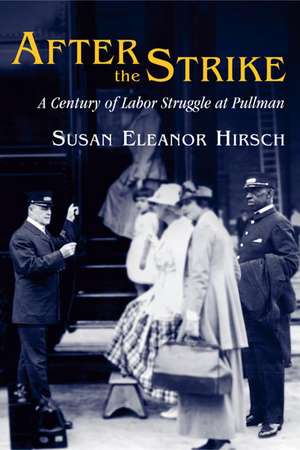
After the Strike: A Century of Labor Struggle at Pullman: Working Class in American History
Autor Susan Eleanor Hirschen Limba Engleză Hardback – 19 mar 2003
The 1894 Pullman strike and the rise of the Brotherhood of Sleeping Car Porters played major roles in the century-long development of union organizing and labor-management relations in the Pullman Company. Susan Eleanor Hirsch connects the stories of Pullman car builders and porters to answer critical questions like: what created job segregation by race and gender? What role did such segregation play in shaping the labor movement?
Hirsch illuminates the relationship between labor organizing and the racial and sexual discrimination practiced by both employers and unions. Because the Pullman Company ran the sleeping-car service for American railroads and was a major manufacturer of railcars, its workers were involved in virtually every wave of union organizing from the 1890s to the 1940s.
In exploring the years of struggle by the men and women of the Pullman Company, After the Strike reveals the factors that determined the limited success and narrow vision of most American unions.
Hirsch illuminates the relationship between labor organizing and the racial and sexual discrimination practiced by both employers and unions. Because the Pullman Company ran the sleeping-car service for American railroads and was a major manufacturer of railcars, its workers were involved in virtually every wave of union organizing from the 1890s to the 1940s.
In exploring the years of struggle by the men and women of the Pullman Company, After the Strike reveals the factors that determined the limited success and narrow vision of most American unions.
Din seria Working Class in American History
-
 Preț: 172.33 lei
 -
 Preț: 171.99 lei
 -
 Preț: 319.96 lei
 - 23%
 Preț: 709.57 lei
 - 23%
 Preț: 601.90 lei
 -
 Preț: 277.89 lei
 -
 Preț: 159.82 lei
 - 23%
 Preț: 675.06 lei
 -
 Preț: 173.05 lei
 -
 Preț: 172.33 lei
 -
 Preț: 189.35 lei
 - 23%
 Preț: 621.48 lei
 -
 Preț: 197.18 lei
 -
 Preț: 184.30 lei
 -
 Preț: 174.45 lei
 -
 Preț: 204.50 lei
 -
 Preț: 172.66 lei
 - 23%
 Preț: 710.42 lei
 -
 Preț: 189.75 lei
 -
 Preț: 247.62 lei
 -
 Preț: 252.80 lei
 -
 Preț: 417.59 lei
 -
 Preț: 188.36 lei
 -
 Preț: 173.05 lei
 - 23%
 Preț: 762.55 lei
 -
 Preț: 187.97 lei
 -
 Preț: 143.15 lei
 -
 Preț: 186.97 lei
 -
 Preț: 337.44 lei
 -
 Preț: 252.40 lei
 -
 Preț: 415.74 lei
 -
 Preț: 175.11 lei
 -
 Preț: 187.63 lei
 -
 Preț: 250.19 lei
 -
 Preț: 218.10 lei
 - 11%
 Preț: 695.83 lei
 - 11%
 Preț: 697.35 lei
 -
 Preț: 133.06 lei
 - 10%
 Preț: 700.44 lei
 -
 Preț: 217.92 lei
 - nou
 Preț: 241.03 lei
 -
 Preț: 165.73 lei
 -
 Preț: 267.21 lei
Preț: 361.83 lei
Puncte Express: 543
Preț estimativ în valută:
63.98€ • 75.43$ • 55.22£
63.98€ • 75.43$ • 55.22£
Carte disponibilă
Livrare economică 26 februarie-12 martie
Livrare express 11-17 februarie pentru 39.92 lei
Specificații
ISBN-13: 9780252027918
ISBN-10: 0252027914
Pagini: 320
Ilustrații: 8 black & white photographs, 18 tables
Dimensiuni: 152 x 229 x 25 mm
Greutate: 0.51 kg
Ediția:New.
Editura: University of Illinois Press
Colecția University of Illinois Press
Seria Working Class in American History
ISBN-10: 0252027914
Pagini: 320
Ilustrații: 8 black & white photographs, 18 tables
Dimensiuni: 152 x 229 x 25 mm
Greutate: 0.51 kg
Ediția:New.
Editura: University of Illinois Press
Colecția University of Illinois Press
Seria Working Class in American History
V-ar putea interesa
-
 Hidden FiguresMargot Lee ShetterlyPreț: 85.10 lei
 -
 Texas RisingStephen L MoorePreț: 105.17 lei
 -
 Kissinger: 1923-1968: The IdealistNiall Ferguson-18%Preț: 110.53 lei134.42 lei
 -
 Ronald ReaganMichael Schaller-18%Preț: 73.39 lei89.08 lei
 -
 Preț: 102.51 lei
 -
 The N WordJabari AsimPreț: 102.63 lei
 -
 The Imperial PresidencyJr. Arthur M. SchlesingerPreț: 173.39 lei
 -
 Preț: 363.89 lei
 -
 Preț: 258.85 lei
 -
 Preț: 446.59 lei
 -
 Black Hawk and the Warrior′s Path 2eRL NicholsPreț: 256.30 lei
 -
 All Our RelationsWinona LadukePreț: 105.98 lei
 -
 The Secret Societies of All Ages & Countries (Two Volumes in One)Charles William HeckethornPreț: 225.14 lei
 -
 Rio de Janeiro: Extreme CityLuiz Eduardo SoaresPreț: 108.40 lei
Recenzii
"This densely argued and richly documented study demands much of the reader, but it also yields substantial rewards that prod us to rethink what once seemed a familiar story."--American Historical Review
"Hirsch's close analysis of payroll and employee service records. . .provides concrete evidence often missing from larger-scale studies of how management carefully manipulated the social division of labor in its quest to control the workplace."--Enterprise & Society
"Hirsch covers broad topics so thoroughly, weaves them together with such skill, and supports her conclusions with such exhaustive research in primary and secondary sources, that the book stands as a remarkable achievement."--Maryland Historical Magazine
"A solid case study that deserves readership."--Business History Review
"Examining the developments within the Pullman Company before and especially after the events of 1894, this book constitutes an important case study in changing industrial relations in the United States."--David Montgomery, author of The Fall of the House of Labor
"Hirsch's close analysis of payroll and employee service records. . .provides concrete evidence often missing from larger-scale studies of how management carefully manipulated the social division of labor in its quest to control the workplace."--Enterprise & Society
"Hirsch covers broad topics so thoroughly, weaves them together with such skill, and supports her conclusions with such exhaustive research in primary and secondary sources, that the book stands as a remarkable achievement."--Maryland Historical Magazine
"A solid case study that deserves readership."--Business History Review
"Examining the developments within the Pullman Company before and especially after the events of 1894, this book constitutes an important case study in changing industrial relations in the United States."--David Montgomery, author of The Fall of the House of Labor
Notă biografică
Susan Eleanor Hirsch is a professor emerita of history at Loyola University Chicago and the author of Roots of the American Working Class: The Industrialization of Crafts in Newark, 1800-1860.
Cuprins
Acknowledgments ix
Introduction 1
1. Working for a Monopoly in Formation 7
2. Two Roads to the Open Shop 42
3. The State and Pullman Workers 70
4. Restoring the Open Shop 100
5. A New Deal for Pullman Workers! 128
6. The War at Home 156
7. The Last Pullman Workers 186
Conclusion 207
Appendix: The Pullman Repair Shop Databases 213
Notes 221
Index 287
Illustrations follow page 112
Introduction 1
1. Working for a Monopoly in Formation 7
2. Two Roads to the Open Shop 42
3. The State and Pullman Workers 70
4. Restoring the Open Shop 100
5. A New Deal for Pullman Workers! 128
6. The War at Home 156
7. The Last Pullman Workers 186
Conclusion 207
Appendix: The Pullman Repair Shop Databases 213
Notes 221
Index 287
Illustrations follow page 112