After the King: Watteau, Spectacle, and the Poetics of Memory: Opera Lab: Explorations in History, Technology, and Performance
Autor Georgia J. Cowarten Limba Engleză Hardback – 26 oct 2026
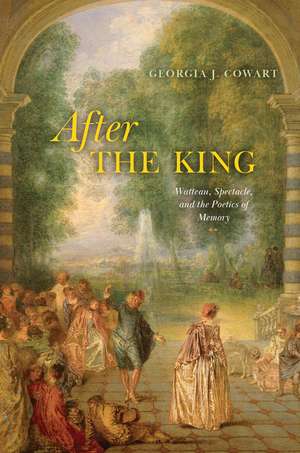
Antoine Watteau has long been known for the theatricality of his paintings, but what that theatricality signifies has remained elusive. In After the King, Georgia Cowart contends that this mode of painting takes shape in response to the spectacle of Louis XIV’s absolutism, which the painter’s late works transform into a new aesthetic language.
The king’s death marked a turning point in Watteau’s art. In the six years that followed, his paintings turned more decisively toward the musical stage. Evoking theatrical plots, frontispieces, and costume types, they conjured a world in which the legacy of absolutist culture lingered as stylized memory—its rituals, emblems, and pleasures recast through theatrical illusion and ironic distance.
Rather than treating Watteau as a painter of nostalgic reverie or Rococo charm, Cowart situates his art within the immersive performance culture of Versailles and the vibrant Parisian stage, at a time when the opéra-ballet, popular opera, and the commedia dell’arte were charting new theatrical landscapes. Drawing on art history, musicology, theater studies, and Pierre Nora’s theory of lieux de mémoire, she proposes a new framework that understands Watteau’s paintings as acts of theatrical memory and cultural recomposition.
Elegantly written and conceptually ambitious, After the King reveals how Watteau recoded the symbols of monarchy to stage a post-absolutist cultural imagination shaped by irony, sensuality, and poetic transformation.








Preț: 402.32 lei
Nou
Puncte Express: 603
Carte disponibilă
Livrare economică 04-18 noiembrie
Livrare prin curier în România Termenul estimat este afișat lângă disponibilitate.
Transport gratuit pentru acest produs Plată online sau ramburs, în funcție de opțiunile comenzii.
Retur gratuit în 14 zile Comandă securizată și suport în română.
Specificații
ISBN-13: 9780226852881
ISBN-10: 0226852881
Pagini: 248
Ilustrații: 8 color plates, 50 halftones, 9 tables
Dimensiuni: 152 x 229 mm
Greutate: 0.5 kg
Ediția:First Edition
Editura: University of Chicago Press
Colecția University of Chicago Press
Seria Opera Lab: Explorations in History, Technology, and Performance
ISBN-10: 0226852881
Pagini: 248
Ilustrații: 8 color plates, 50 halftones, 9 tables
Dimensiuni: 152 x 229 mm
Greutate: 0.5 kg
Ediția:First Edition
Editura: University of Chicago Press
Colecția University of Chicago Press
Seria Opera Lab: Explorations in History, Technology, and Performance
Notă biografică
Georgia J. Cowart is professor of music at Case Western Reserve University. She is the author of Triumph of Pleasure: Louis XIV and the Politics of Spectacle, also published by the University of Chicago Press. From 2022 to 2024, Cowart served as president of the American Musicological Society.
Cuprins
List of Illustrations and Tables
Introduction: Watteau’s Realms of Memory
1. Satire, Galanterie, and the Pastoral Ideal: L’alliance de la Musique et de la Comédie and Le pèlerinage à Cythère
2. Carnival, Commedia dell’arte, and the Memory of Laughter: Les fêtes vénitiennes, L’amour au théâtre français, and L’amour au théâtre italien
3. Venus, Mezzetin, and the Metamorphosis of Memory: Assis auprès de toi, Mezzetin, Le rêve de l’artiste, and Les plaisirs du bal
4. The King Is Dead! Long Live the Fool! Les comédiens français, Les comédiens italiens, Pierrot, and L’enseigne de Gersaint
Acknowledgments
Notes
Bibliography
Index
Introduction: Watteau’s Realms of Memory
1. Satire, Galanterie, and the Pastoral Ideal: L’alliance de la Musique et de la Comédie and Le pèlerinage à Cythère
2. Carnival, Commedia dell’arte, and the Memory of Laughter: Les fêtes vénitiennes, L’amour au théâtre français, and L’amour au théâtre italien
3. Venus, Mezzetin, and the Metamorphosis of Memory: Assis auprès de toi, Mezzetin, Le rêve de l’artiste, and Les plaisirs du bal
4. The King Is Dead! Long Live the Fool! Les comédiens français, Les comédiens italiens, Pierrot, and L’enseigne de Gersaint
Acknowledgments
Notes
Bibliography
Index
Recenzii
“The late paintings of Watteau are well known for their nostalgic and often enigmatic renderings of the Italian Commedia dell’arte. But in this ground-breaking study, Georgia Cowart turns to another subject that was no less of a theatrical spectacle for Watteau’s contemporaries: the Sun King himself in his mise-en-scène of Versailles. Employing sensitive readings of many of Watteau’s most iconic paintings, Cowart lets us see––and hear––how the image of Louis XIV in the final years of his decaying absolutist rule haunt these visual tableaus as both theatrical illusion and stylized memory. It is a tour-de-force of visual hermeneutics that will be revelatory to musicologists and art historians alike.”
“Georgia Cowart’s contribution to the fields of musicology, French court culture, and art history come together in this much-anticipated study of the relationship between Louis XIV’s legacy, especially his influence on the performing arts at Versailles, and the late paintings (1715–1721) of Antoine Watteau. We know Cowart as a leading scholar of court spectacle during absolutist France. But in After the King, Cowart also draws on more than a decade of research, teaching, and curatorial work devoted to Watteau. The result is a dazzling new interdisciplinary study of Louis XIV’s France that uncovers a significant dialogue between the visual and performing arts. Through this dialogue, Cowart shines light on the role artists played in shaping collective memory and constructing the cultural legacy of the Sun King.”
“Georgia Cowart’s contribution to the fields of musicology, French court culture, and art history come together in this much-anticipated study of the relationship between Louis XIV’s legacy, especially his influence on the performing arts at Versailles, and the late paintings (1715–1721) of Antoine Watteau. We know Cowart as a leading scholar of court spectacle during absolutist France. But in After the King, Cowart also draws on more than a decade of research, teaching, and curatorial work devoted to Watteau. The result is a dazzling new interdisciplinary study of Louis XIV’s France that uncovers a significant dialogue between the visual and performing arts. Through this dialogue, Cowart shines light on the role artists played in shaping collective memory and constructing the cultural legacy of the Sun King.”