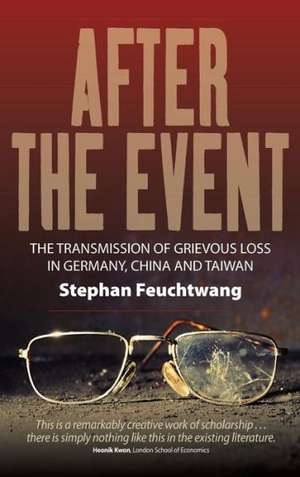
After the Event
Autor Stephan Feuchtwangen Limba Engleză Hardback – apr 2011
Preț: 760.99 lei
Preț vechi: 988.31 lei
-23%
Puncte Express: 1141
Carte tipărită la comandă
Livrare economică 23 noiembrie-07 decembrie
Livrare prin curier în România Termenul estimat este afișat lângă disponibilitate.
Transport gratuit pentru acest produs Plată online sau ramburs, în funcție de opțiunile comenzii.
Retur gratuit în 14 zile Comandă securizată și suport în română.
Specificații
ISBN-13: 9780857450869
ISBN-10: 0857450867
Pagini: 258
Dimensiuni: 157 x 235 x 19 mm
Greutate: 0.53 kg
Editura: BERGHAHN BOOKS
ISBN-10: 0857450867
Pagini: 258
Dimensiuni: 157 x 235 x 19 mm
Greutate: 0.53 kg
Editura: BERGHAHN BOOKS
V-ar putea interesa
-
 WaterlooBernard CornwellPreț: 94.75 lei
 -
 -21%Preț: 119.94 lei152.66 lei
 -
 Building a European IdentityAurélie Élisa Gfeller-23%Preț: 760.37 lei987.50 lei
 -
 A State of Peace in EuropePetri Hakkarainen-23%Preț: 762.76 lei990.60 lei
 -
 Small Town and Village in BavariaPeter H. Merkl-23%Preț: 758.73 lei985.37 lei
 -
 British Paratrooper 1940–45Rebecca Skinner-27%Preț: 78.18 lei107.06 lei
 -
 Germany's Western Front: 1914Mark HumphriesPreț: 439.76 lei
 -
 Dreadnought: The Ship that Changed the WorldRoger ParkinsonPreț: 312.33 lei
 -
 Screening the EastNick HodginPreț: 156.77 lei
 -
 Visions of the End of the Cold War in Europe, 1945-1990Frédéric BozoPreț: 307.03 lei
 -
 Impotent WarriorsSusie KilshawPreț: 159.65 lei
 -
 The Radical Right in SwitzerlandDamir Skenderovic-23%Preț: 992.16 lei1288.52 lei
 -
 -25%Preț: 136.51 lei182.52 lei
Notă biografică
Stephan Feuchtwang is Emeritus Professor of Anthropology at the London School of Economics (LSE). He established the first centre for social scientific study on China in the UK (1973) at City University London, and the MSc China in Comparative Perspective Programme (2006) at the LSE, to date the only one of its kind in the world. He was Present of the British Association of China Studies (BACS). He has been engaged in research on popular religion and politics in mainland China and Taiwan since 1966, resulting in a number of publications on charisma, place, temples and festivals, and civil society. He has recently been engaged in a comparative project exploring the theme of the recognition of catastrophic loss, including the loss of archive and recall, which in Chinese cosmology and possibly elsewhere is pre-figured in the category of ghosts. Most recently he has been pursuing a project on the comparison of civilizations and empires. He has published more than ten books and a few dozen articles, including Popular Religion in China: The Imperial Metaphor (1991, 2001) and After the Event: The Transmission of Grievous Loss in Germany, China and Taiwan (2011).
Cuprins
Chapter 1. Introduction: Transmitting loss
Chapter 2. Comparing the incomparable: the Third Reich and the Great Leap famine
Chapter 3. 'Communism' in Mainland China and Taiwan
PART I: THE GREAT LEAP FAMINE
Chapter 4. Moral and political dilemmas from the Great Leap Famine
Chapter 5. Implicit transmission: the generation gap after the Great Leap famine
PART II: THE LUKU INCIDENT OF THE WHITE TERROR
Chapter 6. Disruption, commemoration and family repair in Taiwan
Chapter 7. Gesture and monument in a tourist landscape: the generation gap in Taiwan
PART III: THE THIRD REICH
Chapter 8. Acknowledgement of the Third Reich in post-war Germany
Chapter 9. Disruption, commemoration and family repair: some Jewish German families
Chapter 10. Recalling the Third Reich and the Holocaust after two generations: some German German families
CONCLUSION
Chapter 11. Beyond bad death
References
Chapter 2. Comparing the incomparable: the Third Reich and the Great Leap famine
Chapter 3. 'Communism' in Mainland China and Taiwan
PART I: THE GREAT LEAP FAMINE
Chapter 4. Moral and political dilemmas from the Great Leap Famine
Chapter 5. Implicit transmission: the generation gap after the Great Leap famine
PART II: THE LUKU INCIDENT OF THE WHITE TERROR
Chapter 6. Disruption, commemoration and family repair in Taiwan
Chapter 7. Gesture and monument in a tourist landscape: the generation gap in Taiwan
PART III: THE THIRD REICH
Chapter 8. Acknowledgement of the Third Reich in post-war Germany
Chapter 9. Disruption, commemoration and family repair: some Jewish German families
Chapter 10. Recalling the Third Reich and the Holocaust after two generations: some German German families
CONCLUSION
Chapter 11. Beyond bad death
References