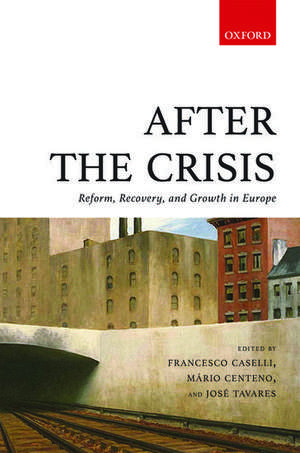
After the Crisis: Reform, Recovery, and Growth in Europe
Editat de Francesco Caselli, Mário Centeno, José Tavaresen Limba Engleză Hardback – 30 iun 2016
Preț: 556.18 lei
Preț vechi: 793.43 lei
-30%
Puncte Express: 834
Carte tipărită la comandă
Livrare economică 04-15 decembrie
Livrare prin curier în România Termenul estimat este afișat lângă disponibilitate.
Transport gratuit pentru acest produs Plată online sau ramburs, în funcție de opțiunile comenzii.
Retur gratuit în 14 zile Comandă securizată și suport în română.
Specificații
ISBN-13: 9780198754688
ISBN-10: 019875468X
Pagini: 222
Ilustrații: 68 Figures and 39 Tables
Dimensiuni: 160 x 241 x 17 mm
Greutate: 0.47 kg
Editura: OUP OXFORD
Colecția OUP Oxford
Locul publicării:Oxford, United Kingdom
ISBN-10: 019875468X
Pagini: 222
Ilustrații: 68 Figures and 39 Tables
Dimensiuni: 160 x 241 x 17 mm
Greutate: 0.47 kg
Editura: OUP OXFORD
Colecția OUP Oxford
Locul publicării:Oxford, United Kingdom
V-ar putea interesa
-
 Europe's Growth ChallengeAnders Aslund-19%Preț: 291.95 lei359.87 lei
 -
 Prosperity for All: How to Prevent Financial CrisesRoger E.A. Farmer-7%Preț: 131.82 lei142.36 lei
 -
 Prosperity For All: How To Prevent Financial CrisesRoger Farmer-20%Preț: 158.12 lei197.77 lei
 -
 -12%Preț: 256.79 lei291.38 lei
 -
 -27%Preț: 405.34 lei557.05 lei
 -
 The Moral Foundation of Economic BehaviorDavid C. Rose-11%Preț: 313.67 lei353.37 lei
 -
 The Subprime Virus: Reckless Credit, Regulatory Failure, and Next StepsKathleen C. Engel-22%Preț: 203.02 lei260.37 lei
 -
 -30%Preț: 720.61 lei1027.04 lei
 -
 British Financial Crises since 1825Nicholas Dimsdale-31%Preț: 784.61 lei1140.67 lei
 -
 -27%Preț: 373.80 lei511.23 lei
 -
 -30%Preț: 549.74 lei784.05 lei
 -
 -30%Preț: 599.46 lei852.44 lei
 -
 BoomerangMichael Lewis-31%Preț: 64.31 lei93.00 lei
 -
 Courage to ACTBen S BernankePreț: 151.37 lei
 -
 Technology Differences over Space and TimeFrancesco CaselliPreț: 473.16 lei
 -
 Modelling Multidisciplinary Causes of the Greek Crisis: A Conceptual AnalysisJanine Mukuddem-Petersen-26%Preț: 1279.32 lei1739.71 lei
 -
 Recurring Economic Crisis in KoreaJong Kyu Lee-26%Preț: 326.51 lei438.63 lei
 -
 Special Examination of Fannie MaeOffice of Federal Housing Enterprise Oversight-21%Preț: 279.39 lei353.85 lei
 -
 CYPRUS BAIL-IN, THEMichaelides Alexander-18%Preț: 774.64 lei944.68 lei
 -
 -10%Preț: 176.67 lei197.14 lei
 -
 -33%Preț: 612.18 lei909.78 lei
 -
 Political Economy Perspectives on the Greek CrisisIoannis Bournakis-18%Preț: 1042.93 lei1271.87 lei
Notă biografică
Francesco Caselli is the Norman Sosnow Professor of Economics at the London School of Economics. Previous appointments include Assistant Professor of Economics at the University of Chicago Graduate School of Business, and Paul Sack Associate Professor of Economics at Harvard University. His research interests include macroeconomics, economic development and political economy, on which he has published extensively in the major professional journals. He is an elected fellow of the British Academy, the director of the Macroeconomics and Growth Programme at the Centre for Economic Policy Research and an editor of Economica. Previously, he has served as managing editor of the Review of Economic Studies, co-editor of the Journal of Economic Development, member of the governing council of the European Economic Association, member of the LSE growth commission, and director of the macroeconomics programmes at the Centre for Economic Performance and the International Growth Centre.Mário Centeno is Advisor of the Board at the Banco de Portugal and Professor of Economics at Lisbon University. He gained his undergraduate degree at Technical University in Lisbon in 1990 and his Ph.D. at Harvard University in 2000. His research interests include labor economics and econometrics, on which he has published in several professional journals. He was awarded the Young Economist Award of the European Economics Association and the Excellence Achievement Award of União Latina.José Tavares is Professor of Economics at Nova School of Business and Economics. Having completed his Ph.D. at Harvard University, where he specialized in political economy, he taught at the University of California Los Angeles and has conducted research on topics ranging from the relationship between democracy and economic growth to the macroeconomic costs of gender discrimination. His academic contributions have been discussed in Time Magazine, The New York Times, Handelsblatt, and La Repubblica, among others.