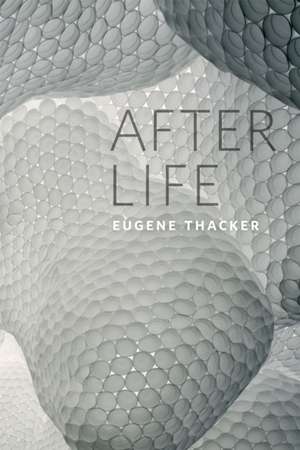
After Life
Autor Eugene Thackeren Limba Engleză Paperback – noi 2010
În lucrarea After Life, Eugene Thacker propune o reconstrucție riguroasă a ontologiei vieții, pornind de la premisa că acest concept, deși fundamental, rămâne unul dintre cele mai contradictorii și evazive teritorii ale gândirii. Observăm în această ediție o structură ambițioasă care nu se mulțumește cu o simplă cronologie, ci caută să identifice momentele de ruptură unde „viața în sine” devine o problemă de nerezolvat. Autorul deschide volumul cu o analiză a tratatului „De Anima”, introducând termenul provocator de „biohorror aristotelic” pentru a descrie tensiunea dintre formă și materia însuflețită. Spre deosebire de abordările pur fenomenologice, cum este cea din Life Phenomenology of Life as the Starting Point of Philosophy de Anna-Teresa Tymieniecka, Eugene Thacker preferă o cale apofatică, investigând viața prin ceea ce nu este sau prin ceea ce depășește limitele inteligibilului. Apreciem modul în care cuprinsul ghidează cititorul de la metafizica greacă spre „viața superlativă” a teologiei negative (Pseudo-Dionisie, Eriugena), culminând cu imposibilitatea kantiană de a defini viața fără a cădea în contradicție. Această lucrare consolidează direcția începută de autor în seria Horror of Philosophy, unde granița dintre filozofia sistematică și estetica horror-ului cosmic este explorată constant. Dacă în Tentacles Longer Than Night accentul cădea pe indiferența cosmosului, în After Life miza este însăși structura internă a vitalismului. Cititorii familiarizați cu Deleuze and the Meaning of Life vor aprecia modul în care Thacker recalibrează conceptul de intensitate deleuziană într-un context istoric mult mai larg, oferind un instrument critic esențial pentru înțelegerea biopoliticii și a turnurii speculative contemporane.
Preț: 304.96 lei
Carte disponibilă
Livrare economică 03-17 noiembrie
Livrare express 17-23 octombrie pentru 33.08 lei
Specificații
ISBN-10: 0226793729
Pagini: 312
Ilustrații: 4 line drawings, 1 table
Dimensiuni: 152 x 229 x 18 mm
Greutate: 0.41 kg
Editura: University of Chicago Press
Colecția University of Chicago Press
V-ar putea interesa
-
 Last Writings on the Philosophy of Psychology, Volume 1Ludwig WittgensteinPreț: 276.13 lei
 -
 Meditations through the Rig VedaAntonio T. de NicolasPreț: 118.97 lei
 -
 Leper CreativityReza NegarestaniPreț: 155.88 lei
 -
 AutopoiesisJoao D. FonsecaPreț: 76.27 lei
 -
 Preț: 62.84 lei
 -
 GlossatorSteven ShakespearePreț: 65.71 lei
 -
 Exploring the Jedi LifestyleK. S. TroutPreț: 74.70 lei
 -
 And They Were Two in One and One in TwoNicola MasciandaroPreț: 231.14 lei
 -
 Flesh of My FleshDr Peter Edward ChojnowskiPreț: 51.85 lei
 -
 Y.O.UAlexander J. PerezPreț: 55.36 lei
 -
 The Shadow of ConsciousnessPeter HankinsPreț: 69.20 lei
 -
 'Human Experience'A. a. B. Oliveira a.Preț: 113.24 lei
 -
 Hindi Edition of Positive Thinking, Power of OptimismGautam SharmaPreț: 64.64 lei
 -
 Drawn and QuarteredE. M. CioranPreț: 111.88 lei
 -
 The Trouble with Being BornE. M. CioranPreț: 95.33 lei
 -
 Tentacles Longer Than NightEugene ThackerPreț: 85.46 lei
 -
 In the Dust of This PlanetEugene ThackerPreț: 92.35 lei
 -
 Infinite ResignationEugene ThackerPreț: 134.21 lei
 -
 The Twilight Language of Gorakh Bodh (Russian)Shailendra SharmaPreț: 91.21 lei
De ce să citești această carte
O recomandare esențială pentru cercetătorii din domeniul filozofiei minții și studiilor culturale. After Life nu este doar o istorie a ideilor, ci o investigație asupra modului în care viața a fost categorisită și exploatată. Cititorul câștigă o perspectivă profundă asupra rădăcinilor teologice ale conceptelor biologice moderne, totul într-un limbaj care îmbină rigoarea academică cu fascinația pentru „necugetabil”.
Despre autor
Eugene Thacker este un filozof și autor american, profesor la The New School din New York, recunoscut pentru contribuțiile sale la intersecția dintre filozofie, teologie și genul horror. Opera sa, care include volume celebre precum Infinite Resignation și seria Horror of Philosophy, explorează adesea teme legate de pesimism, nihilism și limitele experienței umane în fața unui univers indiferent. Prin scrierile sale, Thacker a devenit o voce de referință în realismul speculativ, reușind să integreze texte mistice medievale în dezbaterile contemporane despre biotehnologie și criza post-umanismului.
Descriere scurtă
At a time when life is categorized, measured, and exploited in a variety of ways, After Life invites us to delve deeper into the contours and contradictions of the age-old question, “what is life?”
Notă biografică
Cuprins
1.1 Supernatural Horror as the Paradigm for Life
1.2 Aristotle’s De Anima and the Problem of Life
1.3 The Ontology of Life
1.4 The Entelechy of the Weird
2. Superlative Life
2.1 Life With or Without Limits
2.2 Life as Time in Plotinus
2.3 On the Superlative
2.4 Superlative Life I: Pseudo-Dionysius
2.4.1 Negative vs. Affirmative Theology
2.4.2 Superlative Negation
2.4.3 Negation and Preexistent Life
2.4.4 Excess, Evil, and Non-being
2.5 Superlative Life II: Eriugena
2.5.1 Negation in the Periphyseon
2.5.2 The quaestio de nihilo: On Nothing
2.5.3 The quaestio de nihilo: Superlative Nothing
2.5.4 Dark Intelligible Abyss
2.6 Apophasis
2.6.1 The Apophatic Logic
2.6.2 Negation in Frege and Ayer
2.6.3 Negation vs. Subtraction in Badiou
2.6.4 Negation and Contradiction in Priest
2.7 The Dialetheic Vitalism of Negative Theology
2.8 Ellipses: Suhraward ī and the Luminous Void
3. Univocal Creatures
3.1 On Spiritual Creatures
3.2 Life as Form in Aristotle
3.3 The Concept of the Creature
3.4 Univocity I: Duns Scotus vs. Aquinas
3.4.1 Univocity in Aquinas’ Summa Theologica
3.4.2 Univocity in Duns Scotus’ Opus Oxoniense
3.4.3 The Common Nature of the Creature
3.5 Univocity II: Duns Scotus vs. Henry of Ghent
3.5.1 Univocity in Henry of Ghent
3.5.2 Negative vs. Privative Indetermination
3.5.3 Absolute Indetermination
3.6 Univocity III: Deleuze’s Scholasticism—Three Variations
3.6.1 Spinoza et le Problème de l’Expression
3.6.2 Différence et Répétition
3.6.3 Cours de Vincennes
3.7 Univocal Creatures
3.8 Ellipses: Dōgen and Uncreated Univocity
4. Dark Pantheism
4.1 Everything and Nothing
4.2 Life as Spirit in Aquinas
4.3 The Concept of the Divine Nature
4.4 Immanence I: Eriugena’s Periphyseon
4.4.1 Natura and the Unthought
4.4.2 Universal Life
4.4.3 Four Statements on Pantheism
4.5 Immanence II: Duns Scotus’ Reportatio IA
4.5.1 Univocal Immanence
4.5.2 Actual Infinity
4.5.3 The Pathology of the Triple Primacy
4.6 Immanence III: Nicholas of Cusa’s De Docta Ignorantia
4.6.1 The Coincidence of Opposites
4.6.2 The Folds of Life
4.6.3 Absolute vs. Contracted Pantheism
4.6.4 Speculative Pantheism (Deleuze’s Interlocutors)
4.7 Pantheism and Pure Immanence
4.7.1 The Insubordination of Immanence in Deleuze
4.7.2 Scholia I: The Isomorphism of Univocity and Immanence
4.7.3 Scholia II: The Vitalist Logic of Common Notions
4.7.4 Scholia III: The Life of Substance
4.8 Dark Pantheism
4.9 Ellipses: Wang Yangming and Idealist Naturalism
5. Logic and Life (On Kantian Teratology)
5.1 The Wandering Line from Aristotle to Kant
5.2 Critique of Life
5.3 Spectral Life and Speculative Realism
5.4 Ontotheology in Kant, Atheology in Bataille
5.5 The Night Land
Notes
Index