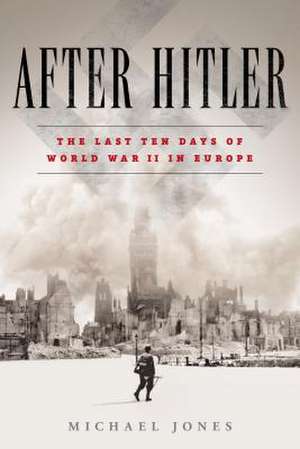
After Hitler
Autor Michael Jonesen Limba Engleză Hardback – 6 oct 2015
Recomandăm acest volum ca referință istorică solidă pentru nivelul de licență și master, oferind o analiză riguroasă a unui vid de putere adesea ignorat în manualele generale. Putem afirma că After Hitler nu este doar o cronică militară, ci un studiu politic despre deznodământul celui de-al Doilea Război Mondial în Europa. Michael Jones se concentrează pe cele zece zile critice de după moartea lui Hitler, investigând motivele pentru care pacea a fost semnată atât de târziu și cum s-au degradat relațiile în cadrul Marii Alianțe. Suntem de părere că autorul reușește o sinteză remarcabilă între macro-istorie — negocierile dintre Truman, Stalin și Eisenhower — și micro-istorie, prin experiențele soldaților de rând. Cititorii familiarizați cu Inside Hitler's Bunker de Joachim Fest vor aprecia modul în care Jones extinde perspectiva dincolo de zidurile buncărului berlinez, mutând centrul de greutate către manevrele lui Karl Dönitz și eforturile diplomatice care au prevenit, la limită, un colaps total al ordinii europene. Spre deosebire de Swansong 1945 de Walter Kempowski, care mizează pe un colaj de jurnale personale, Jones păstrează o narațiune analitică, explicând clar cum semințele Războiului Rece au fost plantate chiar în momentele semnării capitulării. Notăm cu interes modul în care autorul își aplică expertiza de medievist și istoric militar, vizibilă în lucrări precum The King's Grave sau studiile despre Stalingrad, pentru a descifra structurile de putere aflate în disoluție. Ediția de față, publicată de John Murray Press, integrează fotografii de arhivă care completează textul, oferind o perspectivă vizuală asupra Europei ruinate din primăvara anului 1945.
Preț: 161.88 lei
Carte indisponibilă temporar
Specificații
ISBN-10: 0451477014
Pagini: 400
Dimensiuni: 162 x 234 x 26 mm
Greutate: 0.64 kg
Editura: Penguin Publishing Group
V-ar putea interesa
-
 -26%Preț: 68.55 lei93.26 lei
 -
 Accounting for BiodiversityMichael Jones-15%Preț: 465.93 lei548.15 lei
 -
 Lancaster: The Second World War's Greatest BomberLeo McKinstry-25%Preț: 75.61 lei100.77 lei
 -
 Leningrad: State of SiegeMichael Jones-26%Preț: 68.04 lei92.44 lei
 -
 Germany 1918-1945: A depth studyGreg Lacey-27%Preț: 208.86 lei285.54 lei
 -
 Rosa LuxemburgMichael JonesPreț: 132.96 lei
 -
 The Creation of BrittanyMichael Jones-33%Preț: 841.38 lei1248.46 lei
 -
 Understand Nazi Germany: Teach YourselfMichael LynchPreț: 145.85 lei
 -
 -24%Preț: 77.93 lei102.85 lei
 -
 The Last BattleCornelius Ryan-26%Preț: 75.30 lei101.30 lei
 -
 Brain TumorMichael Jones-5%Preț: 648.21 lei682.32 lei
 -
 Clinical Management of Brain TumorMichael Jones-5%Preț: 733.91 lei772.54 lei
 -
 The Children who Fought HitlerJames Fox & Sue Elliott-26%Preț: 68.68 lei93.31 lei
 -
 The King's Grave: The Search for Richard IIIPhilippa Langley-27%Preț: 68.09 lei93.14 lei
 -
 Young Lawrence: A Portrait of the Legend as a Young ManAnthony Sattin-27%Preț: 67.11 lei91.73 lei
 -
 Ordnung durch SpracheSilke Mende-19%Preț: 569.69 lei703.32 lei
 -
 Perennial Biomass Crops for a Resource-Constrained WorldSusanne Barth-18%Preț: 1269.37 lei1548.02 lei
 -
 Die AchseDaniel HedingerPreț: 240.12 lei
 -
 Tengelmann im Dritten ReichLutz NiethammerPreț: 309.02 lei
De ce să citești această carte
Această carte se adresează studenților la istorie și pasionaților de geopolitică dornici să înțeleagă complexitatea tranziției de la război la pace. Cititorul câștigă o viziune clară asupra zilelor de incertitudine care au definit harta Europei moderne. Este un motiv concret pentru a explora cum orgoliile liderilor și strategiile militare din mai 1945 au dictat decenii de confruntare între Est și Vest.
Despre autor
Michael Jones este un istoric britanic de prestigiu, deținător al unui doctorat la Universitatea din Bristol. A predat la Universitatea din Glasgow și la Winchester College, fiind în prezent membru al Royal Historical Society. Expertiza sa vastă acoperă atât istoria medievală, cât și marile conflicte ale secolului XX. Printre lucrările sale de referință se numără analize detaliate ale bătăliilor de la Agincourt și Stalingrad, precum și colaborări importante pentru identificarea rămășițelor lui Richard al III-lea. Această polivalență îi permite să abordeze subiecte complexe cu o rigoare academică dublată de un stil narativ accesibil.
Descriere scurtă
On April 30, 1945, Adolf Hitler committed suicide in a bunker in Berlin. But victory over the Nazi regime was not celebrated in western Europe until May 8, and in Russia a day later, on the ninth. Why did a peace agreement take so much time? How did this brutal, protracted conflict coalesce into its unlikely endgame?
"After Hitler "shines a light on ten fascinating days after that infamous suicide that changed the course of the twentieth century. Combining exhaustive research with masterfully paced storytelling, Michael Jones recounts the Fuhrer s frantic last stand; the devious maneuverings of his handpicked successor, Karl Donitz; the grudging respect Joseph Stalin had for Churchill and FDR, as well as his distrust of Harry Truman; the bold negotiating by General Dwight D. Eisenhower that hastened Germany s surrender but drew the ire of the Kremlin; the journalist who almost scuttled the cease-fire; and the thousands of ordinary British, American, and Russian soldiers caught in the swells of history, from the Red Army s march on Berlin to the liberation of the Nazis remaining concentration camps. Through it all, Jones traces the shifting loyalties between East and West that sowed the seeds of the Cold War and nearly unraveled the Grand Alliance.
In this gripping, eloquent, and even-handed narrative, the spring of 1945 comes alive a fascinating time when nothing was certain, and every second mattered.
INCLUDES PHOTOS"
Descriere
On 30 April 1945, Adolf Hitler committed suicide. The following day, his propaganda minister Joseph Goebbels also killed himself and the crumbling Third Reich passed to Admiral Karl Dönitz. The Nazis' position seemed hopeless. Yet remarkably, the war in the rest of Europe went on for another ten days. After Hitler looks at these days as a narrative day-by-day countdown but also as a broader global history of a European war that had seen some of the most savage battles in history. Relations between the 'Big Three' - the United States, Great Britain and the Soviet Union - suddenly plunged to near breaking point. This book reveals that tumultuous story.
After Hitler also looks at the wider canvas of the war and the terrible humanitarian catastrophe uncovered in Europe. It describes those who felt the joy of freedom, but also those who faced a highly uncertain future. As Red Army soldiers joined forces with their British and American allies, Stalin's East finally came face to face with Churchill's and Truman's West. After Hitler tells of their growing mistrust, but also of moments of remarkable goodwill and co-operation - the brief but poignant hope that these great nations could together fashion a new and safer future. This is a fascinating exploration of the brief but crucial period that shaped the emerging post-war world.
Recenzii
Michael Jones has described the death agonies of Nazism in an excellent, vivid and often moving narrative of the ten days between Hitler's suicide on April 30, 1945, and the celebration of VE day on May 9. He has deftly blended the stories of great events and the great figures who shaped them with the experiences of the myriad men and women who carried out their orders
An evocative, clear and exciting recreation of the final ten days of the crumbling Third Reich. It is fast paced, exceedingly well written, with some very thoughtful and insightful analysis of the atmosphere between the Great Power leaders on the eve of the Cold War, in particular the sensitive surrender negotiations . . . really well done
[Michael] Jones - a master of the vignette - provides an effective retelling of the story. Using an impressive selection of eyewitness accounts, he skips across Europe in that last week of the war - from Reims to Luneburg, Prague to Flensburg - giving an engaging, lively summary of events
An absorbing history . . . communicates the pity of the war and its aftermath with a proper sympathy
Hitler, broken and despairing, killed himself on 30 April 1945; the war in Europe formally ended on 9 May. Acclaimed historian Michael jones resists the common urge to skip over that gap, unearthing a wealth of intriguing detail, much from primary sources . . . in a year sure to be swamped with war publications, few are likely to offer such novel approaches
As such a recognisable and universally reviled figure of the 20th century, Adolf Hitler tends to overshadow what happened after his suicide. This book tells that story, as the German capital Berlin crumbled and tensions between the US, UK and Soviet Union rose
Michael Jones has woven together the many stories of those terrible ten days in a most compelling fashion
A tale of heroism and barbarism; of overwhelming triumph and abysmal defeat; of refugees and revenge; of a nightmare shattered and emerging hopes of a better future . . . Jones demonstrates an ease of command of his historical material and he understands the complex personalities of the commanders who dominate his pages. This is the best book of its genre
Michael Jones's superbly researched account vividly evokes the death throes of the Third Reich
Fast moving and addictively readable, this book covers the ten days from Hitler's suicide to VE Day in Moscow on 9 May 1945