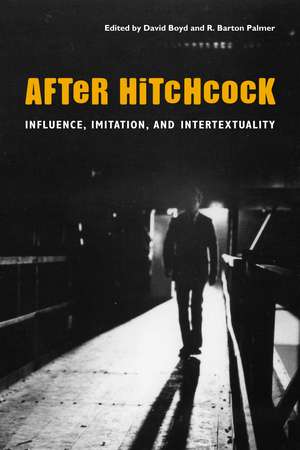
After Hitchcock: Influence, Imitation, and Intertextuality
Editat de David Boyd, R. Barton Palmeren Limba Engleză Paperback – noi 2006
Alfred Hitchcock rămâne figura centrală care a definit arhitectura suspansului, transformând thrillerul dintr-o nișă de divertisment într-un limbaj universal al cinematografiei. Găsim în acest volum, After Hitchcock, o explorare riguroasă a modului în care viziunea sa a continuat să pulseze în venele celei de-a șaptea arte mult după încheierea carierei sale. Ne-a atras atenția rigoarea cu care editorii David Boyd și R. Barton Palmer au structurat cele treisprezece eseuri, oferind o perspectivă ce depășește simpla analiză a operei propriu-zise pentru a urmări ecourile intertextuale în lucrări contemporane.
Observăm o progresie logică a conținutului, de la „reciclarea” impactului visceral al peliculei Psycho în filme precum Tăcerea mieilor, până la traducerile culturale complexe realizate de regizori ca Pedro Almodóvar sau Michelangelo Antonioni. Colecționarii care au apreciat Hitchcock de Richard Allen vor găsi aici aceeași calitate de reproducere a ideilor critice și o profunzime similară în abordarea esteticii de autor. Tonul volumului este unul academic, însă extrem de revelator pentru cititorul care dorește să înțeleagă mecanismele prin care Hitchcock a influențat reprezentarea violenței și structura narativă în Hollywood-ul post-studio.
Spre deosebire de alte lucrări care se concentrează strict pe biografie, acest studiu de la University of Texas Press funcționează ca o hartă a influențelor, punctând modul în care elemente din Rear Window sau Shadow of a Doubt au fost asimilate și reinterpretate. Cele 14 fotografii alb-negru servesc drept puncte de ancorare vizuală, facilitând înțelegerea compozițiilor de cadru care au devenit standarde în industrie. Este o resursă esențială pentru a vedea cum „umbrele” maestrului continuă să modeleze thrillerul modern.
Preț: 233.52 lei
Carte tipărită la comandă
Livrare economică 26 noiembrie-10 decembrie
Specificații
ISBN-10: 029271338X
Pagini: 290
Ilustrații: 14 b&w photographs
Dimensiuni: 152 x 229 x 21 mm
Greutate: 0.45 kg
Editura: University of Texas Press
Colecția University of Texas Press
Locul publicării:United States
V-ar putea interesa
-
 Twentieth-Century American Fiction on ScreenR. Barton Palmer-11%Preț: 611.85 lei687.48 lei
 -
 Nineteenth-Century American Fiction on ScreenR. Barton Palmer-11%Preț: 599.17 lei673.22 lei
 -
 Improving PassionsCharles Burnetts-23%Preț: 722.31 lei938.07 lei
 -
 Unsung Hollywood Musicals of the Golden EraEdwin M. BradleyPreț: 297.08 lei
 -
 Modern British Drama on ScreenR Barton Palmer-43%Preț: 440.54 lei773.41 lei
 -
 Cinema and SpectatorshipJudith Mayne-18%Preț: 1248.18 lei1522.18 lei
 -
 -18%Preț: 1607.27 lei1960.08 lei
 -
 -18%Preț: 1246.62 lei1520.27 lei
 -
 Modern American Drama on ScreenWilliam Robert BrayPreț: 301.95 lei
 -
 One World, Big ScreenM. Todd BennettPreț: 303.60 lei
 -
 Film FablesJacques Rancière-20%Preț: 161.11 lei201.48 lei
 -
 Border CrossingAlexander Burry-24%Preț: 613.25 lei809.15 lei
 -
 The Fox Film Corporation, 1915-1935Aubrey SolomonPreț: 283.99 lei
 -
 Preț: 349.25 lei
 -
 -23%Preț: 1460.73 lei1897.05 lei
 -
 To Force the Enemy off the SeaDavid BoydPreț: 141.46 lei
 -
 Cabinet 44: 24 HoursSina NajafiPreț: 79.35 lei
De ce să citești această carte
Recomandăm această carte oricărui pasionat de teoria filmului care dorește să descopere cum un singur regizor a putut influența generații întregi, de la Brian de Palma la autorii genului giallo. Cititorul câștigă o înțelegere profundă a conceptelor de intertextualitate și imitație creativă, învățând să identifice „codul Hitchcock” în cinematografia contemporană. Este un instrument critic valoros pentru studenți și profesioniști deopotrivă.
Despre autor
David Boyd este conferențiar în cadrul Departamentului de Engleză la Universitatea din Newcastle, Australia, fiind un cercetător recunoscut în studiile culturale. Expertiza sa în analiza textelor cinematografice și literare se reflectă în modul meticulos în care a coordonat această antologie. Deși bibliografia sa include titluri diverse precum The Hole, The Factory sau Diary of a Void — lucrări care explorează adesea alienarea modernă și spațiile liminale ale muncii sau vieții domestice — în After Hitchcock acesta își demonstrează capacitatea de a sintetiza curente majore din istoria filmului, oferind o platformă coerentă pentru unii dintre cei mai importanți teoreticieni ai momentului.
Descriere scurtă
In this book, thirteen original essays by leading film scholars reveal the richness and variety of Alfred Hitchcock's legacy as they trace his shaping influence on particular films, filmmakers, genres, and even on film criticism. Some essays concentrate on films that imitate Hitchcock in diverse ways, including the movies of Brian de Palma and thrillers such as True Lies, The Silence of the Lambs, and Dead Again. Other essays look at genres that have been influenced by Hitchcock's work, including the 1970s paranoid thriller, the Italian giallo film, and the post-Psycho horror film. The remaining essays investigate developments within film culture and academic film study, including the enthusiasm of French New Wave filmmakers for Hitchcock's work, his influence on the filmic representation of violence in the post-studio Hollywood era, and the ways in which his films have become central texts for film theorists.
Notă biografică
R. Barton Palmer is Calhoun Lemon Professor of Literature at Clemson University in South Carolina, where he directs the Film Studies Program.
Cuprins
- Introduction (David Boyd and R. Barton Palmer)
- I: Psycho Recycled
- 1. For Ever Hitchcock: Psycho and Its Remakes (Constantine Verevis)
- 2. Hitchcockian Silence: Psycho and Jonathan Demme's The Silence of the Lambs (Lesley Brill)
- II: The Return of the Repressed
- 3. Shadows of Shadow of a Doubt (Adam Knee)
- 4. Psycho or Psychic? Hitchcock, Dead Again, and the Paranormal (Ina Rae Hark)
- III: The Politics of Intertextuality
- 5. The Hitchcock Romance and the '70s Paranoid Thriller (R. Barton Palmer)
- 6. Exposing the Lies of Hitchcock's Truth (Walter Metz)
- IV: Found in Translation
- 7. Red Blood on White Bread: Hitchcock, Chabrol, and French Cinema (Richard Neupert)
- 8. "You're Tellin' Me You Didn't See": Hitchcock's Rear Window and Antonioni's Blow-Up (Frank P. Tomasulo)
- 9. Melo-Thriller: Hitchcock, Genre, and Nationalism in Pedro Almodóvar's Women on the Verge of a Nervous Breakdown (Ernesto R. Acevedo-Muñoz)
- 10. "Knowing Too Much" about Hitchcock: The Genesis of the Italian Giallo (Philippe Met)
- V: Theoretically Hitchcockian
- 11. Death at Work: Hitchcock's Violence and Spectator Identification (Robert Sklar)
- 12. Hitchcock and the Classical Paradigm (John Belton)
- VI: Modus Operandi
- 13. How to Steal from Hitchcock (Thomas M. Leitch)
- Notes on Contributors
- Index