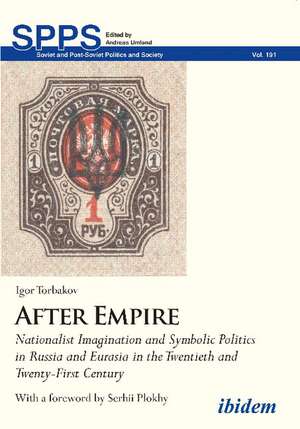
After Empire: Nationalist Imagination and Symbolic Politics in Russia and Eurasia in the Twentieth and Twenty-First Century
Autor Igor Torbakov Andreas Umland Cuvânt înainte de Serhii Plokhyen Limba Engleză Paperback – 30 oct 2018
Preț: 175.49 lei
Preț vechi: 226.24 lei
-22%
Puncte Express: 263
Carte disponibilă
Livrare economică 07-21 noiembrie
Livrare express 24-30 octombrie pentru 84.63 lei
Livrare prin curier în România Termenul estimat este afișat lângă disponibilitate.
Transport gratuit de la 400.00 lei Plată online sau ramburs, în funcție de opțiunile comenzii.
Retur gratuit în 14 zile Comandă securizată și suport în română.
Specificații
ISBN-13: 9783838212173
ISBN-10: 3838212177
Pagini: 356
Dimensiuni: 148 x 210 x 21 mm
Greutate: 0.49 kg
Editura: Ibidem
Colecția ibidem
Locul publicării:Hannover, Germany
ISBN-10: 3838212177
Pagini: 356
Dimensiuni: 148 x 210 x 21 mm
Greutate: 0.49 kg
Editura: Ibidem
Colecția ibidem
Locul publicării:Hannover, Germany
Recenzii
“The publication of Torbakov’s essays in a single volume provides a useful guide to all observers of Russia and Ukraine interested in the deeper ideas behind the events of the day and demonstrates Torbakov’s valuable contribution to the literature on Russian thought.”—The Russian Review, October 2019 (Vol. 78, No. 4)
“The value of the book is that it provides a profound historical context for understanding the Russian national imagination, foreign relations and domestic politics. Although the volume is primarily composed of Torbakov’s earlier published journal articles and book chapters, it provides a coherent overall picture of post-imperial Russia. The author is to be commended for his rich and comprehensive analysis of preserved archival and historical data, and for providing a variety of perspectives from scholarly and non-scholarly literature.”—Europe-Asia Studies, 72:4
“The value of the book is that it provides a profound historical context for understanding the Russian national imagination, foreign relations and domestic politics. Although the volume is primarily composed of Torbakov’s earlier published journal articles and book chapters, it provides a coherent overall picture of post-imperial Russia. The author is to be commended for his rich and comprehensive analysis of preserved archival and historical data, and for providing a variety of perspectives from scholarly and non-scholarly literature.”—Europe-Asia Studies, 72:4