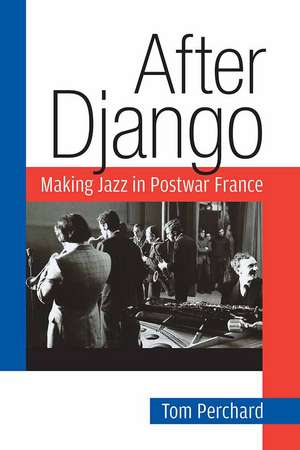
After Django: Making Jazz in Postwar France: Jazz Perspectives
Autor Tom Percharden Limba Engleză Hardback – 12 ian 2015
How did French musicians and critics interpret jazz—that quintessentially American music—in the mid-twentieth century? How far did players reshape what they learned from records and visitors into more local jazz forms, and how did the music figure in those angry debates that so often suffused French cultural and political life? After Django begins with the famous interwar triumphs of Josephine Baker and Django Reinhardt, but, for the first time, the focus here falls on the French jazz practices of the postwar era. The work of important but neglected French musicians such as André Hodeir and Barney Wilen is examined in depth, as are native responses to Americans such as Miles Davis and Thelonious Monk. The book provides an original intertwining of musical and historical narrative, supported by extensive archival work; in clear and compelling prose, Perchard describes the problematic efforts towards aesthetic assimilation and transformation made by those concerned with jazz in fact and in idea, listening to the music as it sounded in discourses around local identity, art, 1968 radicalism, social democracy, and post colonial politics.




Preț: 542.10 lei
Preț vechi: 757.58 lei
-28%
Puncte Express: 813
Preț estimativ în valută:
95.97€ • 111.75$ • 83.37£
95.97€ • 111.75$ • 83.37£
Carte indisponibilă temporar
Doresc să fiu notificat când acest titlu va fi disponibil:
Se trimite...
Preluare comenzi: 021 569.72.76
Specificații
ISBN-13: 9780472072422
ISBN-10: 0472072420
Pagini: 308
Ilustrații: 13 examples, 1 figure, 3 B&W halftones
Dimensiuni: 152 x 229 x 23 mm
Greutate: 0.63 kg
Editura: UNIVERSITY OF MICHIGAN PRESS
Colecția University of Michigan Press
Seria Jazz Perspectives
ISBN-10: 0472072420
Pagini: 308
Ilustrații: 13 examples, 1 figure, 3 B&W halftones
Dimensiuni: 152 x 229 x 23 mm
Greutate: 0.63 kg
Editura: UNIVERSITY OF MICHIGAN PRESS
Colecția University of Michigan Press
Seria Jazz Perspectives
Notă biografică
Tom Perchard teaches in the Department of Music at Goldsmiths, University of London.
Recenzii
"The ambiguity of France’s attraction to Afro-America was surely what James Baldwin had in mind when, in 1960, he suggested that 'someone, some day, should do a study in depth of the role of the American Negro in the mind and life of Europe, and the extraordinary perils, different from those of America but not less grave, which the American Negro encounters in the Old World.' Baldwin’s challenge has been taken up in recent years by a group of jazz historians working on France. Tom Perchard’s After Django is the latest addition to an impressive body of scholarship ... [an] lluminating study."
---New York Review of Books
---New York Review of Books
"Perchard's ability to deal with the nuances of cultural and intellectual history while also making sense of music and how it manifested itself in different media makes this book a standout performance."
--Twentieth-Century Music
--Twentieth-Century Music
"Taking in the entire period from pre-war France up to the early 1980s, this is an extraordinarily detailed and compelling account of a musical subculture within its native setting, tracing the intricacies and roots of the ideas and individuals who populated, and much of the time orchestrated, the era’s institutions and politics. By concentrating on the writers and intellectuals who were not only the critics but also the tastemakers, rather than (as is usual) simply the musicians, Perchard makes the connection of the music to the fabric and tumult of a changing society wonderfully vivid and utterly enthralling. This is a must-have for serious cultural historians."
---Times Higher Education
---Times Higher Education
"As well as being a carefully argued study of such weighty philosophical/sociological concerns, Perchard’s book also contains fascinating details about individual jazz lives, intersections between new wave French cinema and jazz, and interplay between momentous political changes and the music. After Django, in short, is essential reading for anyone interested in the process of jazz’s assimilation into French culture in particular, and into European culture in general."
--Chris Parker, London Jazz News
--Chris Parker, London Jazz News
"After Django" advances our understanding of jazz in post-war France, through a sophisticated analysis of jazz's relationships with national identity, politics and cultural aesthetics. It shows Perchard to be a really first-class jazz historian and critic."
--Andy Hamilton, Jazz Journal International
--Andy Hamilton, Jazz Journal International
"[After Django is] a very important examination of jazz in France."
--Roundup, W. Royal Stokes
--Roundup, W. Royal Stokes
After Django presents a crisp, sometimes wry and ably supported picture of the evolution of art and ideas in postwar France. This is exactly the kind of heft that, even if not always at play, is worth lining ones's quiver with in any serious artistic or experiential endeavor."
--New York City Jazz Record
--New York City Jazz Record
"After Django offers a much-needed English-language study of an area that historical (American) narratives on jazz generally only treat in passing."
--Notes: Quarterly Journal of the Music Library Association
--Notes: Quarterly Journal of the Music Library Association
"An important contribution to institutional history of jazz in France."
--Volume!
--Volume!
Descriere
The first study to focus on jazz in postwar France, this book explores the ways that French musicians and critics received and remade an American music according to their own cultural concerns