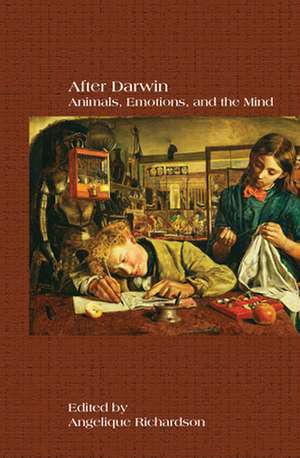
After Darwin
Editat de Angelique Richardsonen Limba Engleză Hardback – 2013
Preț: 892.64 lei
Preț vechi: 1159.27 lei
-23%
Puncte Express: 1339
Preț estimativ în valută:
157.86€ • 186.45$ • 136.00£
157.86€ • 186.45$ • 136.00£
Carte tipărită la comandă
Livrare economică 20 martie-03 aprilie
Specificații
ISBN-13: 9789042037472
ISBN-10: 9042037474
Pagini: 388
Dimensiuni: 158 x 236 x 32 mm
Greutate: 0.71 kg
Editura: de Gruyter Brill
ISBN-10: 9042037474
Pagini: 388
Dimensiuni: 158 x 236 x 32 mm
Greutate: 0.71 kg
Editura: de Gruyter Brill
V-ar putea interesa
-
 -20%Preț: 65.53 lei82.31 lei
 -
 -23%Preț: 336.06 lei433.97 lei
 -
 The Oxford Guide to Literary Britain and IrelandDaniel Hahn-17%Preț: 224.32 lei271.51 lei
 -
 Preț: 57.17 lei
 -
 Faust: Part OneJ. W. von GoethePreț: 53.16 lei
 -
 Preț: 51.50 lei
 -
 The Figaro Trilogy: The Barber of Seville, The Marriage of Figaro, The Guilty MotherPierre Augustin Caron De BeaumarchaisPreț: 70.90 lei
 -
 Preț: 52.79 lei
 -
 Don Juan and Other PlaysMolièrePreț: 63.27 lei
 -
 Danton's Death, Leonce and Lena, WoyzeckGeorg Büchner-21%Preț: 53.38 lei67.88 lei
 -
 -17%Preț: 65.41 lei78.69 lei
 -
 Discourse and Genre: Using Language in ContextStephen Bax-15%Preț: 257.45 lei303.88 lei
 -
 Richard IIIProf. Eric Rasmussen-20%Preț: 64.59 lei80.93 lei
 -
 Much Ado About NothingProfessor Alison FindlayPreț: 148.04 lei
 -
 Finding Ireland – A Poet`s Explorations of Irish Literature and CultureRichard TillinghastPreț: 153.56 lei
 -
 A Writer's BritainMargaret Drabble-17%Preț: 76.80 lei92.41 lei
 -
 I Like it Like That: True Stories of Gay Male DesireRichard LaBontePreț: 86.87 lei
Cuprins
Acknowledgements
Notes on Contributors
List of Illustrations
Introduction: Darwin and Interdisciplinarity: A Historical Perspective
Angelique Richardson
‘Love and Hatred are Common to the Whole Sensitive Creation’: Animal Feeling in the Century before Darwin
Jane Spencer
‘The Book of The Season’: The Conception and Reception of Darwin’s Expression
Angelique Richardson
The Backbone Shiver: Darwin and the Arts
Gillian Beer
Becoming an Animal: Darwin and the Evolution of Sympathy
Paul White
George Eliot, G.H. Lewes, and Darwin: Animals, Emotions, and Morals
Angelique Richardson
Between Medicine and Evolutionary Theory: Sympathy and Other Emotional Investments in Life Writings by and about Charles Darwin
David Amigoni
From Entangled Vision to Ethical Engagement: Darwin, Affect, and Contemporary Exhibition Projects
Monika Pietrzak-Franger
Reckoning with the Emotions: Neurological Responses to the Theory of Evolution, 1870-1930
L.S. Jacyna
Darwin’s Changing Expression and the Making of the Modern State
Rhodri Hayward
Calling the Wild: Selection, Domestication, and Species
Harriet Ritvo
The Development of Emotional Life
Michael Lewis
Afterword: The Emotional and Moral Lives of Animals: What Darwin Would Have Said
Marc Bekoff
Index
Notes on Contributors
List of Illustrations
Introduction: Darwin and Interdisciplinarity: A Historical Perspective
Angelique Richardson
‘Love and Hatred are Common to the Whole Sensitive Creation’: Animal Feeling in the Century before Darwin
Jane Spencer
‘The Book of The Season’: The Conception and Reception of Darwin’s Expression
Angelique Richardson
The Backbone Shiver: Darwin and the Arts
Gillian Beer
Becoming an Animal: Darwin and the Evolution of Sympathy
Paul White
George Eliot, G.H. Lewes, and Darwin: Animals, Emotions, and Morals
Angelique Richardson
Between Medicine and Evolutionary Theory: Sympathy and Other Emotional Investments in Life Writings by and about Charles Darwin
David Amigoni
From Entangled Vision to Ethical Engagement: Darwin, Affect, and Contemporary Exhibition Projects
Monika Pietrzak-Franger
Reckoning with the Emotions: Neurological Responses to the Theory of Evolution, 1870-1930
L.S. Jacyna
Darwin’s Changing Expression and the Making of the Modern State
Rhodri Hayward
Calling the Wild: Selection, Domestication, and Species
Harriet Ritvo
The Development of Emotional Life
Michael Lewis
Afterword: The Emotional and Moral Lives of Animals: What Darwin Would Have Said
Marc Bekoff
Index
Recenzii
"Richardson [...] has brought together a group of eminent literary critics, including Gillian Beer and David Amigoni, and high-caliber historians of the emotions [...] with leading contemporary evolutionay biologists and psychologists [...] this cross-disciplinary conjunction does raise some pertinent and highly interesting questions."
– Gowan Dawson (University of Leicester), in: Victorian Studies, Volume 58, No. 2, p. 354-356.
"After Darwin not only offers a fascinatingly diverse collection of ways to approach Darwin’s influential concenption of the emotions in an evolutionary framework, with contributions from experts in literature, psychology, biology and history, it also provides a rich impetus for future investigations."
– Andrew Ball, University of Manchester, in Social History of Medicine 28.1 (2015) pp. 206-207
“extremely interesting and well organized collection of 11 original essays. […] no summary of these essays will sufficiently indicate their richness. […] This book shows how Darwin’s scientific theory – the product itself of deep imaginative sympathy – helped to transform our understanding of both humans and animals.”
– George Levine (Rutgers University), in The George Eliot Review 45 (2014), pp. 83-85
"The book […] really intrigued me. […] I hope that [this book] somehow [finds its] way into your hands in the not too distant future. [It] really [is] that good."
– Mark Bekoff (University of Colorado), in Psychology Today: Animal Emotions 12 December 2013.
For the full review see: PSYCHOLOGY TODAY/ANIMAL EMOTIONS
"Guided by the assumption that science and culture are at all times reciprocal, After Darwin successfully bridges the gap between science and the humanities. It also typifies the rising interest in the emotions as a field of study in their own right and is furthermore representative of Harriet Ritvo’sobservation of ten years ago that ‘animals have been edging towards the academic mainstream’ (p. 8). Some chapters integrate less well into the overall agenda of the volume, but they all offer a unique way of thinking about emotions, animals and human nature, at the centre of which we ultimately find Darwin himself."
– Stephanie Eichberg in: The British Journal for the History of Science, Volume 48, Issue 03, September 2015, pp. 523 - 525.
– Gowan Dawson (University of Leicester), in: Victorian Studies, Volume 58, No. 2, p. 354-356.
"After Darwin not only offers a fascinatingly diverse collection of ways to approach Darwin’s influential concenption of the emotions in an evolutionary framework, with contributions from experts in literature, psychology, biology and history, it also provides a rich impetus for future investigations."
– Andrew Ball, University of Manchester, in Social History of Medicine 28.1 (2015) pp. 206-207
“extremely interesting and well organized collection of 11 original essays. […] no summary of these essays will sufficiently indicate their richness. […] This book shows how Darwin’s scientific theory – the product itself of deep imaginative sympathy – helped to transform our understanding of both humans and animals.”
– George Levine (Rutgers University), in The George Eliot Review 45 (2014), pp. 83-85
"The book […] really intrigued me. […] I hope that [this book] somehow [finds its] way into your hands in the not too distant future. [It] really [is] that good."
– Mark Bekoff (University of Colorado), in Psychology Today: Animal Emotions 12 December 2013.
For the full review see: PSYCHOLOGY TODAY/ANIMAL EMOTIONS
"Guided by the assumption that science and culture are at all times reciprocal, After Darwin successfully bridges the gap between science and the humanities. It also typifies the rising interest in the emotions as a field of study in their own right and is furthermore representative of Harriet Ritvo’sobservation of ten years ago that ‘animals have been edging towards the academic mainstream’ (p. 8). Some chapters integrate less well into the overall agenda of the volume, but they all offer a unique way of thinking about emotions, animals and human nature, at the centre of which we ultimately find Darwin himself."
– Stephanie Eichberg in: The British Journal for the History of Science, Volume 48, Issue 03, September 2015, pp. 523 - 525.
Notă biografică
Angelique Richardson is a Senior Lecturer in English at the University of Exeter, where she is also a member of the Advisory Board of the Centre for Medical History, and an Associate Research Fellow of the ESRC Centre for Genomics in Society (Egenis). Her research and teaching interests embrace Victorian Studies, medical humanities and animal studies, and she has published widely on aspects of Victorian science and culture. Her books include Love and Eugenics in the Late Nineteenth Century: Rational Reproduction and the New Woman (Oxford University Press, 2003); as editor Women Who Did: Stories by Men and Women, 1890–1914 (Penguin Classics, 2005) and Essentialism in Science and Culture, Critical Quarterly Special Issue (2011); and, as coeditor, Victorian Literature: A Sourcebook (Palgrave, 2012). She is now completing Thomas Hardy and Biology.