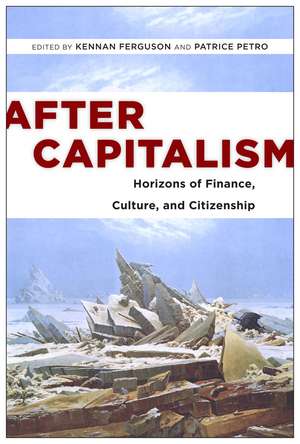
After Capitalism: Horizons of Finance, Culture, and Citizenship: New Directions in International Studies
Editat de Kennan Ferguson, Patrice Petro Contribuţii de Geoff Mann, Andrew Ross, Ivan Ascher, Jeffrey Sommers, Sherryl Vint, Marcus Bullock, Esther Leslie, Professor Cristina Venegas, Niki Akhavan, Professor A. Aneesh, Bernard C. Perleyen Limba Engleză Paperback – 5 iul 2016 – vârsta ani
From Thomas Piketty to David Harvey, scholars are increasingly questioning whether we are entering into a post-capitalist era. If so, does this new epoch signal the failure of capitalism and emergence of alternative systems? Or does it mark the ultimate triumph of capitalism as it evolves into an unstoppable entity that takes new forms as it engulfs its opposition?
After Capitalism brings together leading scholars from across the academy to offer competing perspectives on capitalism’s past incarnations, present conditions, and possible futures. Some contributors reassess classic theorizations of capitalism in light of recent trends, including real estate bubbles, debt relief protests, and the rise of a global creditocracy. Others examine Marx’s writings, unemployment, hoarding, “capitalist realism,” and coyote (trickster) capitalism, among many other topics. Media and design trends locate the key ideologies of the current economic moment, with authors considering everything from the austerity aesthetics of reality TV to the seductive smoothness of liquid crystal.
Even as it draws momentous conclusions about global economic phenomena, After Capitalism also pays close attention to locales as varied as Cuba, India, and Latvia, examining the very different ways that economic conditions have affected the relationship between the state and its citizens. Collectively, these essays raise provocative questions about how we should imagine capitalism in the twenty-first century. Will capitalism, like all economic systems, come to an end, or does there exist in history or elsewhere a hidden world that is already post-capitalist, offering alternative possibilities for thought and action?


Preț: 250.35 lei
Puncte Express: 376
Preț estimativ în valută:
44.27€ • 51.95$ • 38.40£
44.27€ • 51.95$ • 38.40£
Carte tipărită la comandă
Livrare economică 09-23 martie
Specificații
ISBN-13: 9780813584263
ISBN-10: 0813584264
Pagini: 270
Dimensiuni: 152 x 229 x 15 mm
Greutate: 0.37 kg
Ediția:None
Editura: Rutgers University Press
Colecția Rutgers University Press
Seria New Directions in International Studies
ISBN-10: 0813584264
Pagini: 270
Dimensiuni: 152 x 229 x 15 mm
Greutate: 0.37 kg
Ediția:None
Editura: Rutgers University Press
Colecția Rutgers University Press
Seria New Directions in International Studies
V-ar putea interesa
-
 America ChallengedWilliam Orville DouglasPreț: 266.52 lei
 -
 -23%Preț: 325.63 lei421.15 lei
 -
 -16%Preț: 230.57 lei275.77 lei
 -
 The Easter RisingMichael T. FoyPreț: 144.11 lei
 -
 War and the Liberal ConscienceProfessor Michael HowardPreț: 250.23 lei
 -
 Preț: 245.78 lei
 -
 All in the Family – On Community and IncommensurabilityKennan FergusonPreț: 209.86 lei
 -
 Ingenious CitizenshipCharles T. LeePreț: 241.62 lei
 -
 Making Public in a Privatized World: The Struggle for Essential ServicesDavid A. McDonald-23%Preț: 190.65 lei249.14 lei
 -
 Politische Theorie und IdeengeschichteHerfried MünklerPreț: 151.95 lei
 -
 Der Rastatter Kongress und die zweite KoalitionHermann HüfferPreț: 283.49 lei
 -
 Preț: 375.44 lei
Notă biografică
KENNAN FERGUSON is an associate professor of political theory at the University of Wisconsin-Milwaukee, where he also directs the Center for 21st Century Studies. He is the author or coeditor of several books including All in the Family: On Community and Incommensurability.
PATRICE PETRO is a professor of English and film studies at the University of Wisconsin-Milwaukee, where she also serves as Vice Provost and Director of the Center for International Education. She is the author, editor, or coeditor of eleven books, including Idols of Modernity: Movie Stars of the 1920s and Rethinking Global Security: Media, Popular Culture, and the ‘War on Terror’ (both by Rutgers University Press).
Recenzii
"Imagination and passion fuel these essays, which confront the worst of capitalism’s violence and the terrors of capitalism’s aftermath. A timely and well-edited collection, After Capitalism begins a crucial conversation among political economics, representation and imaging, and geopolitical mapping."
"After Capitalism powerfully extends the horizon of capitalism's conceptualization, and is essential reading for anyone interested in critiques of globalization, culture and economics or the cultural politics of recession."
Descriere
After Capitalism brings together leading scholars from across the academy to offer competing perspectives on capitalism’s past incarnations, present conditions, and possible futures. Analyzing global trends from real estate bubbles to debt relief protests, this book also closely examines economic conditions in locales as varied as Cuba, India, and Latvia. Collectively, these essays raise provocative questions about how we should imagine capitalism in the twenty-first century.