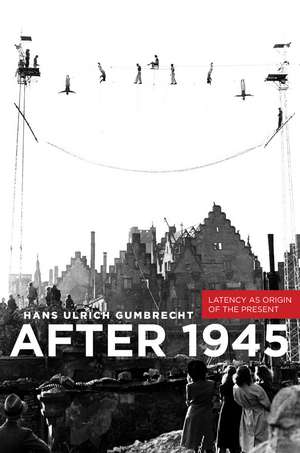
After 1945 : Latency as Origin of the Present
Autor Hans Gumbrechten Limba Engleză Hardback – 8 mai 2013
Considerăm After 1945 o resursă esențială pentru studenții la istorie culturală, cercetătorii în studii literare și practicienii interesați de teoria temporalității. Hans Gumbrecht propune o examinare riguroasă a modului în care s-a prăbușit viziunea asupra timpului ca progres, lăsând loc unei stări de „latență” care definește prezentul nostru extins. Reținem că această lucrare nu este un tratat istoric convențional, ci o cercetare experimentală care împletește experiența personală a generației postbelice germane cu exegeza filosofică.
Textul analizează modul în care tehnologia și amenințările globale (precum încălzirea globală sau riscul nuclear) au transformat viitorul dintr-un orizont al posibilităților într-un set de inevitabilități. After 1945 completează perspectiva oferită de Time – A Vocabulary of the Present de Joel Burges, adăugând o dimensiune autobiografică și o analiză specifică asupra traumei germane care lipsește din abordările pur teoretice. În timp ce Burges se concentrează pe conceptualizarea temporală post-milenială, Gumbrecht caută originea acestei stagnări în deceniile imediat următoare conflagrației mondiale.
În contextul operei sale, volumul reprezintă o evoluție firească de la Production of Presence și Atmosphere, Mood, Stimmung. Dacă în lucrările anterioare Hans Gumbrecht explora capacitatea literaturii de a face prezentul perceptibil, aici aplică aceste concepte asupra unei epoci întregi, demonstrând cum „starea de spirit” a unei perioade istorice modelează traiectoria intelectuală a unei generații. Stilul este dens, dar lipsit de bariere disciplinare rigide, trecând cu ușurință de la analiza poeziei lui Paul Celan la impactul social al Raportului Kinsey.
Preț: 267.73 lei
Carte disponibilă
Livrare economică 02-16 noiembrie
Specificații
ISBN-10: 080478518X
Pagini: 240
Dimensiuni: 152 x 229 x 30 mm
Greutate: 0.5 kg
Editura: Stanford University Press
Colecția Stanford University Press
V-ar putea interesa
-
 In 1926 – Living on the Edge of TimeHans Ulrich GumbrechtPreț: 402.71 lei
 -
 Prophetic Politics – Christian Social Movements and American DemocracyDavid S. GuttermanPreț: 464.34 lei
 -
 The Family and the Nation – Gender and Citizenship in Revolutionary France, 1789–1830Jennifer Ngaire HeuerPreț: 488.37 lei
 -
 Republic of Labor – Russian Printers and Soviet Socialism, 1918–1930Diane P. Koenker-23%Preț: 533.97 lei693.46 lei
 -
 Divided Houses – Religion and Gender in Modern FranceCaroline C. Ford-23%Preț: 410.39 lei532.98 lei
 -
 ProvincetownKaren Christel Krahulik-23%Preț: 632.53 lei821.48 lei
 -
 Babes in TomorrowlandNicholas SammondPreț: 296.38 lei
 -
 The Remains of WarThomas M HawleyPreț: 253.24 lei
 -
 Transnational AmericaInderpal GrewalPreț: 252.38 lei
 -
 Black EmpireMichelle Ann StephensPreț: 295.30 lei
 -
 The Development of Abstractionism in the Writings of Gertrude SteinMichael J Hoffman-11%Preț: 644.54 lei724.21 lei
 -
 Future Trading Upon Organized Commodity Markets in the United StatesG Wright Hoffman-11%Preț: 570.67 lei641.20 lei
 -
 The Colonial Land and Emigration CommissionFred H Hitchins-14%Preț: 706.35 lei821.33 lei
 -
 -11%Preț: 642.01 lei721.37 lei
 -
 Ireland Through Tudor EyesEdward M Hinton-11%Preț: 635.09 lei713.57 lei
 -
 Richard, Myrtle, and IStephen Hudson-11%Preț: 635.32 lei713.84 lei
 -
 The Causes of the War of 1812Reginald Horsman-11%Preț: 646.14 lei726.01 lei
 -
 Daniel Drake (1785-1852)Emmet Field Horine-14%Preț: 710.10 lei825.70 lei
 -
 Old Drury of PhiladelphiaReese D James-11%Preț: 666.09 lei748.42 lei
 -
 Education and the National PurposeHelen Huus-14%Preț: 730.20 lei849.07 lei
 -
 Nach 1945Hans Ulrich GumbrechtPreț: 136.95 lei
 -
 Epochenschwellen und Epochenstrukturen im Diskurs der Literatur- und SprachhistorieHans Ulrich GumbrechtPreț: 175.66 lei
 -
 LatenzFlorian KlingerPreț: 529.93 lei
 -
 ProvinzHans Ulrich GumbrechtPreț: 161.84 lei
De ce să citești această carte
Recomandăm această carte cititorilor care doresc să înțeleagă rădăcinile filosofice ale anxietății contemporane legate de timp. Veți câștiga o perspectivă unică asupra modului în care istoria Germaniei și cultura universală post-1945 au creat un prezent în care ne simțim adesea blocați. Este un instrument critic valoros pentru a descifra cum „latența” trecutului continuă să ne influențeze identitatea și deciziile actuale.
Despre autor
Hans Gumbrecht este unul dintre cei mai originali teoreticieni literari contemporani, profesor la Universitatea Stanford. Opera sa se distinge prin refuzul interpretărilor pur hermeneutice, punând accent pe „prezența” materială a culturii. În lucrări precum Production of Presence, el a redefinit modul în care umanioarele interacționează cu obiectul de studiu. After 1945 marchează un moment de cotitură în cariera sa, fiind prima lucrare în care își folosește propria biografie și contextul național german ca piloni pentru o analiză istorică și filosofică de anvergură globală.
Descriere scurtă
Those born after 1945, and especially those born in Germany, would have liked nothing more than to put the catastrophic events and explosions of the past behind them, but that possibility remained foreclosed or just out of reach. World literatures and cultures of the postwar years reveal this to have been a broadly shared predicament: they hint at promises unfulfilled and obsess over dishonesty and bad faith; they transmit the sensation of confinement and the inability to advance.
After 1945 belies its theme of entrapment. Gumbrecht has never been limited by narrow disciplinary boundaries, and his latest inquiry is both far-ranging and experimental. It combines autobiography with German history and world-historical analysis, offering insightful reflections on Samuel Beckett and Paul Celan, detailed exegesis of the thought of Martin Heidegger and Jean Paul Sartre, and surprising reflections on cultural phenomena ranging from Edith Piaf to the Kinsey Report. This personal and philosophical take on the last century is of immediate relevance to our identity today.