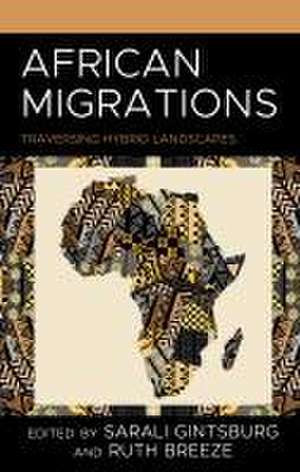
African Migrations: Traversing Hybrid Landscapes
Editat de Sarali Gintsburg, Ruth Breeze Contribuţii de Melina De Dijn, Jessica Falconi, Dorien Van De Mieroop, Judit Nagy, Rosa Pennisi, Carolina Nvé Díaz San Francisco, Marta Amorós Torróen Limba Engleză Hardback – 16 noi 2023
Preț: 491.97 lei
Preț vechi: 717.15 lei
-31%
Puncte Express: 738
Preț estimativ în valută:
87.07€ • 101.76$ • 75.59£
87.07€ • 101.76$ • 75.59£
Carte tipărită la comandă
Livrare economică 20 februarie-06 martie
Preluare comenzi: 021 569.72.76
Specificații
ISBN-13: 9781666938692
ISBN-10: 1666938696
Pagini: 224
Ilustrații: 5 b/w illustrations; 7 b/w photos; 4 tables
Dimensiuni: 158 x 232 x 20 mm
Greutate: 0.48 kg
Editura: Bloomsbury Publishing
Colecția Lexington Books
Locul publicării:New York, United States
ISBN-10: 1666938696
Pagini: 224
Ilustrații: 5 b/w illustrations; 7 b/w photos; 4 tables
Dimensiuni: 158 x 232 x 20 mm
Greutate: 0.48 kg
Editura: Bloomsbury Publishing
Colecția Lexington Books
Locul publicării:New York, United States
Cuprins
Acknowledgments
Introduction: Mapping the Landscapes of Migration by Ruth Breeze and Sarali Gintsburg
Chapter One: From Angola to Portugal: Narrating Migration, Memory, and Identity in Djaimilia Pereira de Almeida's Works by Jessica Falconi
Chapter Two: Gluing Together the Fragmented Identities of Zanzibar Arabs: A Heterotopian-Utopian Approach by Sarali Gintsburg
Chapter Three: Clashing Ideological Frameworks in a Belgian Job Interview with a Sierra Leonean Candidate by Dorien Van De Mieroop and Melina De Dijn
Chapter Four: Along the Paths of Resistance: The History of a Moroccan Family in Catalonia through their Multiple Voices by Marta Amorós Torró
Chapter Five: Finding the Voice: Positioning in African Diaspora Media by Ruth Breeze
Chapter Six: "From Okacha to Molenbeek": Moroccan mu?akkirat in L7a9d's Digital Storytelling by Rosa Pennisi
Chapter Seven: Caribbean Canadian Writers of African Descent: The Legacy of 'the Door' by Judit Nagy
Chapter Eight: Moroccan Women in Rural Spain: Intimate Heterotopias by Sarali Gintsburg and Ruth Breeze
Chapter Nine: Mwinda, 'Light of the World': Healing Among Congolese Diasporas in Massachusetts by Carolina Nvé Díaz San Francisco
About the Contributors
Introduction: Mapping the Landscapes of Migration by Ruth Breeze and Sarali Gintsburg
Chapter One: From Angola to Portugal: Narrating Migration, Memory, and Identity in Djaimilia Pereira de Almeida's Works by Jessica Falconi
Chapter Two: Gluing Together the Fragmented Identities of Zanzibar Arabs: A Heterotopian-Utopian Approach by Sarali Gintsburg
Chapter Three: Clashing Ideological Frameworks in a Belgian Job Interview with a Sierra Leonean Candidate by Dorien Van De Mieroop and Melina De Dijn
Chapter Four: Along the Paths of Resistance: The History of a Moroccan Family in Catalonia through their Multiple Voices by Marta Amorós Torró
Chapter Five: Finding the Voice: Positioning in African Diaspora Media by Ruth Breeze
Chapter Six: "From Okacha to Molenbeek": Moroccan mu?akkirat in L7a9d's Digital Storytelling by Rosa Pennisi
Chapter Seven: Caribbean Canadian Writers of African Descent: The Legacy of 'the Door' by Judit Nagy
Chapter Eight: Moroccan Women in Rural Spain: Intimate Heterotopias by Sarali Gintsburg and Ruth Breeze
Chapter Nine: Mwinda, 'Light of the World': Healing Among Congolese Diasporas in Massachusetts by Carolina Nvé Díaz San Francisco
About the Contributors
Recenzii
This volume offers rich and intriguing engagement with one of the defining themes of our time: mobility and displacement, drawing on literary and sociolinguistic analyses. Its focus on these themes in, around, and from Africa, and the novel theoretical perspectives are a welcome addition to the existing literature.
This book provides a fascinating combination of methodological approaches to migrant spaces and positions centralized on Foucault's heterotopia/utopia concepts. The book brings us from the micro-storia of a family of Moroccan descent in Catalonia, to healing practices in an African diaspora church in Massachusetts, from interviews with 42 women in rural Spain to an activist rapper in Molenbeek. This is a genuinely instructive work on how to do research on the practices and everyday lives of migrants.
This book provides a fascinating combination of methodological approaches to migrant spaces and positions centralized on Foucault's heterotopia/utopia concepts. The book brings us from the micro-storia of a family of Moroccan descent in Catalonia, to healing practices in an African diaspora church in Massachusetts, from interviews with 42 women in rural Spain to an activist rapper in Molenbeek. This is a genuinely instructive work on how to do research on the practices and everyday lives of migrants.