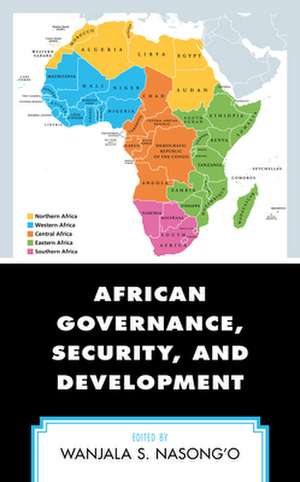
African Governance, Security, and Development
Editat de Wanjala S. Nasong'o Contribuţii de Paulino Do Canto, Patrick Effah, Stanley Osezua Ehiane, John Mwangi Githigaro, Nirmala Gopal, Fatuma Guyo, Joshua M. Kivuva, George C. Mbara, John Musalia, Suleiman Kairu Mwangi, Vundi Naison, Julius Niringiyimana, Francis Onditi, Ken Walibora Waliaula, Ibrahim Yusufen Limba Engleză Hardback – 10 aug 2021
Preț: 661.50 lei
Preț vechi: 1054.91 lei
-37%
Puncte Express: 992
Carte tipărită la comandă
Livrare economică 07-21 decembrie
Livrare prin curier în România Termenul estimat este afișat lângă disponibilitate.
Transport gratuit pentru acest produs Plată online sau ramburs, în funcție de opțiunile comenzii.
Retur gratuit în 14 zile Comandă securizată și suport în română.
Specificații
ISBN-13: 9781793645586
ISBN-10: 1793645582
Pagini: 336
Ilustrații: 9 tables;
Dimensiuni: 163 x 229 x 30 mm
Greutate: 0.65 kg
Editura: Bloomsbury Publishing
Colecția Lexington Books
Locul publicării:New York, United States
ISBN-10: 1793645582
Pagini: 336
Ilustrații: 9 tables;
Dimensiuni: 163 x 229 x 30 mm
Greutate: 0.65 kg
Editura: Bloomsbury Publishing
Colecția Lexington Books
Locul publicării:New York, United States
Cuprins
Introduction: Democracy, Governance, and Development
Wanjala S. Nasong'o
Part I: The Challenge of Democratic Consolidation
Chapter 1: Different Paths, Similar Destination: The Unending and Un-consolidating Democratic Transition in Kenya and Uganda
Joshua M. Kivuva
Chapter 2: The Legislature and Third Term Ambition in African Democracy
Ibrahim Yusuf and Stanley O. Ehiane
Chapter 3: Assessing the Impact of Democratization: The Case of Kenya's Supreme Court
John Mwangi Githigaro
Chapter 4: Democracy and Education in African Schools: Contradictions between Theory and Practice in Kenya
Suleiman Kairu Mwangi
Chapter 5: Politics of Identity and Democratization in Postcolonial Africa: Kenyan Experience
Vundi Nason
Part II: Gender, Ethnicity, and Civic Engagement
Chapter 6: Gender and Political Governance in Africa: Revisiting Past and Contemporary Dimensions
Fatuma Guyo
Chapter 7: Transforming the 'Bearded' Parliament in Africa through Gender Mainstreaming: The Case of the Kenyan N
Wanjala S. Nasong'o
Part I: The Challenge of Democratic Consolidation
Chapter 1: Different Paths, Similar Destination: The Unending and Un-consolidating Democratic Transition in Kenya and Uganda
Joshua M. Kivuva
Chapter 2: The Legislature and Third Term Ambition in African Democracy
Ibrahim Yusuf and Stanley O. Ehiane
Chapter 3: Assessing the Impact of Democratization: The Case of Kenya's Supreme Court
John Mwangi Githigaro
Chapter 4: Democracy and Education in African Schools: Contradictions between Theory and Practice in Kenya
Suleiman Kairu Mwangi
Chapter 5: Politics of Identity and Democratization in Postcolonial Africa: Kenyan Experience
Vundi Nason
Part II: Gender, Ethnicity, and Civic Engagement
Chapter 6: Gender and Political Governance in Africa: Revisiting Past and Contemporary Dimensions
Fatuma Guyo
Chapter 7: Transforming the 'Bearded' Parliament in Africa through Gender Mainstreaming: The Case of the Kenyan N
Recenzii
African Governance, Security, and Development is a comprehensive and thoughtful collection of timely essays written to reveal enduring patterns in African political and socio-economic life. The text goes beyond an explanation of challenges of democratic reforms, consolidation, security, gender inequalities, and unfinished development policy agendas in Africa and explores the complex interactions of these variables as they manifest in different African countries. The volume elegantly interweaves several themes in the development discourse in a way that is useful to students and practitioners of African governance.
Following the democratic wave that swept across Africa in the 1990s, few studies have dedicated their analysis to understanding whether the resulting political transition has proved sustainable. This excellent volume fills this lacuna. By drawing from experiences of several African countries, contributors to the volume masterfully complicate our understanding of democratic transition in Africa, depicting it as a variable against which progress can be understood or measured. They succeed at arguing that outcomes of democratic practice or political transition in Africa have varied from state to state. This variation marks the book's value, as it offers the contributors an opportunity to determine outcomes of political change on the continent by focusing on various germane topics. These range from constitutional practice, identity, development, ethnicity, education, parliamentarism, imagination, new oil economies, security, and regional integration. This timely book is critical to researchers and students of African studies seeking to understand political, social, and economic trends in modern Africa against the backdrop of state and regional politics.
An edifying interdisciplinary inquiry into social, ideological, and political micro-national, macro-national and global identities and institutions and the theory and practice of democracies.
This book captures African politics in its complexity and diversity. It is a "one-stop-shop," and a valuable resource for students, academics, and practitioners who wish to navigate Africa's contemporary political, economic, socio-cultural, and security landscape. It is a must-read!
Following the democratic wave that swept across Africa in the 1990s, few studies have dedicated their analysis to understanding whether the resulting political transition has proved sustainable. This excellent volume fills this lacuna. By drawing from experiences of several African countries, contributors to the volume masterfully complicate our understanding of democratic transition in Africa, depicting it as a variable against which progress can be understood or measured. They succeed at arguing that outcomes of democratic practice or political transition in Africa have varied from state to state. This variation marks the book's value, as it offers the contributors an opportunity to determine outcomes of political change on the continent by focusing on various germane topics. These range from constitutional practice, identity, development, ethnicity, education, parliamentarism, imagination, new oil economies, security, and regional integration. This timely book is critical to researchers and students of African studies seeking to understand political, social, and economic trends in modern Africa against the backdrop of state and regional politics.
An edifying interdisciplinary inquiry into social, ideological, and political micro-national, macro-national and global identities and institutions and the theory and practice of democracies.
This book captures African politics in its complexity and diversity. It is a "one-stop-shop," and a valuable resource for students, academics, and practitioners who wish to navigate Africa's contemporary political, economic, socio-cultural, and security landscape. It is a must-read!