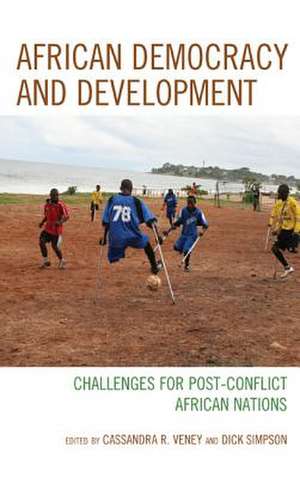
African Democracy and Development: Challenges for Post-Conflict African Nations
Editat de Cassandra Rachel Veney, Dick Simpson Contribuţii de Paul Zeleza, Sylvia Macauley, Thomas Kwasi Tieku, Fredline M’Cormack-Hale, John Yoder, Arthur Abraham, Amos Sawyer, Helen Hintjens, Elisabeth King, Jessica Schaferen Limba Engleză Paperback – 15 mai 2014
The book includes an examination of the various actors who are involved in post-conflict rebuilding and reconstruction that involves internal and external participants. For example, it is clear that the internal actors involve Africans themselves as ordinary citizens, members of local and national governments, and members of non-governmental organizations. This allows the reader to understand the agency and empowerment of Africans in post-conflict reconstruction. Various institutions are addressed within the context of the roles they play in establishing governance organizations such as the Truth and Reconciliation Commission in Sierra Leone, the African Union, chiefs in Liberia, and non-governmental organizations. Furthermore, the external actors who are involved in post-conflict reconstruction are examined such as international non-governmental organizations and the African Diaspora. They both have their own constituents and agendas and can and do play a positive and negative role in post-conflict reconstruction. It is obvious that countries that are addressed in the book are in dire need of financial assistant to rebuild much needed infrastructure that was destroyed during the conflict. All of the countries covered in the book need schools, medical facilities, roads, bridges, airports, ports, and the government does not have the money to provide these. This is where the international non-governmental organizations and the African Diaspora play an important role. The chapters that address these issues are cognizant of their importance and at the same time, the authors realize that sovereignty can be undermined if Africans are not in the forefront of policy and decision making that will determine their future.
There are chapters that provide a gendered analysis of post-conflict when it is appropriate. For example, it is clear that women, men, boys, and girls experienced conflict in different ways because of their gender. They all participated in the conflict in various ways. Consequently, the efforts at peace building are given a gendered analysis in terms of what has happened to women and girls in the demobilization and rehabilitation period including an excellent analysis of land reform in Rwanda and how that affects women and members of a certain ethnic group that are often overlooked in the examination of the 1994 genocide.
This book provides a very good contribution to the literature on conflict and post-conflict African countries because of its depth and the vast topics it embraces. It provides an analysis of the internal and external actors, the role of gender in post-conflict decision making, and it provides the voices of ordinary Africans who were affected by the conflict, and who are determined to live productive lives.
Preț: 380.47 lei
Preț vechi: 579.30 lei
-34%
Puncte Express: 571
Carte tipărită la comandă
Livrare economică 07-21 decembrie
Livrare prin curier în România Termenul estimat este afișat lângă disponibilitate.
Transport gratuit de la 400.00 lei Plată online sau ramburs, în funcție de opțiunile comenzii.
Retur gratuit în 14 zile Comandă securizată și suport în română.
Specificații
ISBN-13: 9780739197998
ISBN-10: 0739197991
Pagini: 306
Ilustrații: 4 BW Photos, 3 Tables
Dimensiuni: 156 x 228 x 24 mm
Greutate: 0.48 kg
Editura: Bloomsbury Publishing
Colecția Lexington Books
Locul publicării:New York, United States
ISBN-10: 0739197991
Pagini: 306
Ilustrații: 4 BW Photos, 3 Tables
Dimensiuni: 156 x 228 x 24 mm
Greutate: 0.48 kg
Editura: Bloomsbury Publishing
Colecția Lexington Books
Locul publicării:New York, United States
Cuprins
Part I: Demobilization and Reconstruction
Chapter 1: Introduction
Cassandra R. Veney
Chapter 2: No Justice, No Peace: The Elusive Search for Justice and Reconciliation in Sierra Leone
Sylvia Macauley
Chapter 3: The Role of Ex-Combatants in Mozambique
Jessica Schafer
Chapter 4: Memory Controversies in Post-Genocide Rwanda: Implications for Peacebuilding
Elisabeth King
Part II: Institutional Challenges
Chapter 5: Land Reform, Social Justice, and Reconstruction: Challenges for Post-Genocide Rwanda
Helen Hintjens
Chapter 6: Elections as a Stress Test of Democratization in Societies: A Comparison of Liberia, Sierra Leone, and the Democratic Republic of the Congo
John Yoder
Chapter 7: Partners or Adversaries? NGOs and the State in Postwar Sierra Leone
Fredline A.O. M'Cormack-Hale
Chapter 8: Chieftancy and Reconstruction in Sierra Leone
Arthur Abraham
Part III: Partnerships on the Way Forward
Chapter 9: The Role of African Diasporas in Reconstruction
Paul Tiyambe Zeleza
Chapter 10: The Role of the African Union in Reconstruction in Africa
Thomas Kwasi Tieku
Chapter 11: Governance Challenges in Sierra Leone
Osman Gbla
12: Challenges of Governance Reform in Liberia
Amos Sawyer
Part IV: The Future of Fragile States
Chapter 13: Achieving Development and Democracy
Dick Simpson
Chapter 1: Introduction
Cassandra R. Veney
Chapter 2: No Justice, No Peace: The Elusive Search for Justice and Reconciliation in Sierra Leone
Sylvia Macauley
Chapter 3: The Role of Ex-Combatants in Mozambique
Jessica Schafer
Chapter 4: Memory Controversies in Post-Genocide Rwanda: Implications for Peacebuilding
Elisabeth King
Part II: Institutional Challenges
Chapter 5: Land Reform, Social Justice, and Reconstruction: Challenges for Post-Genocide Rwanda
Helen Hintjens
Chapter 6: Elections as a Stress Test of Democratization in Societies: A Comparison of Liberia, Sierra Leone, and the Democratic Republic of the Congo
John Yoder
Chapter 7: Partners or Adversaries? NGOs and the State in Postwar Sierra Leone
Fredline A.O. M'Cormack-Hale
Chapter 8: Chieftancy and Reconstruction in Sierra Leone
Arthur Abraham
Part III: Partnerships on the Way Forward
Chapter 9: The Role of African Diasporas in Reconstruction
Paul Tiyambe Zeleza
Chapter 10: The Role of the African Union in Reconstruction in Africa
Thomas Kwasi Tieku
Chapter 11: Governance Challenges in Sierra Leone
Osman Gbla
12: Challenges of Governance Reform in Liberia
Amos Sawyer
Part IV: The Future of Fragile States
Chapter 13: Achieving Development and Democracy
Dick Simpson
Recenzii
The literature on the challenges faced by post-conflict states is abundant. It is thus welcome that this edited book does not try to provide broad discussions but rather tackles precise and essential aspects of post-war situations. This constitutes the common thread of the book as it is quite successful in picking diverse but key issues related to post-conflict contexts. The book's second unifying principle is that it has a geographical bias towards Sierra Leone, Rwanda, and to a lesser extent Liberia and Mozambique.
African Democracy and Development edited by Simpson and Veney is an excellent discussion of post-conflict situations in Africa. Sierra Leone and Rwanda are the most deeply explored here and are two of the most spectacular cases of conflict in recent history. This work advances how we think about and study a welcome phenomenon in contemporary African states.
African Democracy and Development edited by Simpson and Veney is an excellent discussion of post-conflict situations in Africa. Sierra Leone and Rwanda are the most deeply explored here and are two of the most spectacular cases of conflict in recent history. This work advances how we think about and study a welcome phenomenon in contemporary African states.