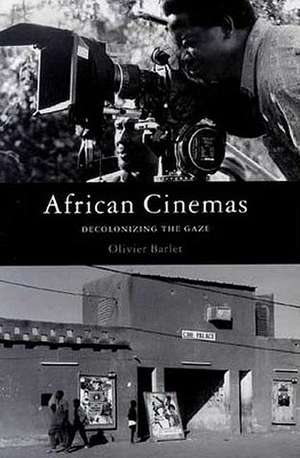
African Cinemas: Decolonizing the Gaze
Autor Olivier Barleten Limba Engleză Paperback – oct 2000
The first part of the book traces the development of African cinema - from colonization to Afrocentrism. The author examines this development through a variety of fundamental themes: the decolonization of the imagination; the quest for legendary African origins and the mobilization of African cultural values. The second part of the book analyses specific films, particularly through narrative and in terms of their African specificity - in the use of silence, orality and humour. Finally, the author explores the social and economic contexts of the African cinema and television industry - including its often vexed relations with the West and the problems of production and distribution African film-makers face.
Exploring the achievements and challenges of those who seek to affirm African cultural values through film, the book also covers the African television industry and African-American cinema. It includes interviews with film-makers, stills from the films and, ultimately, a plea for seeing and respecting the otherness of the Other. Winner of the French National Film Centre's best filmbook of 1997 and now available in four languages, this is book which takes us into a process of learning how to look.
Preț: 266.51 lei
Preț vechi: 311.58 lei
-14%
Puncte Express: 400
Carte tipărită la comandă
Livrare economică 30 noiembrie-14 decembrie
Livrare prin curier în România Termenul estimat este afișat lângă disponibilitate.
Transport gratuit de la 400.00 lei Plată online sau ramburs, în funcție de opțiunile comenzii.
Retur gratuit în 14 zile Comandă securizată și suport în română.
Specificații
ISBN-13: 9781856497435
ISBN-10: 1856497437
Pagini: 328
Dimensiuni: 152 x 230 x 22 mm
Greutate: 0.52 kg
Editura: Bloomsbury Publishing
Colecția Zed Books
Locul publicării:London, United Kingdom
ISBN-10: 1856497437
Pagini: 328
Dimensiuni: 152 x 230 x 22 mm
Greutate: 0.52 kg
Editura: Bloomsbury Publishing
Colecția Zed Books
Locul publicării:London, United Kingdom
V-ar putea interesa
-
 The Film Encyclopedia 7th EditionEphraim KatzPreț: 208.88 lei
 -
 TUTTI insieme!: Part 2: Student's BookLucia D'Angelo-6%Preț: 260.34 lei278.02 lei
 -
 -15%Preț: 474.55 lei558.30 lei
 -
 Visual CultureJessica EvansPreț: 368.91 lei
 -
 Britain's Forgotten Film FactoryEd HarrisPreț: 71.20 lei
 -
 -21%Preț: 73.88 lei93.07 lei
 -
 The Hollywood Studio System: A HistoryDouglas Gomery-25%Preț: 262.97 lei350.75 lei
 -
 Hollywood in the New MillenniumTino Balio-30%Preț: 187.29 lei267.49 lei
 -
 Designing and Building a Miniature Aero-EngineChris TurnerPreț: 134.99 lei
Cuprins
Foreword
Part I: Early Days, First Rites
1. Human Beings, Not Ants
2. Decolonizing the Imagination
3. "Proverbs Were Once People": Referring to the Past
4. Closing One's Eyes
5. Prizing Open the Cracked Identity
6. The Open Gaze
Part II: The Roots of Story-Telling
1. Black Humour
2. Men Die but Words Remain: Narrative and the Oral Tradition
3. If Your Song is Not More Beautiful than the Silence, Then be Quiet
4. Speaking Your Own Language
5. Towards a Critique of Necessity
Part III: A Black Perspective?
1. "If you want honey, you've got to take on the bees": The Difficulties of Film-making
2. The African Public: Diversity Itself
3. Northern Audiences Spinning like a Weathervane
4. "When you have meat to cook, you seek out the one who has a fire": The Logic of Western Aid
5. Televisual Strategies
Conclusion
Part I: Early Days, First Rites
1. Human Beings, Not Ants
2. Decolonizing the Imagination
3. "Proverbs Were Once People": Referring to the Past
4. Closing One's Eyes
5. Prizing Open the Cracked Identity
6. The Open Gaze
Part II: The Roots of Story-Telling
1. Black Humour
2. Men Die but Words Remain: Narrative and the Oral Tradition
3. If Your Song is Not More Beautiful than the Silence, Then be Quiet
4. Speaking Your Own Language
5. Towards a Critique of Necessity
Part III: A Black Perspective?
1. "If you want honey, you've got to take on the bees": The Difficulties of Film-making
2. The African Public: Diversity Itself
3. Northern Audiences Spinning like a Weathervane
4. "When you have meat to cook, you seek out the one who has a fire": The Logic of Western Aid
5. Televisual Strategies
Conclusion
Recenzii
The reader will discover the book's depth and a wealth of information on the varied cinemas of Africa.
This is an excellent book: fresh, graceful, perspicacious, intelligent, current, and always alive with passionate sympathy for its subject... Barlet has impressive powers of synthesis, fashioning an insightful and often elegant thematic argument out of a vast quantity of material... It is hard to do justice to the richness of the book in a brief review... This is very much a book about understanding across cultures and the necessity of multiculturalism ... it is an "invitation au voyage", as Barlet says, and a singularly attractive introduction to African film.
This is an excellent book: fresh, graceful, perspicacious, intelligent, current, and always alive with passionate sympathy for its subject... Barlet has impressive powers of synthesis, fashioning an insightful and often elegant thematic argument out of a vast quantity of material... It is hard to do justice to the richness of the book in a brief review... This is very much a book about understanding across cultures and the necessity of multiculturalism ... it is an "invitation au voyage", as Barlet says, and a singularly attractive introduction to African film.