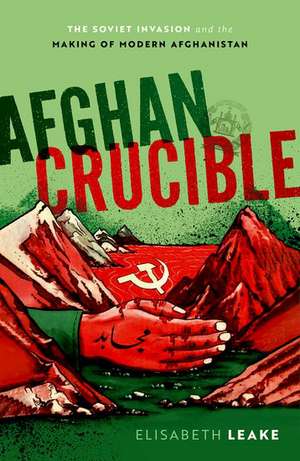
Afghan Crucible: The Soviet Invasion and the Making of Modern Afghanistan
Autor Elisabeth Leakeen Limba Engleză Hardback – 28 apr 2022
Preț: 210.37 lei
Preț vechi: 265.33 lei
-21%
Puncte Express: 316
Carte disponibilă
Livrare economică 12-18 noiembrie
Livrare express 27-31 octombrie pentru 99.97 lei
Livrare prin curier în România Termenul estimat este afișat lângă disponibilitate.
Transport gratuit de la 400.00 lei Plată online sau ramburs, în funcție de opțiunile comenzii.
Retur gratuit în 14 zile Comandă securizată și suport în română.
Specificații
ISBN-13: 9780198846017
ISBN-10: 0198846010
Pagini: 368
Dimensiuni: 162 x 241 x 31 mm
Greutate: 0.59 kg
Editura: OUP OXFORD
Colecția OUP Oxford
Locul publicării:Oxford, United Kingdom
ISBN-10: 0198846010
Pagini: 368
Dimensiuni: 162 x 241 x 31 mm
Greutate: 0.59 kg
Editura: OUP OXFORD
Colecția OUP Oxford
Locul publicării:Oxford, United Kingdom
Recenzii
Leake' intensive research in archives located in Russia, the US, Pakistan, and Europe provides rich materials.
authoritative
a thoughtful and detailed account of Afghanistan's tumultuous history
A compelling read built on Leake's impressive scholarship and mastery of multiple sources - and an important contribution to our understanding not only of Afghanistan, but its effect on the international politics of the late Cold War era.
Leake has produced a meticulous study of the Soviet invasion and the making of modern Afghanistan. It is a detailed work on a very complicated series of events
comprehensively researched
Groundbreaking
This is an expert guide to the forces that continue to roil Afghanistan.
The first book to tell a truly international history of the civil war and Soviet intervention that tore apart Afghanistan. Leake draws out the stories of the political actors who tried to reshape Afghanistan in the twentieth century and shows how their efforts led to a bloody conflict that drew in Cold War superpowers and their allies, with disastrous results still felt today. Beautifully written and drawing on an impressive array of sources, this is a timely and important book.
Afghan Crucible is a classic example of international history - a brilliant account drawing on global sources, covering all the Afghan and non-Afghan participants in Afghan wars of the last fifty years, and doing justice to them all, while preparing readers to understand whatever the rest of the twenty-first century has in store for that benighted country.
Elisabeth Leake provides us with the global historical perspective we need to understand the Soviet invasion of Afghanistan and its legacies.She demonstrates how geopolitical entanglements of the late cold war period, coupled with competing visions of Afghan modernity and post-colonial statehood, are key to understanding the four decades long aftermath of the 1979 moment. Afghan Crucible will be an essential reading in our attempts to write a decolonial modern world history.
Elisabeth Leake has written an excellent book on the origins of the ongoing struggles in and around Afghanistan. While being focused on the Soviet invasion and occupation of Afghanistan, the book puts the story of that country and its people, not the story of the invaders first. In doing that Leake provides not only a new and original interpterion of one of the final battles of the Cold War but also helps us understand the Afghanistan of today.
Afghan Crucible is an important, well-written, and timely book on the Soviet-Afghan War that, while it does not revolutionize our understanding of the conflict through new information, stands out by its novel approach of the subject. It presents a compelling international history of the war, exploring the motivations and policies of the multiple local and international actors involved in this pivotal historical moment.
The book... provides a significant piece of global history, whose importance also for determining the shape of the world today can hardly be overestimated. We must thank Elisabeth Leake for her vivid account, and the manifold insights she provides should indeed be known much more widely as is currently the case.
authoritative
a thoughtful and detailed account of Afghanistan's tumultuous history
A compelling read built on Leake's impressive scholarship and mastery of multiple sources - and an important contribution to our understanding not only of Afghanistan, but its effect on the international politics of the late Cold War era.
Leake has produced a meticulous study of the Soviet invasion and the making of modern Afghanistan. It is a detailed work on a very complicated series of events
comprehensively researched
Groundbreaking
This is an expert guide to the forces that continue to roil Afghanistan.
The first book to tell a truly international history of the civil war and Soviet intervention that tore apart Afghanistan. Leake draws out the stories of the political actors who tried to reshape Afghanistan in the twentieth century and shows how their efforts led to a bloody conflict that drew in Cold War superpowers and their allies, with disastrous results still felt today. Beautifully written and drawing on an impressive array of sources, this is a timely and important book.
Afghan Crucible is a classic example of international history - a brilliant account drawing on global sources, covering all the Afghan and non-Afghan participants in Afghan wars of the last fifty years, and doing justice to them all, while preparing readers to understand whatever the rest of the twenty-first century has in store for that benighted country.
Elisabeth Leake provides us with the global historical perspective we need to understand the Soviet invasion of Afghanistan and its legacies.She demonstrates how geopolitical entanglements of the late cold war period, coupled with competing visions of Afghan modernity and post-colonial statehood, are key to understanding the four decades long aftermath of the 1979 moment. Afghan Crucible will be an essential reading in our attempts to write a decolonial modern world history.
Elisabeth Leake has written an excellent book on the origins of the ongoing struggles in and around Afghanistan. While being focused on the Soviet invasion and occupation of Afghanistan, the book puts the story of that country and its people, not the story of the invaders first. In doing that Leake provides not only a new and original interpterion of one of the final battles of the Cold War but also helps us understand the Afghanistan of today.
Afghan Crucible is an important, well-written, and timely book on the Soviet-Afghan War that, while it does not revolutionize our understanding of the conflict through new information, stands out by its novel approach of the subject. It presents a compelling international history of the war, exploring the motivations and policies of the multiple local and international actors involved in this pivotal historical moment.
The book... provides a significant piece of global history, whose importance also for determining the shape of the world today can hardly be overestimated. We must thank Elisabeth Leake for her vivid account, and the manifold insights she provides should indeed be known much more widely as is currently the case.
Notă biografică
Elisabeth Leake is Lee E. Dirks Chair in Diplomatic History and Associate Professor of History at Fletcher School of Law and Diplomacy. She is the author of The Defiant Border: The Afghan-Pakistan Borderlands in the Era of Decolonization, 1936-65.
Cuprins
- Prologue
- Introduction
- 1: Afghanistan's Many Pasts
- 2: Kabul
- 3: Moscow
- 4: Islamabad
- 5: Peshawar - Panjshir
- 6: Washington
- 7: Nasir Bagh
- 8: Geneva
- 9: Back to Kabul