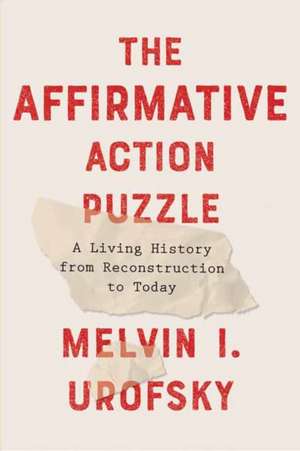
AFFIRMATIVE ACTION PUZZLE
Autor Melvin I. Urofskyen Limba Engleză Hardback – 27 ian 2020
Observăm în AFFIRMATIVE ACTION PUZZLE o radiografie exhaustivă a unuia dintre cele mai complexe mecanisme sociale americane. Autorul Melvin I. Urofsky organizează materialul cronologic și metodologic pentru a evidenția transformarea „acțiunii afirmative” dintr-un imperativ moral într-un labirint juridic și politic. Structura cărții este împărțită în două segmente majore: prima parte analizează geneza și expansiunea politicilor de la Kennedy la Reagan, în timp ce a doua parte explorează perioada de după 1980, marcată de reevaluări judiciare și dezbateri electorale intense. Remarcăm cum Urofsky nu se limitează la mediul academic, ci urmărește progresia conceptului prin prisma sindicatelor, a migrațiilor interne masive și a legislației muncii.
Această lucrare acoperă aceeași arie tematică precum The Pursuit of Fairness de Terry H. Anderson, însă abordarea lui Urofsky este mult mai ancorată în istoria legală și în dinamica precedentelor stabilite de Curtea Supremă. Dacă Anderson oferă o perspectivă echilibrată asupra tensiunilor sociale, Urofsky utilizează experiența sa de istoric al dreptului pentru a diseca mecanismele instituționale care au permis sau au blocat progresul. În contextul operei sale anterioare, precum Supreme Decisions, Combined Volume sau The Bill of Rights in Modern America – Third Edition, Revised and Expanded, acest volum reprezintă o continuare firească a interesului său pentru modul în care marile decizii judiciare modelează viața cotidiană. Apreciem în mod deosebit modul în care autorul integrează „puzzle-ul” acțiunii afirmative în contextul mai larg al istoriei americane, de la GI Bill ca program masiv de sprijin, până la controversele contemporane din epoca Trump.
Preț: 256.44 lei
Carte disponibilă
Livrare economică 09-23 noiembrie
Livrare express 23-29 octombrie pentru 53.42 lei
Specificații
ISBN-10: 1101870877
Pagini: 592
Ilustrații: Black-and-white illustrations throughout
Dimensiuni: 165 x 241 x 40 mm
Greutate: 0.91 kg
Editura: PANTHEON
De ce să citești această carte
Recomandăm această carte oricărui cititor interesat de sociologie, drept constituțional sau istorie politică. Veți câștiga o înțelegere profundă a modului în care egalitatea de șanse a fost negociată la cel mai înalt nivel instituțional. Este o resursă esențială pentru a descifra nu doar trecutul luptei pentru drepturi civile, ci și fundamentele tensiunilor sociale actuale legate de echitate și meritocrație.
Despre autor
Melvin I. Urofsky este profesor emerit de istorie și politici publice la Virginia Commonwealth University. Cu o carieră dedicată studiului sistemului judiciar american, a scris și editat peste treizeci de volume, fiind considerat un expert de referință în biografia juridică și istoria Curții Supreme. Printre lucrările sale notabile se numără biografia definitivă a lui Louis Brandeis și analize critice ale constituționalismului american. Expertiza sa în transformările legale ale secolelor XIX și XX îi conferă autoritatea necesară pentru a naviga subiectul sensibil al acțiunii afirmative cu rigoare academică și claritate narativă.
Descriere scurtă
From acclaimed legal historian, author of a biography of Louis Brandeis ("Remarkable" -Anthony Lewis, The New York Review of Books, "Definitive"-Jeffrey Rosen, The New Republic) and Dissent and the Supreme Court ("Riveting"-Dahlia Lithwick, The New York Times Book Review), a history of affirmative action from its beginning with the Civil Rights Act of 1866 to the first use of the term in 1935 with the enactment of the National Labor Relations Act (the Wagner Act) to 1961 and John F. Kennedy's Executive Order 10925, mandating that federal contractors take "affirmative action" to ensure that there be no discrimination by "race, creed, color, or national origin" down to today's American society.
Melvin Urofsky traces the evolution of affirmative action through labor and the struggle for racial equality, writing of World War I and the exodus that began when some six million African Americans moved northward between 1910 and 1960, one of the greatest internal migrations in the country's history.
The author also writes of World War II, when women replaced men in factories and the issue of equal pay arose, and of Franklin Delano Roosevelt signing into law his last great New Deal measure for returning veterans-the Servicemen's Readjustment Act (the GI Bill), the most massive affirmative action program in American history.
Urofsky tells the story of the struggles of blacks through the 1930s and 1940s, and how the southern states had to live up to the "equal" parts of the "separate but equal" formula. He writes as well about Brown v. Board of Education of Topeka, the passage of the 1964 Civil Rights Act, and the 1965 Voting Rights Act.
He describes how Harry Truman, after becoming president in 1945, fought for Roosevelt's Fair Employment Practice Act and, surprising everyone, appointed a distinguished panel to serve as the President's Commission on Civil Rights, as well as appointing the first black judge on a federal appeals court in 1948 and, by executive order later that year, ordering full racial integration in the armed forces.
We see Dwight Eisenhower sending in one thousand U.S. Army paratroopers and federalizing ten thousand Arkansas national guardsmen to protect black students trying to go to school; John F. Kennedy establishing the President's Committee on Equal Employment Opportunity and naming Lyndon Johnson as its chair, with Kennedy understanding, as did civil rights leaders, that no matter how the government tried to eradicate racial discrimination, the key to progress involved private sector employment with decent paying jobs, which would pull black America out of poverty.
Urofsky explores affirmative action in relation to sex, gender, and education and shows that nearly every public university in the country has at one time or another instituted some form of affirmative action plan-some successful, others not.
In this important, ambitious, far-reaching book, Urofsky writes about the affirmative action cases decided by the Supreme Court: cases that either upheld or struck down particular plans that affected both governmental and private entities. We come to fully understand the societal impact of affirmative action: how and why it has helped, and inflamed, people of all walks of life; how it has evolved; and how, and why, it is still needed.
Notă biografică
Cuprins
PART I: FROM KENNEDY TO REAGAN
1. Affirmative Action Before Kennedy 3
2. Kennedy and Johnson 31
3. Affirmative Action Spreads—and Mutates 57
4. Nixon and the Philadelphia Plan 81
5. Prejudice Persists, Affirmative Action Grows 103
6. Marco DeFunis, Allan Bakke, and Brian Weber 130
7. Changing Academia 157
8. Backlash and Defense 180
9. Blacks and Jews Divide 205
10. Women and Affirmative Action 227
PART II: FROM REAGAN TO TRUMP
11. The Reagan Presidency 245
12. The Court Changes Its Mind 272
13. Mend It, Don’t End It—or Not 298
14. Prop 209 313
15. Affirmative Action and Elections 328
16. Seeking Diversity in Higher Education 346
17. Women and Affirmative Action II 375
18. Other Groups, Here and Abroad 393
19. Bush, Obama, and Fisher 412
20. Yes . . . and No . . . and Trump 436
Acknowledgments 471
Notes 473
Index 545