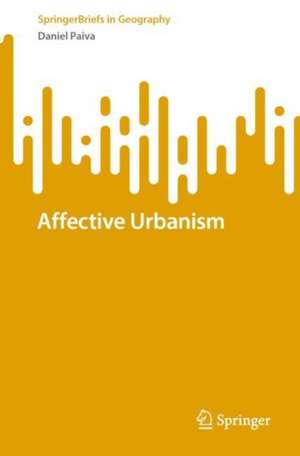
Affective Urbanism: SpringerBriefs in Geography
Autor Daniel Paivaen Limba Engleză Paperback – 9 aug 2024
The book is mainly targeted to researchers, postgraduate students, and practitioners. The topic of affective urbanism is of interest to scholars in urban studies, architecture, geography, anthropology, and sociology.
Din seria SpringerBriefs in Geography
-
 Preț: 382.08 lei
 -
 Preț: 380.73 lei
 -
 Preț: 378.77 lei
 -
 Preț: 337.04 lei
 -
 Preț: 383.79 lei
 -
 Preț: 363.96 lei
 -
 Preț: 380.73 lei
 -
 Preț: 381.83 lei
 -
 Preț: 398.27 lei
 - 15%
 Preț: 472.24 lei
 -
 Preț: 387.93 lei
 -
 Preț: 379.31 lei
 -
 Preț: 363.87 lei
 -
 Preț: 391.31 lei
 -
 Preț: 398.52 lei
 -
 Preț: 365.06 lei
 -
 Preț: 367.72 lei
 -
 Preț: 398.18 lei
 -
 Preț: 380.73 lei
 -
 Preț: 382.37 lei
 -
 Preț: 362.51 lei
 -
 Preț: 379.91 lei
 -
 Preț: 336.82 lei
 -
 Preț: 363.38 lei
 -
 Preț: 384.91 lei
 -
 Preț: 384.58 lei
 -
 Preț: 398.46 lei
 -
 Preț: 367.42 lei
 -
 Preț: 380.30 lei
 -
 Preț: 371.97 lei
 -
 Preț: 376.01 lei
 -
 Preț: 365.31 lei
 -
 Preț: 393.64 lei
 -
 Preț: 379.31 lei
 -
 Preț: 452.45 lei
 -
 Preț: 379.71 lei
 -
 Preț: 381.36 lei
 -
 Preț: 387.00 lei
 -
 Preț: 363.71 lei
 -
 Preț: 174.64 lei
 -
 Preț: 379.78 lei
 -
 Preț: 391.89 lei
 -
 Preț: 378.30 lei
 -
 Preț: 378.30 lei
 -
 Preț: 376.93 lei
 -
 Preț: 366.49 lei
 -
 Preț: 380.04 lei
 -
 Preț: 432.67 lei
 -
 Preț: 460.22 lei
Preț: 347.13 lei
Puncte Express: 521
Carte disponibilă
Livrare economică 16-30 noiembrie
Livrare prin curier în România Termenul estimat este afișat lângă disponibilitate.
Transport gratuit de la 400.00 lei Plată online sau ramburs, în funcție de opțiunile comenzii.
Retur gratuit în 14 zile Comandă securizată și suport în română.
Specificații
ISBN-13: 9783031645068
ISBN-10: 3031645065
Pagini: 116
Ilustrații: XV, 110 p.
Dimensiuni: 155 x 235 x 7 mm
Greutate: 0.2 kg
Ediția:2024
Editura: Springer
Colecția SpringerBriefs in Geography
Seria SpringerBriefs in Geography
Locul publicării:Cham, Switzerland
ISBN-10: 3031645065
Pagini: 116
Ilustrații: XV, 110 p.
Dimensiuni: 155 x 235 x 7 mm
Greutate: 0.2 kg
Ediția:2024
Editura: Springer
Colecția SpringerBriefs in Geography
Seria SpringerBriefs in Geography
Locul publicării:Cham, Switzerland
V-ar putea interesa
-
 Building and DwellingRichard Sennett-18%Preț: 88.89 lei108.04 lei
 -
 Cities Made DifferentlyDavid GraeberPreț: 108.86 lei
 -
 The Image of the CityKevin LynchPreț: 277.67 lei
 -
 Experiencing Architecture, second editionSteen Eiler Rasmussen-19%Preț: 265.22 lei325.62 lei
 -
 Preț: 342.04 lei
 -
 Curating the Commons: Socially Engaged Public ArtKatia ArfaraPreț: 348.08 lei
 -
 A New Index for Public Space: After DistancingTali HatukaPreț: 387.01 lei
 -
 Preț: 387.50 lei
 -
 Comparative Urbanism - Tactics for Global Urban StudiesJennifer RobinsonPreț: 178.51 lei
 -
 Urban GeographyAndrew E. G. JonasPreț: 260.75 lei
 -
 The Homegrown CityMatias EchanovePreț: 152.61 lei
 -
 The City and the WorldGregor HensPreț: 107.93 lei
 -
 Experience SocietyArnar Eggert ThoroddsenPreț: 56.82 lei
 -
 This Must Be the PlaceShain ShapiroPreț: 92.90 lei
 -
 Transversal TerritoryAntoine de PerrotPreț: 221.10 lei
 -
 Flux CitiesGregor H. MewsPreț: 309.59 lei
 -
 New Geographies of Music 2Séverin GuillardPreț: 336.20 lei
Cuprins
Chapter 1. Introduction: affective urbanism and the urban experience.- Chapter 2. The limits of affective urbanism.- Chapter 3. Urban curation and experience co-creation in the city.- Chapter 4. Conclusion: affective urbanism and the right to the city.
Textul de pe ultima copertă
The book poses key questions on the contemporary practices of experience-oriented urbanism from the perspective of the affective turn. Departing from a critique of the imposition of the experience economy on contemporary urbanism, the book seeks alternative narratives and praxis for the co-creation of experiences in the city by looking at how different urban curators play with rhythms, atmospheres, and worlds to improve their communities. In this sense, the book offers practical pathways for urbanists interested in using experience co-creation as a tool for fostering communities and fulfilling the right to the city.
The book is mainly targeted to researchers, postgraduate students, and practitioners. The topic of affective urbanism is of interest to scholars in urban studies, architecture, geography, anthropology, and sociology.
The book is mainly targeted to researchers, postgraduate students, and practitioners. The topic of affective urbanism is of interest to scholars in urban studies, architecture, geography, anthropology, and sociology.
Caracteristici
Provides the first critical overview on affective urbanism Situates affective urbanism within debates on the right to the city Explains the benefits of incorporating the notion of urban curation into affective urbanism