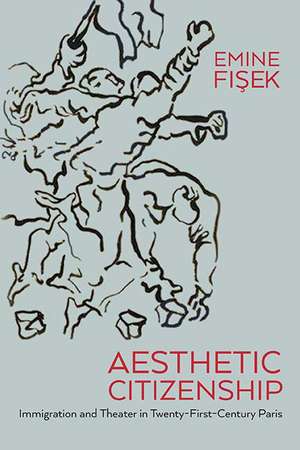
Aesthetic Citizenship: Immigration and Theater in Twenty-First-Century Paris: Performance Works
Autor Emine Fiseken Limba Engleză Hardback – 15 sep 2017
Aesthetic Citizenship is an ethnographic study of the role of theatrical performance in questions regarding immigration, citizenship, and the formation of national identity. Focusing on Paris in the twenty-first century, Emine Fisek analyzes the use of theater by immigrant-rights organizations there and examines the relationship between aesthetic practices and the political personhoods they negotiate.
From neighborhood associations and humanitarian alliances to arts organizations both large and small, Fisek traces how theater has emerged as a practice with the perceived capacity to address questions regarding immigrant rights, integration, and experience. In Aesthetic Citizenship, she explores how the stage, one of France’s most evocative cultural spaces, has come to play a role in contemporary questions about immigration, citizenship and national identity. Yet Fişek’s insightful research also illuminates Paris’s broader historical, political, and cultural through-lines that continue to shape the relationship between theater and migration in France.
By focusing on how French public discourses on immigration are not only rendered meaningful but also inhabited and modified in the context of activist and arts practice, Aesthetic Citizenship seeks to answer the fundamental question: is theater a representational act or can it also be a transformative one?
From neighborhood associations and humanitarian alliances to arts organizations both large and small, Fisek traces how theater has emerged as a practice with the perceived capacity to address questions regarding immigrant rights, integration, and experience. In Aesthetic Citizenship, she explores how the stage, one of France’s most evocative cultural spaces, has come to play a role in contemporary questions about immigration, citizenship and national identity. Yet Fişek’s insightful research also illuminates Paris’s broader historical, political, and cultural through-lines that continue to shape the relationship between theater and migration in France.
By focusing on how French public discourses on immigration are not only rendered meaningful but also inhabited and modified in the context of activist and arts practice, Aesthetic Citizenship seeks to answer the fundamental question: is theater a representational act or can it also be a transformative one?










Preț: 575.77 lei
Preț vechi: 710.82 lei
-19%
Puncte Express: 864
Carte indisponibilă temporar
Doresc să fiu notificat când acest titlu va fi disponibil:
Se trimite...
Specificații
ISBN-13: 9780810135673
ISBN-10: 0810135671
Pagini: 240
Dimensiuni: 152 x 229 mm
Greutate: 0.45 kg
Editura: Northwestern University Press
Colecția Northwestern University Press
Seria Performance Works
ISBN-10: 0810135671
Pagini: 240
Dimensiuni: 152 x 229 mm
Greutate: 0.45 kg
Editura: Northwestern University Press
Colecția Northwestern University Press
Seria Performance Works
Notă biografică
EMINE FISEK is an assistant professor in the Department of Western Languages and Literatures at Bogazici University.
Cuprins
Acknowledgments……………………………………………………………………………3
Dedication…………………………………………………………………………………….8
Introduction…………………………………………………………………………………..9
Chapter One: Al Assifa and La Kahina on the Paris Stage……………………………...54
Chapter Two: Prendre la Parole…………………………………………………………...94
Chapter Three: The Integrated Actor……………………………………………………130
Chapter Four: Re-thinking Community and Culture…………………………………..170
Chapter Five: Theater without Borders? ………………………………………………..208
Conclusion………………………………………………………………………………….250
Bibliography……………………………………………………………………………….256
Notes………………………………………………………………………………………..279
Dedication…………………………………………………………………………………….8
Introduction…………………………………………………………………………………..9
Chapter One: Al Assifa and La Kahina on the Paris Stage……………………………...54
Chapter Two: Prendre la Parole…………………………………………………………...94
Chapter Three: The Integrated Actor……………………………………………………130
Chapter Four: Re-thinking Community and Culture…………………………………..170
Chapter Five: Theater without Borders? ………………………………………………..208
Conclusion………………………………………………………………………………….250
Bibliography……………………………………………………………………………….256
Notes………………………………………………………………………………………..279
Recenzii
"Emine Fisek’s compelling and timely book is an invaluable addition to contemporary theatre studies and to all study of the relationship between cultural production and the shifting discourses of immigration in contemporary France." —French Studies
"[I]n the end, [Aesthetic Citizenship] is not so much about the immigrant experience in France as about French perceptions of it. Fişek has found an apt way to give us an intimate and nuanced view into the French national psyche with its conflicted views of immigration." —Modern Drama
"Emine Fişek's timely and compelling study examines immigrant theater activism in France as a dynamic point of friction between French republican ideals and the embodied performance of citizenship in public life... The book is an exemplary study of theater and politics that draws productively on points of convergence in a wide range of recent scholarship (especially in anthropology and performance studies) to glean insights about the stakes underlying the aesthetic dimension of political belonging in contemporary France." —MLN
"Thanks to the acute and careful analysis of theater practitioners and the book’s generous contextualizations, Fisek’s study will appeal to scholars and practitioners from a wide community of disciplines, including: French theater studies, applied theater and performance studies, community-based theater practice, migration studies, history, politics, human rights, postcolonial studies, gender studies, and activist arts." —Clare Finburgh, coeditor of Contemporary French Theatre and Performance and author of Jean Genet
"Fişek accomplishes a difficult task: she offers new insights to French and Francophone theatre specialists and renders the historical nuances of French political discourse (particularly republican universalism) accessible to students and scholars in other sub-fields. She respects the peculiarity of her chosen case studies and convincingly demonstrates their relevance to broader debates. In such ways, the book will be valuable to anyone interested in theatre and citizenship, theatre and migration, intercultural theatre, community arts, performance and humanitarianism, and documentary theatre and witnessing. Fişek has made an important contribution to the literature on aesthetics and politics." —New Theatre Quarterly
"[I]n the end, [Aesthetic Citizenship] is not so much about the immigrant experience in France as about French perceptions of it. Fişek has found an apt way to give us an intimate and nuanced view into the French national psyche with its conflicted views of immigration." —Modern Drama
"Emine Fişek's timely and compelling study examines immigrant theater activism in France as a dynamic point of friction between French republican ideals and the embodied performance of citizenship in public life... The book is an exemplary study of theater and politics that draws productively on points of convergence in a wide range of recent scholarship (especially in anthropology and performance studies) to glean insights about the stakes underlying the aesthetic dimension of political belonging in contemporary France." —MLN
"Thanks to the acute and careful analysis of theater practitioners and the book’s generous contextualizations, Fisek’s study will appeal to scholars and practitioners from a wide community of disciplines, including: French theater studies, applied theater and performance studies, community-based theater practice, migration studies, history, politics, human rights, postcolonial studies, gender studies, and activist arts." —Clare Finburgh, coeditor of Contemporary French Theatre and Performance and author of Jean Genet
"Fişek accomplishes a difficult task: she offers new insights to French and Francophone theatre specialists and renders the historical nuances of French political discourse (particularly republican universalism) accessible to students and scholars in other sub-fields. She respects the peculiarity of her chosen case studies and convincingly demonstrates their relevance to broader debates. In such ways, the book will be valuable to anyone interested in theatre and citizenship, theatre and migration, intercultural theatre, community arts, performance and humanitarianism, and documentary theatre and witnessing. Fişek has made an important contribution to the literature on aesthetics and politics." —New Theatre Quarterly
"Without sacrificing an exquisite attention to nuance, Aesthetic Citizenship persuasively argues its case, recasting categories like 'national participation, belonging, and citizenship' as 'spheres of experience that require rehearsal.' The book's fine-tuned analysis, enhanced by an impressively interdisciplinary frame of reference, will attract a wide range of scholars interested in theatre and performance, contemporary French and Francophone culture, gender, community-based theatre activism, and migration studies." —L'Esprit Créateur
"Interweaving archival, theoretical, and socio-political sources, Fişek's ethnographic, dialogic, and self-reflective approach calls to mind Dwight Conquergood's ideal ethnography of the 'ears and heart' as a 'co-performative witnessing.' —Theatre Journal
"An essential resource that archives theater practices in France that have not been properly documented to date, Aesthetic Citizenship also makes a fresh and original argument about the complexities of the relationship of theater practice, immigration, and cultural policy in France. It’s the best thing I have read in many years on the complexities of interculturalism." —Mary Noonan, author of Echo's Voice: The Theatres of Sarraute, Duras, Cixous and Renaude and The Fado House
"Interweaving archival, theoretical, and socio-political sources, Fişek's ethnographic, dialogic, and self-reflective approach calls to mind Dwight Conquergood's ideal ethnography of the 'ears and heart' as a 'co-performative witnessing.' —Theatre Journal
"An essential resource that archives theater practices in France that have not been properly documented to date, Aesthetic Citizenship also makes a fresh and original argument about the complexities of the relationship of theater practice, immigration, and cultural policy in France. It’s the best thing I have read in many years on the complexities of interculturalism." —Mary Noonan, author of Echo's Voice: The Theatres of Sarraute, Duras, Cixous and Renaude and The Fado House
"From communautarisme and intégration, Aesthetic Citizenship underscores the fraught tensions between universality and particularity that trouble both French politics and immigrant theater—as well as our own field of dance studies—addressing the modes in which individuals must simultaneously enact themselves and the collective on stage. Fişek expertly negotiates the complicated role of the stage as both representative and constitutive, to heighten our understanding of the actors' role in integration." —Dance Research Journal
"Aesthetic Citizenship is a provocative, passionately argued account of how social belonging is negotiated in and through theatre's creative processes. Part intimate ethnography, part political exposé, this book is not afraid to explore the biases and contradictions of national republicanism in France as they play out on the ground among migrants, asylum seekers and advocacy organizations. Each richly detailed chapter traces complex human investments in bridging or transforming the gaps between what democracy promises and what it seems to deliver. Across the whole, Emine Fisek offers new and nuanced ways of thinking broadly about citizenship as a powerfully performative act.” —Helen Gilbert, author of Performance and Cosmopolitics: Cross-Cultural Transactions in Australasia
Descriere
Aesthetic Citizenship: Immigration, Theater, and Embodiment in Twenty-First Century Paris is an ethnographic study of the use of theater by Parisian organizations involved in immigration, examining theater’s capacity to address questions about immigrant rights, integration, and experience.