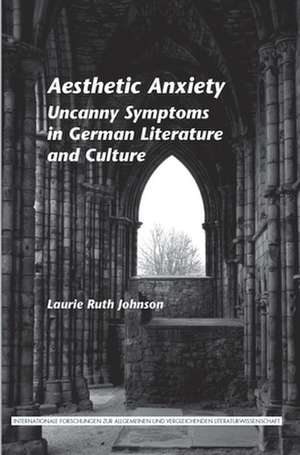
Aesthetic Anxiety: Aesthetic Anxiety, cartea 141
Autor Laurie Ruth Johnsonen Limba Engleză Paperback – 2010
Preț: 612.81 lei
Preț vechi: 688.56 lei
-11%
Puncte Express: 919
Carte tipărită la comandă
Livrare economică 06-20 octombrie
Livrare prin curier în România Termenul estimat este afișat lângă disponibilitate.
Transport gratuit pentru acest produs Plată online sau ramburs, în funcție de opțiunile comenzii.
Retur gratuit în 14 zile Comandă securizată și suport în română.
Specificații
ISBN-13: 9789042031135
ISBN-10: 9042031131
Pagini: 268
Dimensiuni: 146 x 213 x 22 mm
Greutate: 0.38 kg
Editura: Koninklijke Brill Bv
Colecția Aesthetic Anxiety
Seriile Aesthetic Anxiety, Brill
ISBN-10: 9042031131
Pagini: 268
Dimensiuni: 146 x 213 x 22 mm
Greutate: 0.38 kg
Editura: Koninklijke Brill Bv
Colecția Aesthetic Anxiety
Seriile Aesthetic Anxiety, Brill
V-ar putea interesa
-
 Sunday Morning at the Centre of the WorlLouis De BernièresPreț: 87.00 lei
 -
 How To Travel With A SalmonUmberto Eco-32%Preț: 61.63 lei90.66 lei
 -
 The Complete PlaysChristopher Marlowe-16%Preț: 79.53 lei95.03 lei
 -
 The Day RoomDon DeLillo-25%Preț: 44.97 lei60.33 lei
 -
 Tramp in FlamesPaul Farley-37%Preț: 42.48 lei67.27 lei
 -
 Mastering International TradeChris MarshallPreț: 237.96 lei
 -
 Accidental Death of an AnarchistDario Fo-34%Preț: 54.19 lei82.20 lei
 -
 The Field of DramaMartin Esslin-12%Preț: 162.81 lei184.16 lei
 -
 Woman Alone' & Other PlaysDario FoPreț: 87.61 lei
 -
 Blood BrothersJim Mulligan-19%Preț: 74.21 lei91.34 lei
 -
 -16%Preț: 155.03 lei185.18 lei
 -
 ProofDavid AuburnPreț: 85.50 lei
 -
 Samuel Taylor ColeridgeSamuel Taylor ColeridgePreț: 68.62 lei
Notă biografică
Laurie Johnson is Associate Professor of German, Comparative Literature, and in the Unit for Criticism and Interpretive Theory at the University of Illinois at Urbana-Champaign. She published The Art of Recollection in Jena Romanticism: Memory, History, Fiction, and Fragmentation in Texts by Friedrich Schlegel and Novalis with Max Niemeyer Verlag in 2002. Johnson has published articles on Friedrich Schlegel and the practice of animal magnetism, psychosomata in Romantic psychology and literature, and Early Romantic philosophy and aesthetics.
Recenzii
"Laurie Johnson offers an imaginatively conceived alternative critique of modernity that reveals how the drive for the new and fast-paced engenders the counter-desire for the return of the familiar. Expertly synthesizing German literary works from Romanticism to the early twentieth century, film analyses, and texts of early empirical psychology and psychiatry, Aesthetic Anxiety offers a model of interdisciplinary work at its best and highlights the debt modern cultural studies owes German literature and culture." – Azade Seyhan, Bryn Mawr College
"With her focus on the aesthetics of fear and violence that lurks behind the facades of the beautiful and sublime, Laurie Johnson takes the reader on a voyeuristic as well as heuristic journey through the long 19th century. Long before Hartmann’s “Philosophy of the Unconscious” (1869) and Jentsch’s “On the Psychology of the Uncanny” (1906) prompted Freud’s famous reply of 1919, the uncanny fascinated writers. Johnson argues for the mutually sustaining reciprocity of irrationality and rationality, advancing her revisionist ideas in an energetically interdisciplinary fashion. Yet she remains firmly grounded in the aesthetics of literary expression. She admirably succeeds in causing us to think about the uncanny beyond the established paradigm of the dialectic of Enlightenment. The reader will find this tour de force both animating and enlightening." – John A. McCarthy, Vanderbilt University
"With her focus on the aesthetics of fear and violence that lurks behind the facades of the beautiful and sublime, Laurie Johnson takes the reader on a voyeuristic as well as heuristic journey through the long 19th century. Long before Hartmann’s “Philosophy of the Unconscious” (1869) and Jentsch’s “On the Psychology of the Uncanny” (1906) prompted Freud’s famous reply of 1919, the uncanny fascinated writers. Johnson argues for the mutually sustaining reciprocity of irrationality and rationality, advancing her revisionist ideas in an energetically interdisciplinary fashion. Yet she remains firmly grounded in the aesthetics of literary expression. She admirably succeeds in causing us to think about the uncanny beyond the established paradigm of the dialectic of Enlightenment. The reader will find this tour de force both animating and enlightening." – John A. McCarthy, Vanderbilt University
Cuprins
Preface
Aesthetic Anxiety and the Uncanny
The Uncanny Before Freud: Psychological and Philosophical Aspects
Beautiful Breakdowns: Uncanny Symptoms and the Aestheticization of Illness
Conspiracy Theories: The Melancholy and Manipulated Male Subject
Too Much Memory: Uncanny Love
Conclusion: Childish Anxiety, Wish, Belief
Bibliography
Aesthetic Anxiety and the Uncanny
The Uncanny Before Freud: Psychological and Philosophical Aspects
Beautiful Breakdowns: Uncanny Symptoms and the Aestheticization of Illness
Conspiracy Theories: The Melancholy and Manipulated Male Subject
Too Much Memory: Uncanny Love
Conclusion: Childish Anxiety, Wish, Belief
Bibliography