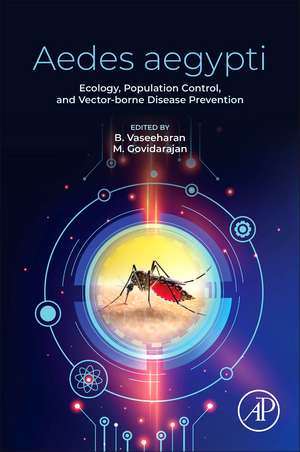
Aedes Aegypti: Ecology, Population Control, and Vector-borne Disease Prevention
Editat de B. Vaseeharan, M. Govindarajanen Limba Engleză Paperback – 28 iul 2025
In addition to extensively discussing the mosquito’s role as a vector, the book emphasizes cutting-edge population control strategies, including genetic modifications, microbial interventions, and community-based efforts. It also addresses the global scale of vector-borne diseases, providing actionable insights into prevention methods, surveillance systems, and the urgent need for interdisciplinary collaboration.
- Covers the aedes aegypti mosquito, including its lifecycle, biology, and competence as a vector for diseases such as Zika virus and Dengue fever
- Outlines strategies for population control to prevent vector-borne illnesses, along with potential challenges in control methods
- Offers the latest, state-of-the-art information to entomologists, ecologists, and biologists working at research facilities and government agencies
Preț: 890.63 lei
Preț vechi: 1211.72 lei
-26%
Puncte Express: 1336
Carte tipărită la comandă
Livrare economică 26 noiembrie-10 decembrie
Livrare prin curier în România Termenul estimat este afișat lângă disponibilitate.
Transport gratuit pentru acest produs Plată online sau ramburs, în funcție de opțiunile comenzii.
Retur gratuit în 14 zile Comandă securizată și suport în română.
Specificații
ISBN-13: 9780443214615
ISBN-10: 0443214611
Pagini: 236
Dimensiuni: 191 x 235 mm
Greutate: 0.48 kg
Editura: ELSEVIER SCIENCE
ISBN-10: 0443214611
Pagini: 236
Dimensiuni: 191 x 235 mm
Greutate: 0.48 kg
Editura: ELSEVIER SCIENCE
Cuprins
I. An Introduction to Mosquitos: Aedes aegypti
1. Epidemiological impact of Aedes aegypti
2. Behavior and Ecology of Aedes mosquitos
3. Microbiota and vector competence of Aedes mosquitos
II. Aedes aegypti: Mechanisms of Action in Vector-borne diseases
4. Dengue Virus and Aedes aegypti
5. Yellow Fever Virus and Aedes aegypti
6. Chikungunya, Zika virus and Aedes aegypti
III. Control Measures of Aedes aegypti
7. Chemical interventions and approaches and non-chemical larviciding: species of larvivorous fish used
8. Habitat Management: Existing endemicity
9. Microbial Secondary Metabolites in the Control of Aedes aegypti
IV. Advanced Control Strategies
10. Nano drug delivery approaches in the control of Aedes aegypti
11. Electrochemical biosensing for mosquito control
12. Machine learning techniques in the control of Aedes aegypti
V. Challenges in mosquito control
13. Development of Insecticide-resistant mosquitos and impact of environmental changes on ecological traits of mosquitos
14. Lack of insights into mosquito dispersal and mating behavior
15. Future Directions of Research and Surveillance for the Control of Aedes aegypti
1. Epidemiological impact of Aedes aegypti
2. Behavior and Ecology of Aedes mosquitos
3. Microbiota and vector competence of Aedes mosquitos
II. Aedes aegypti: Mechanisms of Action in Vector-borne diseases
4. Dengue Virus and Aedes aegypti
5. Yellow Fever Virus and Aedes aegypti
6. Chikungunya, Zika virus and Aedes aegypti
III. Control Measures of Aedes aegypti
7. Chemical interventions and approaches and non-chemical larviciding: species of larvivorous fish used
8. Habitat Management: Existing endemicity
9. Microbial Secondary Metabolites in the Control of Aedes aegypti
IV. Advanced Control Strategies
10. Nano drug delivery approaches in the control of Aedes aegypti
11. Electrochemical biosensing for mosquito control
12. Machine learning techniques in the control of Aedes aegypti
V. Challenges in mosquito control
13. Development of Insecticide-resistant mosquitos and impact of environmental changes on ecological traits of mosquitos
14. Lack of insights into mosquito dispersal and mating behavior
15. Future Directions of Research and Surveillance for the Control of Aedes aegypti