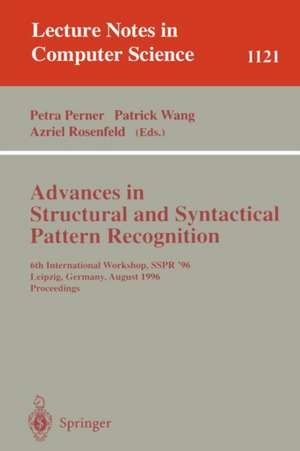
Advances in Structural and Syntactical Pattern Recognition
Editat de Petra Perner, Patrick Wang, Azriel Rosenfelden Limba Engleză Paperback – 7 aug 1996
The 36 revised full papers included together with three invited papers were carefully selected from a total of 52 submissions. The papers are organized in topical sections on grammars and languages; morphology and mathematical approaches to pattern recognition; semantic nets, relational models and graph-based methods; 2D and 3D shape recognition; document image analysis and recognition; and handwritten and printed character recognition.
Preț: 327.92 lei
Preț vechi: 409.89 lei
-20%
Puncte Express: 492
Carte tipărită la comandă
Livrare economică 27 noiembrie-11 decembrie
Livrare prin curier în România Termenul estimat este afișat lângă disponibilitate.
Transport gratuit de la 400.00 lei Plată online sau ramburs, în funcție de opțiunile comenzii.
Retur gratuit în 14 zile Comandă securizată și suport în română.
Specificații
ISBN-13: 9783540615774
ISBN-10: 3540615776
Pagini: 412
Ilustrații: X, 426 p.
Dimensiuni: 155 x 235 x 23 mm
Greutate: 0.62 kg
Ediția:1996
Editura: Springer
Locul publicării:Berlin, Heidelberg, Germany
ISBN-10: 3540615776
Pagini: 412
Ilustrații: X, 426 p.
Dimensiuni: 155 x 235 x 23 mm
Greutate: 0.62 kg
Ediția:1996
Editura: Springer
Locul publicării:Berlin, Heidelberg, Germany
V-ar putea interesa
-
 -20%Preț: 647.51 lei809.39 lei
 -
 Machine Learning for Audio, Image and Video AnalysisFrancesco Camastra-20%Preț: 631.58 lei789.48 lei
 -
 Digital FingerprintingCliff Wang-20%Preț: 722.41 lei903.01 lei
 -
 Digital Geometry: Geometric Methods for Digital Picture AnalysisReinhard Klette-29%Preț: 489.40 lei694.05 lei
 -
 Pattern Recognition and Image AnalysisRoberto Paredes-20%Preț: 360.15 lei450.18 lei
 -
 Hybrid Artificial Intelligent SystemsEnrique Onieva-20%Preț: 345.71 lei432.13 lei
 -
 Combinatorial Pattern MatchingFerdinando Cicalese-20%Preț: 328.93 lei411.16 lei
 -
 Computational ForensicsUtpal Garain-20%Preț: 330.98 lei413.72 lei
 -
 Computer Vision SystemsLazaros Nalpantidis-20%Preț: 335.48 lei419.35 lei
 -
 -20%Preț: 257.61 lei322.01 lei
 -
 Belief Functions: Theory and ApplicationsJi¿ina Vejnarová-20%Preț: 343.01 lei428.76 lei
 -
 String Processing and Information RetrievalShunsuke Inenaga-20%Preț: 334.59 lei418.24 lei
 -
 Machine Learning and Knowledge Discovery in DatabasesPaolo Frasconi-20%Preț: 678.57 lei848.21 lei
 -
 Artificial Neural Networks in Pattern RecognitionFriedhelm Schwenker-20%Preț: 461.76 lei577.20 lei
 -
 Algorithmic Learning TheoryRonald Ortner-20%Preț: 339.95 lei424.94 lei
 -
 Nature of Computation and CommunicationPhan Cong Vinh-20%Preț: 329.48 lei411.85 lei
 -
 Patch-Based Techniques in Medical ImagingGuorong Wu-20%Preț: 327.16 lei408.95 lei
 -
 -20%Preț: 324.22 lei405.27 lei
 -
 Latent Variable Analysis and Signal SeparationPetr Tichavský-20%Preț: 361.01 lei451.26 lei
 -
 Pattern Recognition and Information ProcessingViktor V. Krasnoproshin-20%Preț: 320.58 lei400.72 lei
 -
 Reproducible Research in Pattern RecognitionBertrand Kerautret-20%Preț: 316.62 lei395.77 lei
 -
 Guide to Convolutional Neural NetworksHamed Habibi Aghdam-20%Preț: 519.95 lei649.94 lei
 -
 -20%Preț: 309.93 lei387.41 lei
 -
 Graph-Grammars and Their Application to Computer ScienceHartmut Ehrig-15%Preț: 660.97 lei777.61 lei
 -
 Fuzzy Group TheoryJohn N. Mordeson-20%Preț: 955.94 lei1194.93 lei
 -
 Preț: 369.55 lei
 -
 -20%Preț: 329.51 lei411.90 lei
 -
 Transactions on Rough Sets XIXJames F. Peters-20%Preț: 326.26 lei407.83 lei
 -
 Digital Image Processing and AnalysisJ. C. Simon-20%Preț: 330.85 lei413.56 lei
Public țintă
ResearchCuprins
Efficient recognition of a class of context-sensitive languages described by Augmented Regular Expressions.- Optimal and information theoretic syntactic pattern recognition for traditional errors.- The morphic generator grammatical inference methodology and multilayer perceptrons: A hybrid approach to acoustic modeling.- Two different approaches for cost-efficient Viterbi parsing with error correction.- Bounded parallelism in array grammars used for character recognition.- Comparison between the Inside-Outside algorithm and the Viterbi algorithm for stochastic context-free grammars.- Generalized morphological operators applied to map-analysis.- Derivatives in scale space.- On skeletonization in 4D images.- Extended Cascade-Correlation for syntactic and structural pattern recognition.- A metric of planar self-similar forms.- Including geometry in graph representations: A quadratic-time graph isomorphism algorithm and its applications.- Hierarchical discrete relaxation.- Relational indexing.- An evidential merit function to guide search in a semantic network based image analysis system.- Inexact graph matching with genetic search.- Automatic recognition of bidimensional models learned by grammatical inference in outdoor scenes.- Signal decomposition with multiscale learning algorithms.- Structural learning of character patterns for on-line recognition of handwritten Japanese characters.- Recognition of hand-printed characters using induct machine learning.- Opponent color processing based on neural models.- Knowledge acquisition by symbolic decision tree induction for interpretation of digital images in radiology.- Invariants and fixed structures lead the way to change.- Representing shape by line patterns.- Recognition of 3D objects from 2D images — Some issues.- Surface skeletonization of volume objects.- Peculiarities of structural analysis of image contours under various orders of scanning.- A structural analysis of curve deformation by discontinuous transformations.- Three dimensional computer vision for computer aided design and manufacturing applications.- Using weighted minutiae for fingerprint identification.- Recognizing 2-D rigid and non-rigid wire-shapes.- Structural and syntactic methods in line drawing analysis: To which extent do they work?.- Vector-based segmentation of text connected to graphics in engineering drawings.- Automatic resolution of object features from engineering drawings for 3D reconstruction.- The feedback approach to cartographic areal text placement.- A hierarchical representation for the reference database of on-line Chinese character recognition.- Substructure shape analysis for Kanji character recognition.- Recognition of hand-printed Chinese characters using Ripple Down Rules.- A fuzzy syntactic method for on-line handwriting recognition.