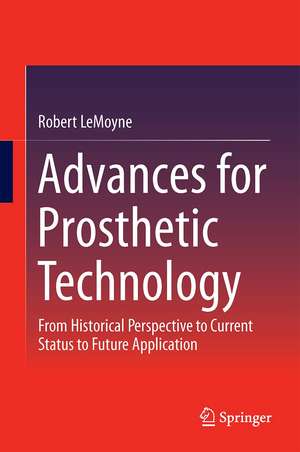
Advances for Prosthetic Technology: From Historical Perspective to Current Status to Future Application
Autor Robert LeMoyneen Limba Engleză Hardback – 25 mar 2016
Adresat cercetătorilor în inginerie biomedicală, medicilor rezidenți în reabilitare și specialiștilor în biomecanică, Advances for Prosthetic Technology reprezintă o sinteză clinică a evoluției sistemelor de protezare a membrelor inferioare. Observăm o tranziție riguroasă de la perspectiva istorică a dispozitivelor pasive către complexitatea sistemelor robotice contemporane. Robert LeMoyne ancorează discuția în fundamentele biomecanicii mersului, explicând cum asimetria și mecanismele compensatorii în protezarea transtibială pot conduce la morbidități secundare, un aspect crucial pentru managementul clinic pe termen lung.
Structura volumului reflectă o progresie logică, pornind de la etiologia amputațiilor și terminând cu arhitectura sistemelor motorizate. Merită menționat modul în care autorul detaliază subsistemele tehnice — actuatoare, senzori și control — oferind o privire detaliată asupra tehnologiei BiOM, derivată din cercetările de la MIT. Această focalizare pe integrarea hardware-ului cu algoritmi de machine learning diferențiază lucrarea de abordările pur teoretice. Acolo unde Biomechanics of Lower Limb Prosthetics acoperă principiile fundamentale ale fizicii aplicate în protetică, volumul de față aprofundează implementarea tehnologică a sistemelor active și tranziția către bionică.
În contextul operei sale, această carte continuă preocuparea autorului pentru monitorizarea digitală a sănătății, temă explorată și în Wearable and Wireless Systems for Healthcare I. Dacă în lucrările anterioare Robert LeMoyne s-a concentrat pe cuantificarea reflexelor și a tulburărilor de mișcare prin senzori wireless, aici aplică aceleași principii de precizie în designul și evaluarea protezelor motorizate, transformând datele de cercetare în soluții aplicabile pentru mobilitatea umană.
Preț: 688.44 lei
Preț vechi: 724.67 lei
-5%
Carte disponibilă
Livrare economică 19 octombrie-02 noiembrie
Specificații
ISBN-10: 4431558144
Pagini: 150
Ilustrații: XII, 135 p.
Dimensiuni: 155 x 235 x 12 mm
Greutate: 0.43 kg
Ediția:1st ed. 2016
Editura: Springer
Colecția Springer
Locul publicării:Tokyo, Japan
V-ar putea interesa
-
 Orthotics and Prosthetics in RehabilitationKevin K. Chui-5%Preț: 1009.25 lei1062.36 lei
 -
 -5%Preț: 685.26 lei721.32 lei
 -
 Robotics in Physical Medicine and RehabilitationDouglas P. Murphy-29%Preț: 835.73 lei1183.69 lei
 -
 -28%Preț: 453.96 lei631.01 lei
 -
 Orthotics and Prosthetics in RehabilitationKevin K. Chui-5%Preț: 766.69 lei807.04 lei
 -
 Atlas of Abdominal Wall ReconstructionMichael J. Rosen-29%Preț: 1445.33 lei2022.42 leiRecomandat
 -
 Atlas of Orthoses and Assistive DevicesDouglas P. Murphy-28%Preț: 1141.83 lei1590.55 leiRecomandat
 -
 Sabiston Textbook of Surgery: The Biological Basis of Modern Surgical PracticeDouglas Scott Tyler-30%Preț: 1141.19 lei1622.63 leiRecomandat
 -
 -9%Preț: 832.11 lei914.41 lei
 -
 Whittle's Gait AnalysisJim Richards-31%Preț: 320.69 lei461.45 lei
 -
 Prosthetics and Orthotics for Physical TherapistsM. Jason Highsmith-5%Preț: 537.71 lei566.01 lei
 -
 -5%Preț: 378.62 lei398.55 leiRecomandat
 -
 Human 2.0Patrick KanePreț: 79.61 lei
 -
 Replaceable YouMary Roach-5%Preț: 106.62 lei112.23 lei
 -
 Operative Techniques in Foot and Ankle SurgeryMark E. Easley MD-21%Preț: 1988.17 lei2514.53 lei
 -
 Atlas of Amputations and Limb Deficiencies 5: Surgical, Prosthetic, and Rehabilitation PrinciplesJoseph Ivan Krajbich MD, FRCS(C)-22%Preț: 2259.21 lei2897.53 lei
 -
 -18%Preț: 960.64 lei1171.51 lei
 -
 Walking Robots into Real WorldKarsten Berns-18%Preț: 1177.33 lei1435.77 lei
 -
 Partial Knee ArthroplastyJean-Noël A. Argenson-5%Preț: 634.19 lei667.57 lei
 -
 Advanced Techniques in Limb Reconstruction SurgeryMehmet Kocao¿lu-5%Preț: 1031.94 lei1086.26 lei
Public țintă
ResearchDe ce să citești această carte
Această lucrare este esențială pentru inginerii și clinicienii care doresc să înțeleagă saltul de la protezele elastice pasive la cele robotice. Cititorul câștigă o perspectivă tehnică asupra modului în care machine learning și sistemele de control de la MIT au revoluționat mobilitatea persoanelor cu amputații transtibiale. Este un ghid concis care leagă chirurgia de vârf cu ingineria de ultimă generație.