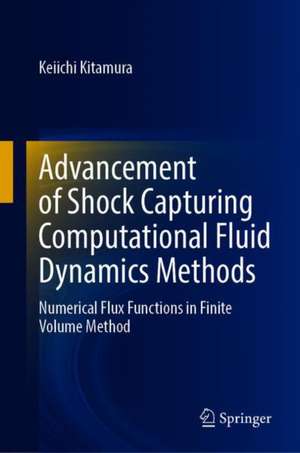
Advancement of Shock Capturing Computational Fluid Dynamics Methods
Autor Keiichi Kitamuraen Limba Engleză Hardback – noi 2020
The first two chapters of the book reviews finite volume methods and numerical functions, before discussing issues commonly encountered in connection with each. The third and fourth chapter, respectively, address numerical flux functions for ideal gases and more complex fluid flow cases— multiphase flows, supercritical fluids and magnetohydrodynamics. In closing, the book highlights methods that provide high levels of accuracy.
The concise content provides an overview of recent advances in CFD methods for shockwaves. Further, it presents the author’s insights into the advantages and disadvantages of each method, helping readers implement the numerical methods in their own research.
Preț: 700.53 lei
Preț vechi: 854.31 lei
-18%
Puncte Express: 1051
Carte tipărită la comandă
Livrare economică 30 mai-13 iunie
Specificații
ISBN-13: 9789811590108
ISBN-10: 9811590109
Pagini: 148
Ilustrații: XI, 136 p. 52 illus., 13 illus. in color.
Dimensiuni: 160 x 241 x 14 mm
Greutate: 0.4 kg
Ediția:1st ed. 2020
Editura: Springer
Locul publicării:Singapore, Singapore
ISBN-10: 9811590109
Pagini: 148
Ilustrații: XI, 136 p. 52 illus., 13 illus. in color.
Dimensiuni: 160 x 241 x 14 mm
Greutate: 0.4 kg
Ediția:1st ed. 2020
Editura: Springer
Locul publicării:Singapore, Singapore
Cuprins
Introduction: Brief Review of Finite Volume Method (FVM) in Computational Fluid Dynamics.- Role and History of Numerical Flux Functions.- Numerical Flux Functions for Ideal Gases.- Numerical Flux Functions Extended to Real Fluids.- Reconstruction and Slope Limiters.
Notă biografică
Keiichi Kitamura is an Associate Professor at Yokohama National University. His work focuses on developing numerical methods in computational fluid dynamics for high-speed, low-speed, and multiphase/supercritical/MHD flows, and he has proposed numerical flux functions, e.g., SLAU2 and Post Limiter.
He received his doctor of engineering from Nagoya University in 2008. After serving as a postdoctoral researcher at JAXA and Glenn Research Center, NASA, he was appointed an Assistant Professor at Nagoya University in 2012. Since 2014, he has served in his current position. He was honored with young researcher awards by the Japan Society for Aeronautical and Space Sciences in 2012, by the Society for Promotion of Space Science in 2018, and by the Japan Society of Fluid Mechanics in 2018. He was also awarded the Commendation for Science and Technology by the Minister of Education, Culture, Sports, Science and Technology (The Young Scientist’s Prize) in Japan, andthe Frontier Commendation from Fluids Engineering Division, The Japan Society of Mechanical Engineers, both in 2019.
Textul de pe ultima copertă
This book offers a compact primer on advanced numerical flux functions in computational fluid dynamics (CFD). It comprehensively introduces readers to methods used at the forefront of compressible flow simulation research. Further, it provides a comparative evaluation of the methods discussed, helping readers select the best numerical flux function for their specific needs. The first two chapters of the book reviews finite volume methods and numerical functions, before discussing issues commonly encountered in connection with each. The third and fourth chapter, respectively, address numerical flux functions for ideal gases and more complex fluid flow cases— multiphase flows, supercritical fluids and magnetohydrodynamics. In closing, the book highlights methods that provide high levels of accuracy.
The concise content provides an overview of recent advances in CFD methods for shockwaves. Further, it presents the author’s insights into the advantages and disadvantages of each method, helping readers implement the numerical methods in their own research.
The concise content provides an overview of recent advances in CFD methods for shockwaves. Further, it presents the author’s insights into the advantages and disadvantages of each method, helping readers implement the numerical methods in their own research.
Caracteristici
Offers a concise guide to advanced computational fluid dynamics Covers methods and principles that are essential to computing shockwaves Compares major methods, weighing their advantages and disadvantages