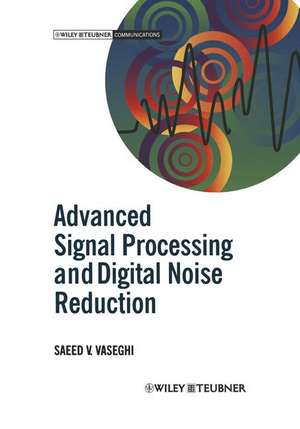
Advanced Signal Processing and Digital Noise Reduction
Autor Saeed V. Vaseghide Limba Germană Paperback – 31 mai 2012
Preț: 478.93 lei
Puncte Express: 718
Carte tipărită la comandă
Livrare economică 17 septembrie-01 octombrie
Livrare prin curier în România Termenul estimat este afișat lângă disponibilitate.
Transport gratuit pentru acest produs Plată online sau ramburs, în funcție de opțiunile comenzii.
Retur gratuit în 14 zile Comandă securizată și suport în română.
Specificații
ISBN-13: 9783322927743
ISBN-10: 3322927741
Pagini: 416
Ilustrații: XIII, 397 S. 42 Abb.
Dimensiuni: 170 x 244 x 22 mm
Greutate: 0.66 kg
Ediția:Softcover reprint of the original 1st ed. 1996
Editura: Vieweg+Teubner Verlag
Colecția Vieweg+Teubner Verlag
Locul publicării:Wiesbaden, Germany
ISBN-10: 3322927741
Pagini: 416
Ilustrații: XIII, 397 S. 42 Abb.
Dimensiuni: 170 x 244 x 22 mm
Greutate: 0.66 kg
Ediția:Softcover reprint of the original 1st ed. 1996
Editura: Vieweg+Teubner Verlag
Colecția Vieweg+Teubner Verlag
Locul publicării:Wiesbaden, Germany
V-ar putea interesa
-
 SysML DistilledLenny DelligattiPreț: 324.68 lei
 -
 Preț: 230.24 lei
 -
 Engineer Your Own SuccessAnthony FasanoPreț: 280.89 lei
 -
 Self-Assembling SystemsLi-Tang Yan-23%Preț: 908.77 lei1180.22 lei
 -
 -27%Preț: 703.09 lei963.14 lei
 -
 Making Simple AutomataRobert RacePreț: 98.62 lei
 -
 Optimization in Engineering SciencesDan Stefanoiu-9%Preț: 1157.45 lei1271.93 lei
 -
 HochleistungsfaserverbundwerkstoffeLeif A. CarlssonPreț: 315.40 lei
Public țintă
Professional/practitionerCuprins
1 Introduction.- 1.1 Signals and Information.- 1.2 Signal Processing Methods.- 1.3 Applications of Digital Signal Processing.- 1.4 Sampling and Analog to Digital Conversion.- 2 Stochastic Processes.- 2.1 Random Signals and Stochastic Processes.- 2.2 Probabilistic Models of a Random Process.- 2.3 Stationary and Nonstationary Random Processes.- 2.4 Expected Values of a Stochastic Process.- 2.5 Some Useful Classes of Random Processes.- 2.6 Transformation of a Random Process.- Summary.- 3 Bayesian Estimation and Classification.- 3.1 Estimation Theory: Basic Definitions.- 3.2 Bayesian Estimation.- 3.3 Estimate-Maximise (EM) Method.- 3.4 Cramer-Rao Bound on the Minimum Estimator Variance.- 3.5 Bayesian Classification.- 3.6 Modelling the Space of a Random Signal.- Summary.- 4 Hidden Markov Models.- 4.1 Statistical Models for Nonstationary Processes.- 4.2 Hidden Markov Models.- 4.3 Training Hidden Markov Models.- 4.4 Decoding of Signals Using Hidden Markov Models.- 4.5 HMM-based Estimation of Signals in Noise.- Summary.- 5 Wiener Filters.- 5.1 Wiener Filters: Least Squared Error Estimation.- 5.2 Block-data Formulation of the Wiener Filter.- 5.3 Vector Space Interpretation of Wiener Filters.- 5.4 Analysis of the Least Mean Squared Error Signal.- 5.5 Formulation of Wiener Filter in Frequency Domain.- 5.6 Some Applications of Wiener Filters.- Summary.- 6 Kalman and Adaptive Least Squared Error Filters.- 6.1 State-space Kalman Filters.- 6.2 Sample Adaptive Filters.- 6.3 Recursive Least Squares (RLS) Adaptive Filters.- 6.4 The Steepest Descent Method.- 6.5 The LMS Adaptation Method.- Summary.- 7 Linear Prediction Models.- 7.1 Linear Prediction Coding.- 7.2 Forward, Backward and Lattice Predictors.- 7.3 Short-term and Long-term Predictors.- 7.4 MAP Estimation of Predictor Coefficients.- 7.5 Signal Restoration Using Linear Prediction Models.- Summary.- 8 Power Spectrum Estimation.- 8.1 Fourier Transform, Power Spectrum and Correlation.- 8.2 Non-parametric Power Spectrum Estimation.- 8.3 Model-based Power Spectrum Estimation.- 8.4 High Resolution Spectral Estimation Based on Subspace Eigen Analysis.- Summary.- 9 Spectral Subtraction.- 9.1 Spectral Subtraction.- 9.2 Processing Distortions.- 9.3 Non-linear Spectral Subtraction.- 9.4 Implementation of Spectral Subtraction.- Summary.- 10 Interpolation.- 10.1 Introduction.- 10.2 Polynomial Interpolation.- 10.3 Statistical Interpolation.- Summary.- 11 Impulsive Noise.- 11.1 Impulsive Noise.- 11.2 Stochastic Models for Impulsive Noise.- 11.3 Median Filters.- 11.4 Impulsive Noise Removal Using Linear Prediction Models.- 11.5 Robust Parameter Estimation.- 11.6 Restoration of Archived Gramophone Records.- Summary.- 12 Transient Noise.- 12.1 Transient Noise Waveforms.- 12.2 Transient Noise Pulse Models.- 12.3 Detection of Noise Pulses.- 12.4 Removal of Noise Pulse Distortions.- Summary.- 13 Echo Cancellation.- 13.1 Telephone Line Echoes.- 13.2 Adaptive Echo Cancellation.- 13.3 Acoustic Feedback Coupling.- 13.4 Sub-band Acoustic Echo Cancellation.- Summary.- 14 Blind Deconvolution and Channel Equalisation.- 14.1 Introduction.- 14.2 Blind Equalisation Using Channel Input Power Spectrum.- 14.3 Equalisation Based on Linear Prediction Models.- 14.4 Bayesian Blind Deconvolution and Equalisation.- 14.5 Blind Equalisation for Digital Communication Channels.- 14.6 Equalisation Based on Higher-Order Statistics.- Summary.- Frequently used Symbols and Abbreviations.