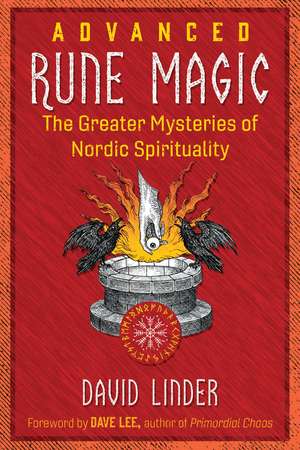
Advanced Rune Magic: The Greater Mysteries of Nordic Spirituality
Autor David Linder Cuvânt înainte de Dave Leeen Limba Engleză Paperback – 16 iul 2026
• Comprehensively explores the meanings of the 24 Elder Futhark runes and how each serves as a distinct interface to the greater Mystery
• Draws upon source texts such as the Prose and Poetic Eddas as well as the Anglo Saxon, Norwegian, and Icelandic Rune Poems
• Offers methods to incorporate the runes into your daily life as powerful tools for contemplation and magical self-transformation
The runes are a system of magical symbols that can be used for divination and casting spells, both to harm and protect. While these uses of the runes are powerful, David Linder focuses on a deeper and arguably more significant level of the runic mysteries—the magic of self-transformation.
The runes of the Elder Futhark are 24 facets of the great Mystery, which is translated as Runa. Each rune serves as a distinct interface that allows access to certain aspects of the great Mystery in order to heal, to reconnect, and to transform oneself. To grasp a rune is not just a matter of intellectual understanding, but a task of experiencing it physically and spiritually. Linder reveals how the lived experience of grasping a rune’s meaning is an initiatory step toward realizing one’s higher self and coming closer to the great Mystery.
The author draws upon the Prose and Poetic Eddas as well as the Anglo-Saxon, Norwegian, and Icelandic Rune Poems to explain each rune. These source texts show how Nordic spirituality is more concerned with the practicalities of mundane life than dogmatic codes. Linder contextualizes the meaning of each rune for our time and reveals the concrete opportunities for growth that each rune offers when the spiritual insight is lived and embodied in the modern world.
Advanced Rune Magic teaches methods to incorporate the runes into your daily life as tools for both contemplation and self-transformation, showing how simple applications can produce tangible results. While these methods can enrich one’s magical and spiritual practices, they will also lead to improved daily functioning, a stronger sense of purpose, and overall well-being.
Preț: 116.08 lei
Preț vechi: 153.65 lei
-24%
Puncte Express: 174
Carte disponibilă
Livrare economică 20 noiembrie-02 decembrie
Livrare express 31 octombrie-06 noiembrie pentru 63.91 lei
Livrare prin curier în România Termenul estimat este afișat lângă disponibilitate.
Transport gratuit de la 400.00 lei Plată online sau ramburs, în funcție de opțiunile comenzii.
Retur gratuit în 14 zile Comandă securizată și suport în română.
Specificații
ISBN-13: 9798888502174
Pagini: 288
Ilustrații: 24 b&w illustrations
Dimensiuni: 152 x 229 x 18 mm
Greutate: 0.35 kg
Editura: Inner Traditions/Bear & Company
Colecția Inner Traditions
Pagini: 288
Ilustrații: 24 b&w illustrations
Dimensiuni: 152 x 229 x 18 mm
Greutate: 0.35 kg
Editura: Inner Traditions/Bear & Company
Colecția Inner Traditions
Notă biografică
David Linder holds a bachelors degree in German linguistics and European history. A licensed falconer, he has studied the runes and Norse mythology extensively with a focus on practical applications. He lives in northern Switzerland with his wife and children.
Extras
INTRODUCTION
TWILIGHT AND DAWN
HOW IT ALL BEGAN . . .
Twilight rules in the mythical realm before time. All that can be seen is the silhouette of an enormous tree, its branches swaying softly in the breeze that comes from no place and goes nowhere. The otherwise serene air carries the barely audible sounds of a wounded man close to death. Far up in the tree, his shape can be made out. He’s been hanging there for nine days and nights without food or drink, bleeding from a self-inflicted wound. He is the true seeker, the one who never stops and never rests—always wandering, always searching for ways to expand his consciousness and slake his unquenchable thirst for knowledge. But in this empty realm before time, all that exists is the tree: the mighty mother who will give life to all things that ever come to be, and who will swallow them up again when their time is done. He has used all his strength to climb this wondrous tree, tie himself to one of its mighty branches, and stab himself with his spear. His blood drips steadily onto the branches below, slowly shading the evergreen foliage red.
He can feel them lurking in the shadows—the three cruel women who will become the weavers of fate once the Universe is born. But for now, they don’t show themselves. They hand him no food, they hold no horn to his lips so that he may drink, and they do not dress his ever-bleeding wound. They watch from the shadows in silence, unmoving and emotionless, as his life slowly drains away.
Now the last drop of his blood leaves his body. He draws his final breath, the air barely getting past his swollen tongue, burning his parched throat on its way into his lungs. Nothing has been revealed to him; his sacrifice was for naught. He exhales that last breath and lets it all go: his hopes and his dreams, his desperation and his disappointment. As the air leaves his chest, he lets his head droop downward with a strange sense of relief. He has given his all, and—even though he has failed—this thought sets him free. As his chin comes to rest on his chest, his eyelids grow heavy and he closes them for good. And suddenly, he sees! He sees the things to come, the things that will be: the intricacy of how it all works, how one thing causes the next and how it is all connected in this marvelous and deadly frightening web of causality. He sees the creation, destruction, and rebirth of worlds, Gods, Giants, Dwarves, Elves, Humans, animals, plants, and myriad other lifeforms. One after the other, images assault his weakened frame, demanding entry into his now-fractured mind until they condense into radiant red staves representing the whole Universe that has not yet come into existence. When he had climbed Yggdrasil, he was Odin. But now he is Fjolnir and Fimbultyr, Omi and Oski, Herjann and Helblindi, Gondlir and Grimnir, and countless others. Screaming, he takes up these mysterious staves deep into the shattered core of his Self; then the great mother suddenly releases him and he falls back toward nothingness.
Or, to say it in the words of a Norse poet:
I know that I hung, on a wind-swept tree
for all of nine nights,
wounded by spear, and given to Odin,
myself to myself,
on that tree of which no man knows
from what root it rises.
They dealt me no bread, nor drinking horn.
I looked down, I drew up the runes,
screaming I took them up,
and fell back from there.
Havamal 138–39 (trans. Chisholm)
THE TRUE SEEKER
This is a book for those who want to see what Odin spied when facing his imminent death. It is a book for those of us who are chasing the great Mystery, those with a fire in their belly that keeps them ever restless and always seeking—for more knowledge, more insights, more consciousness. Runa, the great Mystery, cannot be known as it can’t be put into words.* It can only be encountered by directly experiencing it, and each of those experiences again stokes the eternal flame, which in turn keeps us searching and hunting to find it once more. The Runes of the Elder Futhark are twenty-four facets of this great Mystery: twenty-four interfaces that allow us to interact with certain aspects of Runa as a means for healing. Thus, we may reconnect with our roots, our past, and with nature, in order to transform ourselves. Each Rune contains vast amounts of energy, emotion, and experience. Each one is linked to the innermost core of consciousness, to the void out of which it manifested and to which it shall again return. Each one is closely interwoven with the everlasting cycle of life and death. This is what makes it so difficult to define these mysterious signs, or to to simply say “Fehu stands for wealth” and leave it at that. Such a statement may be true on one level, but if you really want to understand any Rune, you must delve far deeper than that, for there are many—perhaps countless—other levels to explore and integrate. You cannot know a Rune in a purely intellectual way. If you wish to discover the inner tension it holds—the wealth of knowledge, the connectedness to your psyche and your innermost being, to the natural world, the Universe, life, death, consciousness, the Gods, the Wights, the Giants—you must experience it.
But let us start at the beginning . . .
THE EMERGENCE OF THE UNIVERSE
It was in the earliest times that Ymir dwelled.
Neither sand nor sea, nor cold waves, nor earth
were to be found. There was neither heaven above,
nor grass anywhere, there was nothing
but Ginnungagap.
Voluspa 3 (trans. Chisholm)
Many creation stories begin at a similar point: there is an emptiness in which creation takes place at the behest or direct action of some divine spirit. Norse mythology has a rather different story to offer, however.
Ginnungagap essentially means “Yawning Void.” This emptiness contained the potential for everything and therefore allowed for nothing to ever manifest. Darkness canceled out light, heat canceled out cold, height canceled out depth. But one day an opposing pair of elemental forces escaped the clutches of the seemingly almighty void. The pair immediately split, each trying to get as far away from the other so that it could come into existence without being canceled out by its opposite. They didn’t get very far, though, as they were suddenly gripped by a hidden structure that seemed to have emerged at the same time as Ginnungagap. This structure would later become known as Yggdrasil, the great World Tree. It was an ash or a yew tree, and its roots reached far down into Ginnungagap and there are no stories and no lore about how it came to be as no one yet existed who could witness its birth. Nevertheless, the pair was still far enough apart that they could manifest. The first one to come into existence was a hot spark of pure energy that burst into a fiery world called Muspelheim. Its counterpart became Niflheim, the world of mist, the source of all water. The mist in this cold and hostile world stemmed from a huge geyser in its center, called Hvergelmir (“boiling cauldron”). The water that it emitted wasn’t clear drinking water but was laced with yeast, venom, and salt. More and more water gathered, and when it couldn’t be contained any longer, it started to flow out of Niflheim and was inevitably drawn back toward Ginnungagap. As the once-hot water was flowing through empty space, it chilled and froze. The pleasant sound of rushing water turned into a grating din as the newly formed sheets of ice started to rub against each other. The waters continued to flow out of Niflheim, relentlessly pushing the ice forward until it reached Ginnungagap. The noise increased as the sheets of ice began to pile up—the ones at the bottom cracking under the immense weight, as greater quantities of ice tumbled into the void, starting to fill it up.
The boundless energy of Muspelheim could not be contained, either. Glowing sparks, each as hot as the sun, were hurtled out of this fiery furnace and drifted toward Ginnungagap. There they hit the sheets of ice, melting it upon contact, creating pools of murky water. More sparks floated down and hit the water with loud hissing noises, heating it up and returning it into its original boiling state. No one was present to behold this impressive spectacle, to hear the incredible commotion of screeching, cracking ice, the hissing of searing hot sparks landing on ice and water, boiling, evaporating, charging it with the boundless energy of Muspelheim until suddenly there was a scream so loud that all the other sounds seemed to fade away instantly. In the middle of this chaos there now stood a figure so large that it defied description, shouting at the top of its lungs. Ymir, the first being, had been born.
TWILIGHT AND DAWN
HOW IT ALL BEGAN . . .
Twilight rules in the mythical realm before time. All that can be seen is the silhouette of an enormous tree, its branches swaying softly in the breeze that comes from no place and goes nowhere. The otherwise serene air carries the barely audible sounds of a wounded man close to death. Far up in the tree, his shape can be made out. He’s been hanging there for nine days and nights without food or drink, bleeding from a self-inflicted wound. He is the true seeker, the one who never stops and never rests—always wandering, always searching for ways to expand his consciousness and slake his unquenchable thirst for knowledge. But in this empty realm before time, all that exists is the tree: the mighty mother who will give life to all things that ever come to be, and who will swallow them up again when their time is done. He has used all his strength to climb this wondrous tree, tie himself to one of its mighty branches, and stab himself with his spear. His blood drips steadily onto the branches below, slowly shading the evergreen foliage red.
He can feel them lurking in the shadows—the three cruel women who will become the weavers of fate once the Universe is born. But for now, they don’t show themselves. They hand him no food, they hold no horn to his lips so that he may drink, and they do not dress his ever-bleeding wound. They watch from the shadows in silence, unmoving and emotionless, as his life slowly drains away.
Now the last drop of his blood leaves his body. He draws his final breath, the air barely getting past his swollen tongue, burning his parched throat on its way into his lungs. Nothing has been revealed to him; his sacrifice was for naught. He exhales that last breath and lets it all go: his hopes and his dreams, his desperation and his disappointment. As the air leaves his chest, he lets his head droop downward with a strange sense of relief. He has given his all, and—even though he has failed—this thought sets him free. As his chin comes to rest on his chest, his eyelids grow heavy and he closes them for good. And suddenly, he sees! He sees the things to come, the things that will be: the intricacy of how it all works, how one thing causes the next and how it is all connected in this marvelous and deadly frightening web of causality. He sees the creation, destruction, and rebirth of worlds, Gods, Giants, Dwarves, Elves, Humans, animals, plants, and myriad other lifeforms. One after the other, images assault his weakened frame, demanding entry into his now-fractured mind until they condense into radiant red staves representing the whole Universe that has not yet come into existence. When he had climbed Yggdrasil, he was Odin. But now he is Fjolnir and Fimbultyr, Omi and Oski, Herjann and Helblindi, Gondlir and Grimnir, and countless others. Screaming, he takes up these mysterious staves deep into the shattered core of his Self; then the great mother suddenly releases him and he falls back toward nothingness.
Or, to say it in the words of a Norse poet:
I know that I hung, on a wind-swept tree
for all of nine nights,
wounded by spear, and given to Odin,
myself to myself,
on that tree of which no man knows
from what root it rises.
They dealt me no bread, nor drinking horn.
I looked down, I drew up the runes,
screaming I took them up,
and fell back from there.
Havamal 138–39 (trans. Chisholm)
THE TRUE SEEKER
This is a book for those who want to see what Odin spied when facing his imminent death. It is a book for those of us who are chasing the great Mystery, those with a fire in their belly that keeps them ever restless and always seeking—for more knowledge, more insights, more consciousness. Runa, the great Mystery, cannot be known as it can’t be put into words.* It can only be encountered by directly experiencing it, and each of those experiences again stokes the eternal flame, which in turn keeps us searching and hunting to find it once more. The Runes of the Elder Futhark are twenty-four facets of this great Mystery: twenty-four interfaces that allow us to interact with certain aspects of Runa as a means for healing. Thus, we may reconnect with our roots, our past, and with nature, in order to transform ourselves. Each Rune contains vast amounts of energy, emotion, and experience. Each one is linked to the innermost core of consciousness, to the void out of which it manifested and to which it shall again return. Each one is closely interwoven with the everlasting cycle of life and death. This is what makes it so difficult to define these mysterious signs, or to to simply say “Fehu stands for wealth” and leave it at that. Such a statement may be true on one level, but if you really want to understand any Rune, you must delve far deeper than that, for there are many—perhaps countless—other levels to explore and integrate. You cannot know a Rune in a purely intellectual way. If you wish to discover the inner tension it holds—the wealth of knowledge, the connectedness to your psyche and your innermost being, to the natural world, the Universe, life, death, consciousness, the Gods, the Wights, the Giants—you must experience it.
But let us start at the beginning . . .
THE EMERGENCE OF THE UNIVERSE
It was in the earliest times that Ymir dwelled.
Neither sand nor sea, nor cold waves, nor earth
were to be found. There was neither heaven above,
nor grass anywhere, there was nothing
but Ginnungagap.
Voluspa 3 (trans. Chisholm)
Many creation stories begin at a similar point: there is an emptiness in which creation takes place at the behest or direct action of some divine spirit. Norse mythology has a rather different story to offer, however.
Ginnungagap essentially means “Yawning Void.” This emptiness contained the potential for everything and therefore allowed for nothing to ever manifest. Darkness canceled out light, heat canceled out cold, height canceled out depth. But one day an opposing pair of elemental forces escaped the clutches of the seemingly almighty void. The pair immediately split, each trying to get as far away from the other so that it could come into existence without being canceled out by its opposite. They didn’t get very far, though, as they were suddenly gripped by a hidden structure that seemed to have emerged at the same time as Ginnungagap. This structure would later become known as Yggdrasil, the great World Tree. It was an ash or a yew tree, and its roots reached far down into Ginnungagap and there are no stories and no lore about how it came to be as no one yet existed who could witness its birth. Nevertheless, the pair was still far enough apart that they could manifest. The first one to come into existence was a hot spark of pure energy that burst into a fiery world called Muspelheim. Its counterpart became Niflheim, the world of mist, the source of all water. The mist in this cold and hostile world stemmed from a huge geyser in its center, called Hvergelmir (“boiling cauldron”). The water that it emitted wasn’t clear drinking water but was laced with yeast, venom, and salt. More and more water gathered, and when it couldn’t be contained any longer, it started to flow out of Niflheim and was inevitably drawn back toward Ginnungagap. As the once-hot water was flowing through empty space, it chilled and froze. The pleasant sound of rushing water turned into a grating din as the newly formed sheets of ice started to rub against each other. The waters continued to flow out of Niflheim, relentlessly pushing the ice forward until it reached Ginnungagap. The noise increased as the sheets of ice began to pile up—the ones at the bottom cracking under the immense weight, as greater quantities of ice tumbled into the void, starting to fill it up.
The boundless energy of Muspelheim could not be contained, either. Glowing sparks, each as hot as the sun, were hurtled out of this fiery furnace and drifted toward Ginnungagap. There they hit the sheets of ice, melting it upon contact, creating pools of murky water. More sparks floated down and hit the water with loud hissing noises, heating it up and returning it into its original boiling state. No one was present to behold this impressive spectacle, to hear the incredible commotion of screeching, cracking ice, the hissing of searing hot sparks landing on ice and water, boiling, evaporating, charging it with the boundless energy of Muspelheim until suddenly there was a scream so loud that all the other sounds seemed to fade away instantly. In the middle of this chaos there now stood a figure so large that it defied description, shouting at the top of its lungs. Ymir, the first being, had been born.
Cuprins
FOREWORD
TALES FROM TRUE SEEKER
DAVE LEE
NOTE TO THE READER
ON THE TRANSLATIONS USED IN THIS BOOK
INTRODUCTION
TWILIGHT AND DAWN
HOW IT ALL BEGAN . . .
THE FIRST FAMILY
FEHU—CATTLE
URUZ—AUROCHS
THURISAZ—THORN
ANSUZ—GOD
RAIDO—RIDING
KENAZ—TORCH
GEBO—GIFT
WUNJO—JOY
THE SECOND FAMILY
HAGALAZ—HAIL
NAUDIZ—NEED
ISA—ICE
JERA—YEAR
EIHWAZ—YEW
PERTHRO—LOT BOX
ELHAZ—ELK
SOWILO—SUN
THE THIRD FAMILY
TIWAZ—TYR
BERKANO—BIRCH
EHWAZ—HORSE
MANNAZ—MAN
LAGUZ—WATER
INGWAZ—ING
DAGAZ—DAY
OTHALA—HOMELAND
EPILOGUE
THEN I BEGAN TO GROW . . .
APPENDIX
THE RUNE POEMS
THE ANGO-SAXON RUNE POEM
THE NORWEGIAN RUNE POEM
THE ICELANDIC RUNE POEM
LEXICON OF NORSE NAMES, PLACES, AND TERMS
SOURCES AND FURTHER READING
INDEX
TALES FROM TRUE SEEKER
DAVE LEE
NOTE TO THE READER
ON THE TRANSLATIONS USED IN THIS BOOK
INTRODUCTION
TWILIGHT AND DAWN
HOW IT ALL BEGAN . . .
THE FIRST FAMILY
FEHU—CATTLE
URUZ—AUROCHS
THURISAZ—THORN
ANSUZ—GOD
RAIDO—RIDING
KENAZ—TORCH
GEBO—GIFT
WUNJO—JOY
THE SECOND FAMILY
HAGALAZ—HAIL
NAUDIZ—NEED
ISA—ICE
JERA—YEAR
EIHWAZ—YEW
PERTHRO—LOT BOX
ELHAZ—ELK
SOWILO—SUN
THE THIRD FAMILY
TIWAZ—TYR
BERKANO—BIRCH
EHWAZ—HORSE
MANNAZ—MAN
LAGUZ—WATER
INGWAZ—ING
DAGAZ—DAY
OTHALA—HOMELAND
EPILOGUE
THEN I BEGAN TO GROW . . .
APPENDIX
THE RUNE POEMS
THE ANGO-SAXON RUNE POEM
THE NORWEGIAN RUNE POEM
THE ICELANDIC RUNE POEM
LEXICON OF NORSE NAMES, PLACES, AND TERMS
SOURCES AND FURTHER READING
INDEX
Recenzii
“In the growing flora of books that treat rune magic, Advanced Rune Magic stands out as a valuable addition—with insight into tradition as well as innovative creativity that gives the reader new perspectives on the runes. The book is rooted in historical runology and highlights esoteric aspects of the medieval rune poems, while being at the same time applicable to contemporary practitioners. Given all the beginner books on magic and runes, it is also appreciated to have a book that is aimed at experienced practitioners.”
“This book presents the runes the way they were meant to be approached: through the worldview of the ancients, grounded in literary sources, not modern fantasy. It honors how the ancient Norse peoples understood and used the runes, then carries that wisdom forward into a clear, practical application for life today. This is the way I believe the runes are best understood: historically rooted, spiritually alive, and immediately usable.”
“Here David presents a mythic travelogue through the mysteries of the runes. Anyone who seeks to travel these roads and rivers at the highest levels will find in these pages a useful guide and companion.”
“Truly a book of advanced rune magic! Whether you are a novice or an experienced practitioner, this work will still teach you something. Above all, it has a positive, magical application to one’s daily life.”
“This is a book that shows the reader how to employ the magic of the runes for radical self-transformation. David bases his explanation of the runes on the historic medieval rune poems and then links each rune to the wights of the Nordic world—the deities, elves, giants, and dwarves—and to their mythology, making impressive sense of how the old tales fit together. An inspiring book for seasoned practitioners as well as beginners.”
“This book presents the runes the way they were meant to be approached: through the worldview of the ancients, grounded in literary sources, not modern fantasy. It honors how the ancient Norse peoples understood and used the runes, then carries that wisdom forward into a clear, practical application for life today. This is the way I believe the runes are best understood: historically rooted, spiritually alive, and immediately usable.”
“Here David presents a mythic travelogue through the mysteries of the runes. Anyone who seeks to travel these roads and rivers at the highest levels will find in these pages a useful guide and companion.”
“Truly a book of advanced rune magic! Whether you are a novice or an experienced practitioner, this work will still teach you something. Above all, it has a positive, magical application to one’s daily life.”
“This is a book that shows the reader how to employ the magic of the runes for radical self-transformation. David bases his explanation of the runes on the historic medieval rune poems and then links each rune to the wights of the Nordic world—the deities, elves, giants, and dwarves—and to their mythology, making impressive sense of how the old tales fit together. An inspiring book for seasoned practitioners as well as beginners.”
Descriere
Accessing deeper levels of rune magic to achieve self-transformation