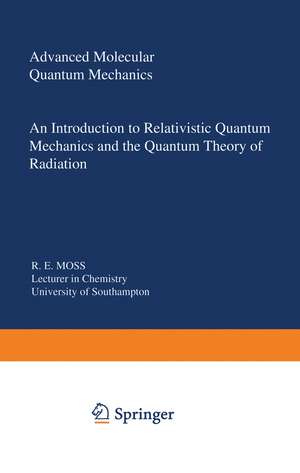
Advanced Molecular Quantum Mechanics: An Introduction to Relativistic Quantum Mechanics and the Quantum Theory of Radiation: Studies in Chemical Physics
Autor R. Mossen Limba Engleză Paperback – 11 noi 2011
Preț: 616.77 lei
Preț vechi: 725.62 lei
-15%
Puncte Express: 925
Carte tipărită la comandă
Livrare economică 02-16 decembrie
Livrare prin curier în România Termenul estimat este afișat lângă disponibilitate.
Transport gratuit pentru acest produs Plată online sau ramburs, în funcție de opțiunile comenzii.
Retur gratuit în 14 zile Comandă securizată și suport în română.
Specificații
ISBN-13: 9789400956902
ISBN-10: 9400956908
Pagini: 320
Ilustrații: XVI, 300 p.
Dimensiuni: 155 x 235 x 17 mm
Greutate: 0.45 kg
Ediția:Softcover reprint of the original 1st ed. 1973
Editura: SPRINGER NETHERLANDS
Colecția Springer
Seria Studies in Chemical Physics
Locul publicării:Dordrecht, Netherlands
ISBN-10: 9400956908
Pagini: 320
Ilustrații: XVI, 300 p.
Dimensiuni: 155 x 235 x 17 mm
Greutate: 0.45 kg
Ediția:Softcover reprint of the original 1st ed. 1973
Editura: SPRINGER NETHERLANDS
Colecția Springer
Seria Studies in Chemical Physics
Locul publicării:Dordrecht, Netherlands
V-ar putea interesa
-
 How to Pass Intermediate 2 BiologyHARRY HOEYPreț: 87.41 lei
 -
 OCR Revise A2 BiologyRichard FosberyPreț: 106.53 lei
 -
 AQA Psychology A ASJane Willson-6%Preț: 226.08 lei239.29 lei
 -
 Who Will Plant a Tree?Jerry PallottaPreț: 101.51 lei
Public țintă
ResearchCuprins
1 Non-relativistic Quantum Mechanics.- 1.1 Formal quantum mechanics.- 1.2 The Schrödinger equation.- 1.3 Heisenberg’s uncertainty principle and related topics.- 1.4 Angular momentum.- 1.5 Electron spin.- 1.6 The need for a relativistic theory.- 2 Vector and Matrix Algebra.- 2.1 Vectors and vector multiplication.- 2.2 The repeated subscript convention for summation.- 2.3 The Kronecker delta ?ij.- 2.4 The ?ijk notation.- 2.5 The ?ijk sum rules.- 2.6 Examples I.- 2.7 The vector operator ?.- 2.8 The gradient.- 2.9 The divergence.- 2.10 The curl.- 2.11 Examples II.- 2.12 Second derivatives in vector calculus.- 2.13 The Dirac delta function.- 2.14 Matrices and determinants: a summary.- 2.15 Vectors in four dimensions.- 3 Classical Mechanics.- 3.1 Inertial frames and Galileo’s relativity principle.- 3.2 The principle of least action.- 3.3 Lagrange’s equations of motion.- 3.4 The Lagrangian for a system of particles.- 3.5 Constants of motion.- 3.6 The Hamiltonian.- 4 Special Relativity.- 4.1 Einstein’s principle of relativity.- 4.2 The interval.- 4.3 The Lorentz transformation.- 4.4 Contraction, dilation and paradoxes.- 4.5 The transformation of velocities.- 4.6 The relativistic mechanics of a free particle.- 4.7 Four-vectors.- 5 The Interaction of Charged Particles with Electromagnetic Fields.- 5.1 Units.- 5.2 The electromagnetic potentials.- 5.3 The field vectors.- 5.4 The Lorentz transformation of electric and magnetic fields.- 5.5 Gauge transformations.- 5.6 Maxwell’s equations.- 5.7 The potentials and fields due to a stationary charge.- 5.8 The potentials due to a moving charge.- 5.9 The interaction of two charged particles.- 5.10 The Thomas precession.- 6 The Classical Theory of Electromagnetic Fields.- 6.1 Continuous mechanical systems.- 6.2 TheLagrangian density for an electromagnetic field.- 6.3 The current four-vector.- 6.4 The second pair of Maxwell’s equations.- 6.5 Electromagnetic waves.- 6.6 Solution of the wave equation for free space.- 6.7 The characteristic vibrations of an electromagnetic field.- 7 Relativistic Wave Equations.- 7.1 Quantization of classical equations.- 7.2 Gauge invariance of quantum mechanical equations.- 7.3 The Klein-Gordon equation.- 8 The Dirac Equation.- 8.1 The Dirac equation for a free electron.- 8.2 The Dirac operators ? and ?.- 8.3 The introduction of an electromagnetic field.- 8.4 Electron spin.- 8.5 Lorentz invariance of the Dirac equation.- 8.6 The negative energy solutions — positrons.- 8.7 The non-relativistic approximation of the Dirac equation.- 8.8 The method of small components.- 8.9 The Foldy-Wouthuysen transformation.- 8.10 The free electron.- 9 The Wave Equation for Many Electrons.- 9.1 The electromagnetic potentials due to a moving electron.- 9.2 The Hamiltonian for two electrons.- 9.3 The Breit equation.- 9.4 Reduction of the Breit equation to non-relativistic form.- 9.5 Radiative corrections.- 9.6 The many-electron Hamiltonian.- 10 The Molecular Hamiltonian.- 10.1 The introduction of nuclei.- 10.2 Finite nuclear size effects.- 10.3 Spectroscopically useful Hamiltonians.- 10.4 Effective Hamiltonians.- 11 The Hydrogen Atom.- 11.1 Non-relativistic theory for a one-electron atom.- 11.2 The non-relativistic approximation of the Dirac equation.- 11.3 The simultaneous eigenfunctions of j2, jz, l2, s2 and K.- 11.4 Commutation relations for the Dirac Hamiltonian.- 11.5 The Dirac equation in polar coordinates.- 11.6 Solution of the radial equations.- 11.7 The energy levels.- 11.8 Comparison of Dirac and non-relativistic atomic orbitals.- 11.9 The Lamb shift.-11.10 More complicated systems.- 12 Quantum Field Theory.- 12.1 Quantization of the electromagnetic field.- 12.2 Solution of the one-dimensional harmonic oscillator equation.- 12.3 Creation and annihilation operators.- 12.4 Photons.- 12.5 Zero-point energy and vacuum fluctuations.- 12.6 Fermions and second quantization.- 13 The Interaction of Radiation and Matter.- 13.1 The interaction Hamiltonian.- 13.2 Time-dependent perturbation theory.- 13.3 Matrix elements of the interaction Hamiltonian.- 13.4 Absorption and emission.- 13.5 Comparison of the semiclassical and quantized theories.- 13.6 Multi-photon processes.- 13.7 The scattering of photons by molecules.- 13.8 Line widths and resonance fluorescence.- Appendix A Units.- A.1 SI units.- A.2 Conversion from the mixed (Gaussian) CGS system to the SI system.- A.3 Recommended values of physical constants.- Appendix B Vector Relations in Three Dimensions.- Appendix C General Bibliography.- Author Index.