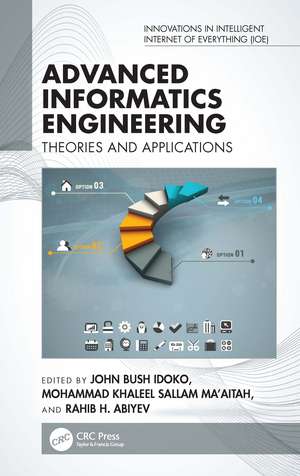
Advanced Informatics Engineering: Theories and Applications: Innovations in Intelligent Internet of Everything (IoE)
Editat de John Bush Idoko, Mohammad Khaleel Sallam Ma'aitah, Rahib H. Abiyeven Limba Engleză Hardback – 27 oct 2026
Din seria Innovations in Intelligent Internet of Everything (IoE)
- 15%
 Preț: 471.35 lei
 - 20%
 Preț: 386.21 lei
 - 15%
 Preț: 438.27 lei
 - 15%
 Preț: 421.01 lei
 -
 Preț: 449.55 lei
 - 20%
 Preț: 636.62 lei
 - 18%
 Preț: 1301.35 lei
 - 18%
 Preț: 969.68 lei
 - 20%
 Preț: 1405.74 lei
 - nou
 Preț: 1014.63 lei
 - 30%
 Preț: 819.47 lei
 - nou
 Preț: 687.22 lei
 - nou
 Preț: 1125.74 lei
 - nou
 Preț: 1100.72 lei
 - nou
 Preț: 1095.76 lei
 - nou
 Preț: 946.13 lei
Preț: 1016.17 lei
Preț vechi: 1270.22 lei
-20% Precomandă
Puncte Express: 1524
Carte nepublicată încă
Livrare prin curier în România Precomanda se expediază când titlul devine disponibil.
Transport gratuit pentru acest produs Plată online sau ramburs, în funcție de opțiunile comenzii.
Retur gratuit în 14 zile Comandă securizată și suport în română.
Doresc să fiu notificat când acest titlu va fi disponibil:
Se trimite...
Specificații
ISBN-13: 9781041275091
ISBN-10: 1041275099
Pagini: 366
Ilustrații: 186
Dimensiuni: 156 x 234 mm
Greutate: 0.69 kg
Ediția:1
Editura: CRC Press
Colecția CRC Press
Seria Innovations in Intelligent Internet of Everything (IoE)
ISBN-10: 1041275099
Pagini: 366
Ilustrații: 186
Dimensiuni: 156 x 234 mm
Greutate: 0.69 kg
Ediția:1
Editura: CRC Press
Colecția CRC Press
Seria Innovations in Intelligent Internet of Everything (IoE)
Public țintă
AcademicCuprins
Chapter 1 - Overview of Advanced Informatics Engineering - Theories and Applications, Chapter 2 - Advanced Univariate Data Preprocessing Rainfall Prediction Using Stacked Deep Learning Networks, Chapter 3 - A Hybrid Fuzzy Logic-Convolutional Neural Network for Enhanced Vehicle Detection, Chapter 4 - Learning Management System: a Review, Chapter 5 - Classification of Damaged Solar Cells Using ResNet50 Model Architecture, Chapter 6 - A High-Performance Deep Learning Pipeline for Mammogram Classification Using Pretrained EfficientNetV2-S, Chapter 7 - Comparative Analysis of Automated Hyperparameter Tuning Methods in Deep Learning Models: Evaluating Performance and Computational Efficiency, Chapter 8 - Deep Learning Techniques Evaluation for Improved Bladder Cancer Diagnostic Performance, Chapter 9 - Machine Learning Approaches for Malware Detection Assessment, Chapter 10 - Malware Detection in Medical Mechatronics Distribution System Using Support Vector Machine: Ensuring Data Access, Integrity and Privacy, Chapter 11 - Machine Learning Algorithm-Based Smart Shopping Recommendation System, Chapter 12 - Implementation of Real-Time Irrigation Monitoring System Using IoT Technology, Chapter 13 - UAV-Assisted Dynamic IoT Network Deployment in Disaster Zones, Chapter 14 - Predictive Modeling of Outdoor Wireless Propagation for Future 5G Networks in Cyprus, Chapter 15 - Assessment of Cybersecurity Readiness for Entrepreneurial Possibilities, Chapter 16 - Design and Development of a Digital Educational Game: Magical Questions with a Wheel of Fortune, Chapter 17 - The New Axis of Global Security and Competition: Artificial Intelligence Policies, Application Fields, and Geopolitical Implications, Chapter 18 - Intelligent Course Registration - Enhancing Schedule Optimization for University Students, Chapter 19 - A Smart Beehive with Integrated Advanced Technology: a Survey, Chapter 20 - Prof Dux: Optimizing AI Curriculum Delivery and Enhancing Class Management for Improved Learning Experiences, Chapter 21 - Harnessing Natural Language Processing for Multilingual Education in Nigeria: a Review, Chapter 22 - Investigation of Phubber Levels of Students in Terms of Various Variables, Chapter 23 - Machine Learning-Based Prediction of Student Performance in Flipped Physics Labs, Chapter 24 - Metaverse-Based Education: the Education Paradigm of the Future.
Notă biografică
John Bush Idoko graduated from the Benue State University Makurdi, Nigeria where he obtained BSc degree in Computer Science in 2010. He started MSc program in Computer Engineering at Near East University, North Cyprus. After receiving MSc degree in 2017, he started PhD program in the same department in the same year. During his post graduate programs at Near East University, he worked as research assistant in the Applied Artificial Intelligence Research Centre. He obtained his PhD in 2020 and he is currently the Head of Cyber Security Engineering Department, and an Associate Professor in Computer Engineering Department, Near East University, Cyprus. His research interests include but not limited to: AI, machine learning, deep learning, computer vision, data analysis, informatics, softcomputing, advanced image processing, bioinformatics.
He recently published a book series: Machine Learning and the Internet of Things in Education (https://link.springer.com/book/10.1007/978-3-031-42924-8)
Dr. Mohammad Ma'aitah is an Assistant Professor of Computer Engineering with extensive experience in academic leadership, research, and curriculum development. He holds a Ph.D. in Computer Engineering and has demonstrated a strong commitment to advancing education and innovation in engineering disciplines.
From 2016 to 2022, Dr. Ma'aitah served as a faculty member at Near East University, where he contributed to both undergraduate and graduate education, supervised research projects, and published numerous scientific papers in high-impact journals and international conferences.
In 2022, Dr. Ma'atah joined Applied Science Private University (ASU) in Jordan, where he currently serves as the Head of the Department of Electrical Engineering within the Faculty of Engineering and Technology. His leadership encompasses oversight of five specialized academic programs: Communication and Computer Engineering, Robotics and Artificial Intelligence Engineering, Power and Renewable Energy Engineering, Power and Control Engineering, and Renewable Energy Technology.
Dr. Ma'atah’s research interests include artificial intelligence, robotics, renewable energy systems, computer vision, and intelligent computing. He has published a wide range of scientific articles and remains active in the academic community through research collaborations, conferences, and curriculum development initiatives.
Rahib H. Abiyev received the B.Sc. and M.Sc. degrees (First Class Hons.) in electrical and electronic engineering from Azerbaijan State Oil Academy, Baku, in 1989, and the Ph.D. degree in electrical and electronic engineering from Computer-Aided Control System Department of the same university, in 1997. He was a Senior Researcher with the research laboratory “Industrial intelligent control systems” of Computer-aided Control System Department. In 1999, he joined the Department of Computer Engineering, Near East University, Nicosia, North Cyprus, where he is currently a Full Professor and the Chair of Computer Engineering Department. In 2001, he founded Applied Artificial Intelligence Research Centre and in 2008, he created “Robotics” research group. He is currently the Director of the Research Centre. He has published over 300 papers in related subjects. His current research interests include softcomputing, control systems, robotics, and signal processing.
He recently published a book series: Machine Learning and the Internet of Things in Education (https://link.springer.com/book/10.1007/978-3-031-42924-8)
Dr. Mohammad Ma'aitah is an Assistant Professor of Computer Engineering with extensive experience in academic leadership, research, and curriculum development. He holds a Ph.D. in Computer Engineering and has demonstrated a strong commitment to advancing education and innovation in engineering disciplines.
From 2016 to 2022, Dr. Ma'aitah served as a faculty member at Near East University, where he contributed to both undergraduate and graduate education, supervised research projects, and published numerous scientific papers in high-impact journals and international conferences.
In 2022, Dr. Ma'atah joined Applied Science Private University (ASU) in Jordan, where he currently serves as the Head of the Department of Electrical Engineering within the Faculty of Engineering and Technology. His leadership encompasses oversight of five specialized academic programs: Communication and Computer Engineering, Robotics and Artificial Intelligence Engineering, Power and Renewable Energy Engineering, Power and Control Engineering, and Renewable Energy Technology.
Dr. Ma'atah’s research interests include artificial intelligence, robotics, renewable energy systems, computer vision, and intelligent computing. He has published a wide range of scientific articles and remains active in the academic community through research collaborations, conferences, and curriculum development initiatives.
Rahib H. Abiyev received the B.Sc. and M.Sc. degrees (First Class Hons.) in electrical and electronic engineering from Azerbaijan State Oil Academy, Baku, in 1989, and the Ph.D. degree in electrical and electronic engineering from Computer-Aided Control System Department of the same university, in 1997. He was a Senior Researcher with the research laboratory “Industrial intelligent control systems” of Computer-aided Control System Department. In 1999, he joined the Department of Computer Engineering, Near East University, Nicosia, North Cyprus, where he is currently a Full Professor and the Chair of Computer Engineering Department. In 2001, he founded Applied Artificial Intelligence Research Centre and in 2008, he created “Robotics” research group. He is currently the Director of the Research Centre. He has published over 300 papers in related subjects. His current research interests include softcomputing, control systems, robotics, and signal processing.
Descriere
The book focuses on the application of advanced computing methods and technologies to various engineering disciplines, including reasoning, knowledge representation, and the development of new engineering applications.