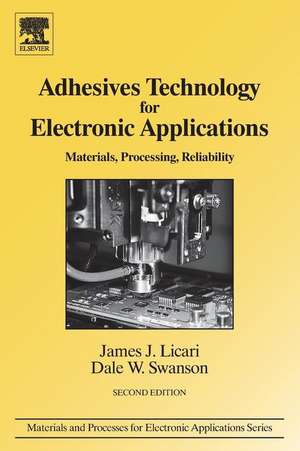
Adhesives Technology for Electronic Applications: Materials, Processing, Reliability: Materials and Processes for Electronic Applications
Autor James J. Licari, Dale W. Swansonen Limba Engleză Paperback – 19 aug 2016
The book includes chapters covering types of adhesive, the chemistry on which they are based, and their properties, applications, processes, specifications, and reliability. Coverage of toxicity, environmental impacts and the regulatory framework make this book particularly important for engineers and managers alike.
The third edition has been updated throughout and includes new sections on nanomaterials, environmental impacts and new environmentally friendly ‘green’ adhesives. Information about regulations and compliance has been brought fully up-to-date.
As well as providing full coverage of standard adhesive types, Licari explores the most recent developments in fields such as:
- Tamper-proof adhesives for electronic security devices
- Bio-compatible adhesives for implantable medical devices
- Electrically conductive adhesives to replace toxic tin-lead solders in printed circuit assembly – as required by regulatory regimes, e.g. the EU’s Restriction of Hazardous Substances Directive or RoHS (compliance is required for all products placed on the European market)
- Nano-fillers in adhesives, used to increase the thermal conductivity of current adhesives for cooling electronic devices.
- A complete guide for the electronics industry to adhesive types, their properties and applications – this book is an essential reference for a wide range of specialists including electrical engineers, adhesion chemists and other engineering professionals
- Provides specifications of adhesives for particular uses and outlines the processes for application and curing – coverage that is of particular benefit to design engineers, who are charged with creating the interface between the adhesive material and the microelectronic device
- Discusses the respective advantages and limitations of different adhesives for a varying applications, thereby addressing reliability issues before they occur and offering useful information to both design engineers and Quality Assurance personnel
Preț: 893.73 lei
Preț vechi: 1489.91 lei
-40%
Carte tipărită la comandă
Livrare economică 28 noiembrie-12 decembrie
Specificații
ISBN-10: 0128103701
Pagini: 512
Dimensiuni: 152 x 229 x 22 mm
Greutate: 0.55 kg
Ediția:2
Editura: ELSEVIER SCIENCE
Seria Materials and Processes for Electronic Applications
V-ar putea interesa
-
 Encapsulation Technologies for Electronic ApplicationsHaleh Ardebili-31%Preț: 1182.09 lei1713.05 lei
 -
 -30%Preț: 1076.00 lei1545.34 lei
 -
 -26%Preț: 949.92 lei1284.36 lei
 -
 -27%Preț: 1029.90 lei1401.25 lei
 -
 Thermoelectric Materials and DevicesLidong Chen-31%Preț: 878.88 lei1268.37 lei
 -
 -26%Preț: 865.82 lei1174.49 lei
 -
 Tribology of Polymer Composites: Characterization, Properties, and ApplicationsSanjay Mavinkere Rangappa-7%Preț: 1224.89 lei1318.59 lei
 -
 -26%Preț: 1241.21 lei1682.74 lei
 -
 Heterostructured Photocatalysts for Solar Energy ConversionSrabanti Ghosh-25%Preț: 1128.12 lei1511.92 lei
 -
 -25%Preț: 1004.96 lei1338.56 lei
 -
 Handbook of Nanotechnology Applications: Environment, Energy, Agriculture and MedicineKajornsak Faungnawakij-28%Preț: 1569.00 lei2165.88 lei
 -
 Phytonanotechnology: Challenges and ProspectsN. Thajuddin-25%Preț: 1078.42 lei1444.80 lei
 -
 Nuclear Corrosion: Research, Progress and ChallengesStefan Ritter-41%Preț: 1255.61 lei2119.56 lei
 -
 Engineering Materials: Properties and SelectionKenneth G. Budinski-23%Preț: 1577.68 lei2048.93 lei
 -
 Textile Design: Products and ProcessesMichael Hann-18%Preț: 1308.02 lei1595.15 lei
 -
 Surface Engineering of Metals: Principles, Equipment, TechnologiesTadeusz Burakowski-15%Preț: 544.26 lei640.30 lei
 -
 -18%Preț: 1445.08 lei1762.29 lei
 -
 -27%Preț: 591.31 lei810.01 lei
 -
 -9%Preț: 1112.38 lei1222.39 lei
 -
 Introduction to the Physics and Chemistry of MaterialsRobert J. Naumann-18%Preț: 1383.91 lei1687.70 lei
Public țintă
Electronics and materials engineers in the automotive, medical, semiconductors, space, plastics, and military industriesCuprins
Recenzii
Notă biografică
Notable achievements throughout this career include conducting the first studies on the reliability and use of die-attach adhesives for microcircuits, which he did in the mid-1970s through the early 1980s, making industry and the government aware of the degrading effects of trace amounts of ionic contaminants in epoxy resins. He conducted early exploratory development on the use of non-noble metal (Cu) thick-film conductor pastes for thick-film ceramic circuits. He carried out the first studies on the use of Parylene as a dielectric and passivation coating for MOS devices and as a particle immobilizer for hybrid microcircuits. He developed the first photo-definable thick-film conductor and resistor pastes that were the forerunners of DuPont's Fodel process, for which he received a patent was granted in England. And he developed the first photocurable epoxy coating using cationic photoinitiation by employing a diazonium salt as the catalytic agent (U.S. 3205157) . The work was referenced as pioneering work in a review article by J.V. Crivello "The Discovery ad Development of Onium Salt Cationic Photoinitiators,? J. Polymer Chemistry (1999)