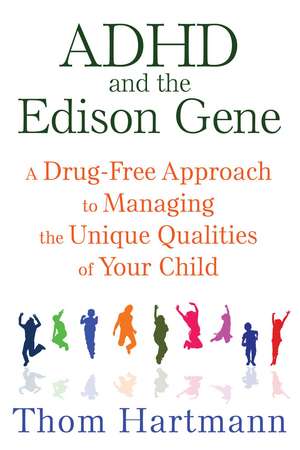
ADHD and the Edison Gene: A Drug-Free Approach to Managing the Unique Qualities of Your Child
Autor Thom Hartmannen Limba Engleză Paperback – 5 noi 2015
Observăm astăzi o schimbare de paradigmă în modul în care înțelegem neurodiversitatea, trecând de la etichetarea comportamentelor drept „deficiențe” către recunoașterea lor ca avantaje evolutive. ADHD and the Edison Gene se înscrie în această tendință, propunând o perspectivă revoluționară: trăsăturile specifice ADHD — impulsivitatea, căutarea noutății și distractibilitatea — sunt, de fapt, componentele unui set de abilități de supraviețuire moștenite de la strămoșii noștri vânători-culegători. Thom Hartmann, pionierul teoriei „vânătorului versus fermier”, ne invită să reîncadrăm diagnosticul nu ca pe o boală, ci ca pe o adaptare biologică la schimbări radicale.
Structura cărții este concepută pentru a ne purta de la rădăcinile genetice și istorice ale acestei trăsături, explorând „gena vânătorului” apărută acum 40.000 de ani, până la strategii practice pentru prezent. Descoperim aici cum figuri emblematice precum Thomas Edison sau Ben Franklin au transformat aceste provocări în motoare ale inovației. Complementar lucrării ADHD 2.0 de Edward M. Hallowell, unde accentul cade pe mecanismele neurologice moderne și strategii de conectare, volumul lui Hartmann explorează mai profund rădăcinile antropologice și oferă o justificare istorică fascinantă pentru existența acestui profil cognitiv.
Această lucrare continuă misiunea începută de autor în Attention Deficit Disorder: A Different Perception, rafinând conceptul de „genă Edison”. Spre deosebire de alte scrieri ale sale, precum Walking Your Blues Away, care se concentrează pe vindecarea traumelor prin mișcare, aici Hartmann se axează pe educație și parenting, oferind părinților și profesorilor instrumentele necesare pentru a proteja stima de sine a copiilor și pentru a le canaliza energia creativă în direcții constructive, fără a apela la medicație.
Preț: 85.41 lei
Preț vechi: 114.34 lei
-25%
Carte disponibilă
Livrare economică 24 iulie-05 august
Livrare express 03-09 iulie pentru 54.49 lei
Specificații
ISBN-10: 1620555069
Pagini: 288
Ilustrații: 3 b&w illustrations
Dimensiuni: 152 x 229 x 18 mm
Greutate: 0.34 kg
Ediția:3rd Edition, New Edition of The Edison Gene
Editura: Inner Traditions/Bear & Company
Colecția Park Street Press
V-ar putea interesa
-
 -21%Preț: 93.56 lei118.98 lei
 -
 -18%Preț: 369.15 lei451.13 lei
 -
 NeuroTribesSteve Silberman-18%Preț: 100.60 lei123.25 lei
 -
 What is Normal?Roz Carroll-30%Preț: 115.95 lei166.60 lei
De ce să citești această carte
Recomandăm această carte părinților și educatorilor care caută o alternativă la abordarea medicală tradițională a ADHD-ului. Cititorul va câștiga o înțelegere profundă a modului în care mintea unui copil cu „gena Edison” funcționează, transformând frustrarea zilnică în admirație pentru potențialul creativ al acestuia. Este un ghid esențial pentru a transforma o etichetă clinică într-un avantaj competitiv în viața de adult.
Despre autor
Thom Hartmann este un autor de succes, psihoterapeut și realizator de emisiuni radio, cunoscut la nivel internațional pentru contribuțiile sale în domeniul ADHD. Fondator al Hunter School, o instituție dedicată copiilor cu acest diagnostic, Hartmann și-a dedicat cariera reframării modului în care societatea percepe neurodiversitatea. Lucrările sale, printre care se numără și bestselleruri New York Times, îmbină cercetarea istorică, psihologia și ecologia, oferind perspective unice asupra condiției umane în contextul modernității.
Descriere scurtă
Hartmann, creator of the "hunter versus farmer" theory of ADHD, examines the differences in neurology between people with ADHD and those without, sharing recent discoveries that confirm the existence of an ADHD gene and the global catastrophe 40,000 years ago that triggered its development. He cites examples of significant innovators with ADHD traits, such as Ben Franklin and Thomas Edison, and argues that the children who possess the ADHD gene have neurology that is wired to give them brilliant success as artists, innovators, inventors, explorers, and entrepreneurs.
Emphasizing the role that parents and teachers can play in harnessing the advantages of ADHD, he shares the story of how Edison was expelled from school for ADHD-related behavior and luckily his mother understood how to salvage his self-esteem and prepare him for a lifetime of success. Offering concrete strategies for nurturing, educating, and helping these children reach their full potential, Hartmann shows that rather than being "problems" such children are a vital gift to our society and the world.
Notă biografică
Extras
Providing Discipline and Structure for the Edison-Gene Child
Separating Person from Behavior
I was in the local food co-op recently, and about four feet from me a two-year-old child in a shopping cart reached out from the cart and grabbed a bag of dried sweetened pineapple pieces. “Mine!” he said, tossing them into the cart.
His mother’s reaction was immediate. She grabbed the pineapple from the cart and put it back on the shelf, then turned and glared at her son. “Don’t be a bad boy!” she commanded, wagging her finger in his face.
His reaction looked to me like a mixture of pain and pride; the former from mother being unhappy with him, and the latter from some inner knowledge of identity, confirmed by her words. He reached into the cart and grabbed a can of soup, glancing at me, his audience, and prepared to throw it on the floor. Mom intervened by roughly grabbing the can and again demanding that he not be bad, this time giving him a slap on the hand. I found my cookies and moved away as the little boy began looking for a new audience for his behavior.
Whenever we react to a person’s behavior--particularly a child’s--we can do it in either of two primary ways. One addresses the individual’s personhood and ties it to his behavior, and the other addresses his personhood and disconnects it from his behavior. This is a critical distinction.
People who think they are their behaviors are caught in a continuous loop: in order to define themselves or to feel okay about themselves, they must continually bounce their behaviors off other people. Most people who start with this as children also become early and vulnerable targets for the advertising industry, whose primary message is that you are your possessions or that you are your body.
In each parent/child interactive situation in which the child is defined by his behavior, the “I am” center of his personhood becomes disconnected from any state of inner centeredness. Happiness and selfassurance come only with doing or getting and have no relationship to simply being, to “I know who I am, and I’m larger and deeper than what I do or what I own or what my body looks like.”
The lack of this important self-knowledge begins with parents or the media telling children that they are their behaviors. Thus the alternative to saying, “Don’t be a bad boy,” is to say, “If you do that, we won’t be able to continue shopping.” For a more severe behavior, it may even be, “I love you so much that I’m not going to let you do that.” It brings the core of the interaction back to the community of parent/child and doesn’t speak at all about the child as a bad or good person.
Break the Pattern with a Positive Message
The child in the supermarket also reminded me of one of the best lessons in childrearing that Louise and I ever learned. A friend of ours, an NLP (Neurolinguistic Programming) practitioner and psychologist, shared it with Louise back in the early 1980s.
One of our children was in the habit of throwing fits in the supermarket, demanding things and shouting loudly when the demands weren’t met. We’d tried both placating and punishing, and neither worked; the behavior just continued. Our friend had a two-part suggestion. “Do something unexpected,” he said, “and do it in a way that reinforces both your love and the idea that life can be fun.”
We started by priming our child during the day, talking about how much fun Louise was going to have shopping in the afternoon. “Would you like to have fun with me at the store?” she asked our four-year-old. “Yes!” was the enthusiastic reply.
When they got to the store and were going through the aisles, our child began to throw the predictable fit in the predictable place. At that point, Louise had a shopping cart only half full of food. “Oh,” she said, “I thought you wanted to have fun with me here. But if it’s not fun for both of us, it doesn’t work, and it’s not fun for me if you’re throwing this fit.”
She propelled the cart--complete with demanding child--to the service counter in the supermarket, where she said to the startled clerk, “I came to the supermarket to have fun shopping with my child, but my child doesn’t want us both to have fun, so I’m going to leave these groceries here, drop my child off at home, and come back alone to finish having fun shopping.”
“Okay,” said the clerk, nodding the way people do to the inmates in an asylum.
Louise picked up our child from the cart, drove the two of them home, came into the house, and said to me, “Our child wasn’t willing to let us both have fun at the supermarket, so will you baby-sit while I go back to the store to have fun shopping?”
“Of course,” I said, watching our child’s astonished expression. “I hope you have a lot of fun!”
“I will,” Louise said cheerfully as she went out the door. It was the last supermarket fit we ever experienced, and the story highlights one aspect of how many hunter-gatherer tribal children are raised: interactions are cooperative and positive, even as the adults clearly define the parameters of behavior and the values that underlie those parameters.
Cuprins
Acknowledgments
Introduction: A New View for Our Children
Genetics and Differences
1993: The Hunter Gene
Distractibility
Impulsivity
Risk-Taking
Where Have All the Hunters Gone?
Indigenous Hunters Today
The Agricultural Revolution
Our Society’s Hunters
The Edison Gene
The Crisis-Survival Gene
Hunters Before the Holocene
Adapted to Adversity and Change
Part 1
The Past
1 The World of the Edison-Gene Child
The Ancient World
The Salt Pump
The Great Ice Age
Heated by the Great Conveyor Belt
2 The Dawn of Civilization
What Made Us Human?
The Bacteria That Took Over the World
The Human Bottleneck
Before the Bottleneck
3 Three Ways Humans Were Killed Off by Weather
Warming by the Sun
Vulcan’s Hammer
Survivors: AIDS
Chimps and the Black Plague
Creativity Saves the Day
ADHD and Creativity
The Beads: Clue to the First Edisons
Part 2
The Present
4 Anatomy of a Diagnosis
How Edison-Gene Children Are Different
Are They Disordered?
Anthropology Meets Psychology • From Hunters to Inventors
5 The Mystery of Novelty-Seeking Behavior
The “Novelty Gene”
The Novelty Gene and ADHD
6 Genes Move Around and Turn On and Off
The Genetics of Behavior
Turning on Genes
Codominant Genes
Turning on Edison Characteristics
7 Other Genes and Influences
Neurotransmitters and Personality Characteristics
The Reasons for Genetic Variations
Culture and Genes
8 Scientists Find the “Adaptive” Edison Gene
But Some Say It’s a Disease
Is It a Disorder?
Novelty Seeking
9 The ADHD Gene and the Dawn of Human Civilization
The Time Machine
The News Hits the Streets
The Edison
Gene and Democracy
10 Brain Development and the Edison-Gene Child
Sense of Self
A Process that Mirrors Evolution
The Reptilian Brain
The Limbic Brain
The “New” Brain
The Unique Prefrontal Brain
The Brain Develops After Birth, Too
The First Pruning of the Brain
The Impact of Stress
The Brain in the Birth Period
The Brain in the Toddler Period
The Brain in the Early Childhood Period
The Brain in the Teenage Period
The Brain in the Early Adult Years
Adult Memory of the Stages of Brain Development
Intuition versus Information
The Loss of Intuition
The Tragedy of Lost Potential
Invasion of the Lizard People?
Are We Stuck in a Loop?
Triggering Events
Raising Fully Human Children
Schools May Be the Key
School as Torture
Condemnation
School as Work
Comorbidities
Applying Comorbidities to Edison-Gene Children
Breaking the Loop
Offering a New Story
11 The Edison Gene, Drugs, Exercise, and Nutrition
Nutritional Deficiencies Are Rampant
Environmental Toxins
Nutriceuticals
Yerba Maté: Nature’s Ritalin
Drugs for Edison-Gene Children
Medications Bite Back
Burning Out Brain Cells?
Do Drugs Help Over the Long Term?
The Loss of Play
EEG Neurofeedback
Exercise: The Optimal “Treatment”?
12 Providing Discipline and Structure for the Edison-Gene Child
Nurturing the Hunters
Reward/Punishment versus Inclusion/Interdependence
Separating Person from Behavior
Break the Pattern with a Positive Message
Watch for Islands of Success
The Importance of Mastery
Turn Off the Television
13 Alfred Adler’s Principles for Raising Children
Promote Mutual Respect
Encourage
Foster Security
Avoid reward and Punishment
Use Natural and Logical Consequences
Act Instead of Talk in Conflict Situations
Use Withdrawal as a Counteraction
Withdraw from the Provocation, Not from the Child
Don’t Interfere in Children’s Fights
Fighting Requires Cooperation
Take Time to Teach Essential Skills and Habits
Never Do for a Child What He Can Do for Himself
Don’t Overprotect
Avoid Being Overly Responsible
Distinguish between Positive and Negative Attention
Understand the Child’s Goal
A Habit Is Maintained if It Achieves Its Purpose
Minimize Mistakes
Try a Family Council and Have Fun Together
The Edison-Gene Family
14 Educating the Edison-Gene Child
Learned Helplessness
Reframing Identity = Success in Learning
Government Studies Pronounce on Medication
They Ignored the Environment
The Study Proved Ritalin Doesn’t Improve Learning
But It Makes the Teachers Happy
Lighting a Fire for Learning
Education and Testing Corporations
How Modern Education
Came About
German Schools Come to America
American Education and the Catholic Problem
Backlash Against the Authoritarian Model of Public Education
Maria Montessori
Rudolf Steiner
Free and Alternative Schools
Homeschooling and Internet Schooling
But What About Socialization?
Why Homeschooling Works for Edison-Gene Children
The Edison Gene through the College Years
Find a Mentor or a Coach
15 Edison-Gene Girls and Women
Be a Good Girl
Cinderella in a Hostile World
Cultural Barriers
Cultural Programming and Expectations
Healing the Wounds
Spirituality and the Edison-Gene Child
Edison-Gene Mystics
The Hunter’s Reality
The World of the Hunter’s Dreams
Dreaming with the Natives
Learning to Know
Understanding the Real World
Wild People and Tame People
The Loss of True Wisdom
When Access to Personal Spirituality Is Lost
Part 3
The Future
17 How Edison-Gene Children May Change the World
Glimmers of How Culture Works
What Causes Culture?
The Biology of Culture
Primal Human Cultures
Cultural and Genetic Selection
18 Is Human Evolution Finally Over?
As Good As It Gets
We’re Going Downhill
It’s the Fault of Those People with ADHD!
Are We Standing Still? Distant Bottleneck Events
19 One Generation to Save the World
Climate Flip-Flops to the Next Ice Age
A Global-Warming Bottleneck
Afterword: Yesterday’s Child by Janie Bowman
Notes
Index
Recenzii
“Instead of pathologizing the differences we call ADHD, we need to value neurodiversity, and Thom’s book shows us in rich detail how and why this is true. Thom’s work can help protect children and adults from the devastating effects of being viewed through a pervasive pathological lens--a much more severe problem than ADHD could ever be!”
“Thom Hartmann has made one of the most important contributions to transforming our understanding of ADHD. Thom was the first to consider ADHD in an evolutionary context. He showed that ADHD has not only a significant survival advantage in hunter gatherer societies, but that it also confers powerful advantages in our contemporary civilization. Thom was one of the very first to comment on the link between ADHD and creativity. He will be recognized as a pioneer contributing to the reconceptualization of ADHD from being simply a ‘disorder’ to being viewed as a ‘mode of thought’ characterized by strengths, such as enhanced creativity.”
"From the marvelous mind, and lively pen of Thom Hartmann comes this new opportunity to celebratethe magnificent diversity of how we learn to thrive Read it... and start a new conversation with your kids."
“The very gene associated with attention deficit hyperactivity disorder (ADHD) may have helped humans survive sudden climate changes before the end of the ice age. Thom Hartmann explains that children and adults with ADHD have characteristics such as risk-taking, distractibility, creativity and impulsiveness that are ideal for life paths that could well save us in the future. They're ideally suited to becoming entrepreneurs, explorers, inventors, innovators, emergency room physicians and fighter pilots. Drugs are not the answer; nor is the structured education system which has no room for "problem" children. Hartmann has strategies to help parents and teachers bring out the best in so-called hyperactive kids.”
“The very gene associated with attention deficit hyperactivity disorder (ADHD) may have helped humans survive sudden climate changes before the end of the ice age.…children and adults with ADHD have characteristics such as risk-taking, distractibility, creativity and impulsiveness that are ideal for life paths that could well save us in the future. They’re ideally suited to becoming entrepreneurs, explorers, inventors, innovators, ER physicians and fighter pilots. Hartman has strategies to help parents and teachers bring out the best in so-called hyperactive kids.”
“There is a lot of practical advice on how to interact and encourage ‘Edison Gene’ children; showing how to celebrate their skills rather than condemn their behavior. I found this book insightful, informative and inspirational. The message I took away from this book was: ‘child-hood’ is not a psychological disorder--stop drugging our kids.”