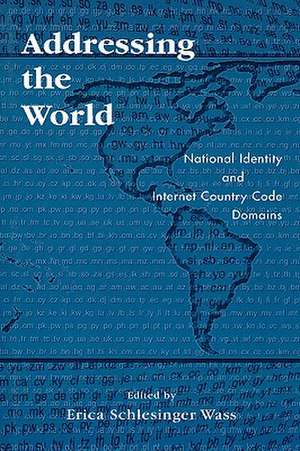
Addressing the World: National Identity and Internet Country Code Domains
Editat de Erica Schlesinger Wass Contribuţii de Dana M. Gallup, Tushar A. Gandhi, Toby E. Huff, Patrik Lindén, Martin Maguire, Paiki Muswazi, Patricio Poblete, Jenny Sinclair, Richard StClair, Peter K. Yuen Limba Engleză Paperback – 29 sep 2003
Visit the author's website for additional information, including chapter abstracts and pictures and bios of all contributors.
Preț: 276.57 lei
Preț vechi: 361.08 lei
-23%
Puncte Express: 415
Carte tipărită la comandă
Livrare economică 03-17 decembrie
Livrare prin curier în România Termenul estimat este afișat lângă disponibilitate.
Transport gratuit de la 400.00 lei Plată online sau ramburs, în funcție de opțiunile comenzii.
Retur gratuit în 14 zile Comandă securizată și suport în română.
Specificații
ISBN-13: 9780742528109
ISBN-10: 0742528103
Pagini: 186
Dimensiuni: 150 x 226 x 14 mm
Greutate: 0.29 kg
Ediția:New.
Editura: Bloomsbury Publishing
Colecția Rowman & Littlefield
Locul publicării:New York, United States
ISBN-10: 0742528103
Pagini: 186
Dimensiuni: 150 x 226 x 14 mm
Greutate: 0.29 kg
Ediția:New.
Editura: Bloomsbury Publishing
Colecția Rowman & Littlefield
Locul publicării:New York, United States
V-ar putea interesa
-
 -15%Preț: 418.13 lei491.91 lei
 -
 Preț: 120.95 lei
 -
 Still a Man's WorldChristine L. WilliamsPreț: 259.30 lei
 -
 Encounters with AgingMargaret M. LockPreț: 312.62 lei
 -
 Preț: 322.71 lei
 -
 Preț: 393.05 lei
 -
 The Homeless (Paper)Christopher JencksPreț: 250.82 lei
 -
 Road Dogs and Loners: Family Relationships among Homeless MenTimothy D. Pippert-29%Preț: 341.92 lei482.08 lei
 -
 -33%Preț: 354.79 lei532.21 lei
 -
 -32%Preț: 461.65 lei675.60 lei
 -
 City-building In AmericaAnthony M. OrumPreț: 464.26 lei
 -
 The AIDS Epidemic: Social Dimensions Of An Infectious DiseaseWilliam A. Rushing-15%Preț: 434.24 lei510.88 lei
 -
 After Political Correctness: The Humanities And Society In The 1990sChristopher NewfieldPreț: 464.26 lei
 -
 "Tell Me a Riddle": Tillie OlsenDeborah Silverton RosenfeltPreț: 320.68 lei
 -
 Drugs, Crime, and CorruptionRichard ClutterbuckPreț: 221.74 lei
 -
 Women in Between: Female Roles in a Male World: Mount Hagen, New GuineaMarilyn Strathern-33%Preț: 480.70 lei722.64 lei
Cuprins
Part 1 Acknowledgments
Part 2 Introduction- Lots of Dots
Chapter 3 1: The NeverEnding ccTLD Story
Chapter 4 2: East Timor's .TP: From a Virtual Initiative to a Political Reality
Chapter 5 3: Chile's .CL: A Virtual Home for Chileans Worldwide
Chapter 6 4: India's .IN: Underused and Under Appreciated
Chapter 7 5: Malaysia's .MY: Globalization and Domain Identification Among Malaysian Students
Chapter 8 6: Sweden's .SE: Re-establishing Itself as the Best Choice for All Swedes
Chapter 9 7: Niue's .NU: Providing a Free Internet to an Isolated Nation
Chapter 10 8: Moldova's .MD: The Little Domain That Roared
Chapter 11 9: China's .CN: Reaching Every Corner of the World
Chapter 12 10: Swaziland's .SZ: Virtual Symbols of Swaziland's National Aspirations and Character
Chapter 13 11: The United States' .US: Striving for the American Dream
Chapter 14 12: Australia's .AU: Australia's Second Gold Rush
Part 15 Conclusion: Only Time Will Tell
Part 16 About the Contributors
Part 17 Notes
Part 18 Appendix: The Top-Level Domains
Part 19 Index
Part 2 Introduction- Lots of Dots
Chapter 3 1: The NeverEnding ccTLD Story
Chapter 4 2: East Timor's .TP: From a Virtual Initiative to a Political Reality
Chapter 5 3: Chile's .CL: A Virtual Home for Chileans Worldwide
Chapter 6 4: India's .IN: Underused and Under Appreciated
Chapter 7 5: Malaysia's .MY: Globalization and Domain Identification Among Malaysian Students
Chapter 8 6: Sweden's .SE: Re-establishing Itself as the Best Choice for All Swedes
Chapter 9 7: Niue's .NU: Providing a Free Internet to an Isolated Nation
Chapter 10 8: Moldova's .MD: The Little Domain That Roared
Chapter 11 9: China's .CN: Reaching Every Corner of the World
Chapter 12 10: Swaziland's .SZ: Virtual Symbols of Swaziland's National Aspirations and Character
Chapter 13 11: The United States' .US: Striving for the American Dream
Chapter 14 12: Australia's .AU: Australia's Second Gold Rush
Part 15 Conclusion: Only Time Will Tell
Part 16 About the Contributors
Part 17 Notes
Part 18 Appendix: The Top-Level Domains
Part 19 Index
Recenzii
Addressing the World is a sophisticated look at a poorly understood, if key, aspect of the Internet. Erica Schlesinger Wass and her contributors do an excellent job of delineating the political and commercial forces that shape a global medium in a world still dominated by nation states.
This volume provides the next generation of scholars with a useful base of international information on which to chart the politics and commodification of the Internet. Its information and detail are a welcome contribution to the field. It challenges assumptions about not only how the Internet operates but also what its naming conventions mean for issues of local and national identity, for access to free and uncensored communication capabilities, and for matters of political-and commercial-expression.
This book offers a fresh and insightful perspective on the Internet and its implications for life in the global village. Taking an international perspective, the chapters provide a combination of original research and theory to explain the nature and impact of the Internet on diverse populations around the world. I recommend this book as a must-read for those interested in either the Internet or its global consequences.
This volume provides the next generation of scholars with a useful base of international information on which to chart the politics and commodification of the Internet. Its information and detail are a welcome contribution to the field. It challenges assumptions about not only how the Internet operates but also what its naming conventions mean for issues of local and national identity, for access to free and uncensored communication capabilities, and for matters of political-and commercial-expression.
This book offers a fresh and insightful perspective on the Internet and its implications for life in the global village. Taking an international perspective, the chapters provide a combination of original research and theory to explain the nature and impact of the Internet on diverse populations around the world. I recommend this book as a must-read for those interested in either the Internet or its global consequences.