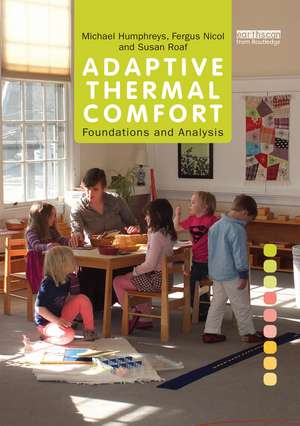
Adaptive Thermal Comfort: Foundations and Analysis
Autor Michael Humphreys, Fergus Nicol, Susan Roafen Limba Engleză Paperback – 14 aug 2020
This book is the second in a three volume set covering all aspects of Adaptive Thermal Comfort. The first part narrates the development of the adaptive approach to thermal comfort from its early beginnings in the 1960s. It discusses recent work in the field and suggests ways in which it can be developed and modelled. Such models can be used to set dynamic, interactive standards for thermal comfort which will help overcome the problems inherited from the past. The second part of the volume engages with the practical and theoretical problems encountered in field studies and in their statistical analysis, providing guidance towards their resolution, so that valid conclusions may be drawn from such studies.
| Toate formatele și edițiile | Preț | Express |
|---|---|---|
| Paperback (2) | 426.54 lei 6-8 săpt. | |
| CRC Press – 14 aug 2020 | 426.54 lei 6-8 săpt. | |
| CRC Press – 19 mar 2026 | 327.55 lei Precomandă |
Preț: 426.54 lei
Preț vechi: 501.81 lei
-15%
Puncte Express: 640
Preț estimativ în valută:
75.43€ • 88.52$ • 65.43£
75.43€ • 88.52$ • 65.43£
Carte tipărită la comandă
Livrare economică 10-24 martie
Specificații
ISBN-13: 9780367598242
ISBN-10: 0367598248
Pagini: 408
Dimensiuni: 174 x 246 x 23 mm
Greutate: 0.75 kg
Ediția:1
Editura: CRC Press
Colecția Routledge
ISBN-10: 0367598248
Pagini: 408
Dimensiuni: 174 x 246 x 23 mm
Greutate: 0.75 kg
Ediția:1
Editura: CRC Press
Colecția Routledge
Public țintă
Postgraduate, Professional, Professional Practice & Development, and UndergraduateCuprins
Part I: Foundations 1. Introduction to adaptive behaviour 2. Adaptive Beginnings 3. The emergence of the adaptive point of view 4. Summertime Overheating in Schools 5. The first international conference on thermal comfort 6. Adapting to enforced changes of temperature 7. The First Meta-analysis 8. Clothing outdoors and during sleep 9. Meta-analysis 2: relating climate to indoor comfort 10. The origin of the Oxford Thermal Comfort Unit 11. Fieldwork in Pakistan 12. Raising awareness of the adaptive approach 13. Beginning fieldwork at Oxford Brookes University 14. PMV and the results of field studies 15. Adaptation and the ASHRAE RP-884 database 16. Going international: the SCATs project Part II: Analysis 17. Introducing part 2 18. Using the Method of Successive Categories to explore the properties of thermal comfort scales 19. Developing, adapting and testing thermal subjective scales 20. A Simple Heat Exchange Model for Thermal Comfort Conditions 21. Regression analysis: general features and effects of data-selection and binning 22. The effects of error in the predictor-variable 23. Mutual relation between room temperature and subjective warmth 24. The relation between regression analysis and probit analysis 25. The dependence of subjective warmth on within-day changes in room temperature 26. Constructing Bell-shaped Curves for Comfort and Temperature 27. Tolerance of seasonal drift of indoor temperature 28. Estimating Neutral Temperatures from Survey Data 29. The adaptive relation between indoor neutral temperatures and the outdoor climate 30. Do people like to feel neutral? Semantic offsets and zero-errors 31. Clothing and thermal behaviour 32. Interactions among environmental variables, adaptation and overall comfort 33. Drawing the threads together
Notă biografică
Michael Humphreys is known for his pioneering work on the adaptive approach to comfort. He was Head of Human Factors at the Building Research Establishment, and has been a Research Professor at Oxford Brookes University. His scientific interests are the methodology of field studies of environmental comfort, the structure and statistical modelling of human adaptive behaviour, and the interactions between the several aspects of the indoor environment.
Fergus Nicol has led a number of important research projects on comfort, which have influenced thinking internationally. He has authored numerous journal articles and other publications including guidance on comfort and overheating. Fergus convenes the Network for Comfort and Energy Use in Buildings and organises their regular international Windsor Conferences.
Susan Roaf did her PhD on comfort and the windcatchers of Yazd, and after a decade working with Nicol and Humphreys at the Oxford Thermal Comfort Unit, she is now Professor of Architectural Engineering at Heriot Watt University in Edinburgh. She is a teacher, researcher, designer and author and editor of 21 books including Ecohouse: A Design Guide and Adapting Buildings and Cities for Climate Change.
Fergus Nicol has led a number of important research projects on comfort, which have influenced thinking internationally. He has authored numerous journal articles and other publications including guidance on comfort and overheating. Fergus convenes the Network for Comfort and Energy Use in Buildings and organises their regular international Windsor Conferences.
Susan Roaf did her PhD on comfort and the windcatchers of Yazd, and after a decade working with Nicol and Humphreys at the Oxford Thermal Comfort Unit, she is now Professor of Architectural Engineering at Heriot Watt University in Edinburgh. She is a teacher, researcher, designer and author and editor of 21 books including Ecohouse: A Design Guide and Adapting Buildings and Cities for Climate Change.
Descriere
The second volume of a three part work which describes in detail the 'adaptive' approach to thermal comfort. Concentrating on the theoretical aspects of thermal comfort and presenting the latest work in the field, the book also suggests ways in which new models can be developed.
Recenzii
“Even as the climate warms, so too does the debate about thermal comfort in buildings. ‘At the Extremes’ is appropriately hard-hitting and insightful—a true guide for hotter times ahead”.
Jonathon Porritt, writer and campaigner, President of The Conservation Volunteers and Population Matters
“We can’t air-condition our way out of the climate crisis—this book is an essential manifesto for designing a resilient future, showing how our bodies, buildings, and cultures must adapt to a heating world.”
Prashant Kapoor, Chief Industry Specialist, Green Buildings and Cities, Climate Business Department, IFC
"This is a truly stupendous piece of work covering all dimensions of the question of thermal comfort in buildings –historical time, location, built space and the challenge of Climate Change. A must read for designers and researchers for an urgently needed 'reset' for theory and practice."
Ashok Lall, Principal of Ashok B Lall Architects, Delhi, India
"How wonderful to read a book on science that is written so clearly: for in a time of adjustment we need plain speaking… As Sue Roaf says: 'the first step to escaping from an echo chamber is to realise that you are in one.' May this book assist you to thrust the window of your enclosed space wide open and brave this world which created you – if you can find one that opens!"
Phil Harris, Troppo Architects
"Many congratulations on this new book. It's brimming with ideas related to radically cutting carbon in the face of the drastic rates of climate change we are now caught in."
Aubrey Meyer, The Global Commons Institute, UK
"Adaptive Thermal Comfort: At the Extremes is a provocative reading of how comfort has been defined, captured, codified, exported and enforced in our built environment—with highly uncomfortable results for our heating world. We are honored that our projects have been identified as exemplars for localized, adaptable and culturally attuned comfort. This book is a necessary critique of how we got here and offers actionable suggestions for designers, professionals and policy-makers moving forward."
Richard Hassell, WOHA, Singapore
Jonathon Porritt, writer and campaigner, President of The Conservation Volunteers and Population Matters
“We can’t air-condition our way out of the climate crisis—this book is an essential manifesto for designing a resilient future, showing how our bodies, buildings, and cultures must adapt to a heating world.”
Prashant Kapoor, Chief Industry Specialist, Green Buildings and Cities, Climate Business Department, IFC
"This is a truly stupendous piece of work covering all dimensions of the question of thermal comfort in buildings –historical time, location, built space and the challenge of Climate Change. A must read for designers and researchers for an urgently needed 'reset' for theory and practice."
Ashok Lall, Principal of Ashok B Lall Architects, Delhi, India
"How wonderful to read a book on science that is written so clearly: for in a time of adjustment we need plain speaking… As Sue Roaf says: 'the first step to escaping from an echo chamber is to realise that you are in one.' May this book assist you to thrust the window of your enclosed space wide open and brave this world which created you – if you can find one that opens!"
Phil Harris, Troppo Architects
"Many congratulations on this new book. It's brimming with ideas related to radically cutting carbon in the face of the drastic rates of climate change we are now caught in."
Aubrey Meyer, The Global Commons Institute, UK
"Adaptive Thermal Comfort: At the Extremes is a provocative reading of how comfort has been defined, captured, codified, exported and enforced in our built environment—with highly uncomfortable results for our heating world. We are honored that our projects have been identified as exemplars for localized, adaptable and culturally attuned comfort. This book is a necessary critique of how we got here and offers actionable suggestions for designers, professionals and policy-makers moving forward."
Richard Hassell, WOHA, Singapore