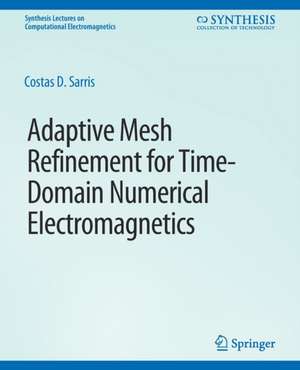
Adaptive Mesh Refinement in Time-Domain Numerical Electromagnetics: Synthesis Lectures on Computational Electromagnetics
Autor Costas D. Sarrisen Limba Engleză Paperback – 31 dec 2007
Descoperim în această lucrare un exercițiu riguros de optimizare a resurselor de calcul: modelarea unui filtru microstrip sau a unui rezonator optic în inel prin tehnica AMR-FDTD. Adaptive Mesh Refinement in Time-Domain Numerical Electromagnetics abordează direct limitările metodei clasice a diferențelor finite în domeniul timp (FDTD), propunând o metodologie robustă pentru variația dinamică a densității rețelei de discretizare în funcție de evoluția câmpului electromagnetic. Remarcăm o structură logică, orientată spre implementare. Autorul, Costas D. Sarris, începe prin stabilirea unei interfețe numerice între FDTD și MRTD (Multi-Resolution Time-Domain) bazată pe wavelet-uri Haar, oferind o soluție stabilă pentru problemele de analiză asistată de calculator (CAD). Pe linia practică a volumului Electromagnetic Simulation Techniques Based on the Fdtd Method, dar cu un focus strict pe rafinarea adaptivă și eficiența computațională, cartea ghidează cititorul prin formulări matematice ce reduc timpul de simulare cu ordine de mărime, fără a sacrifica precizia. Considerăm cuprinsul a fi un foaie de parcurs esențială pentru inginerii care dezvoltă propriile coduri de simulare. De la fundamentele teoretice ale AMR, textul progresează spre aplicații specifice în circuite integrate de microunde și structuri optice neliniare, precum joncțiunile în Y. Spre deosebire de Multiresolution Frequency Domain Technique for Electromagnetics, care explorează domeniul frecvență, lucrarea de față rămâne ancorată în domeniul timp, fiind ideală pentru simulări de bandă largă unde geometria structurilor și natura soluțiilor de câmp cer o adaptabilitate spațio-temporală fină.
Din seria Synthesis Lectures on Computational Electromagnetics
-
 Preț: 263.01 lei
 -
 Preț: 231.89 lei
 -
 Preț: 251.71 lei
 -
 Preț: 256.38 lei
 -
 Preț: 239.69 lei
 -
 Preț: 239.69 lei
 -
 Preț: 377.33 lei
 -
 Preț: 231.60 lei
 -
 Preț: 239.02 lei
 -
 Preț: 206.90 lei
 -
 Preț: 250.24 lei
 -
 Preț: 323.01 lei
 -
 Preț: 238.93 lei
 -
 Preț: 239.32 lei
 -
 Preț: 256.27 lei
 -
 Preț: 373.24 lei
 -
 Preț: 250.53 lei
 -
 Preț: 233.38 lei
 -
 Preț: 251.39 lei
 -
 Preț: 239.22 lei
 -
 Preț: 240.28 lei
 -
 Preț: 239.60 lei
 -
 Preț: 253.85 lei
 -
 Preț: 336.47 lei
 -
 Preț: 241.94 lei
 -
 Preț: 231.69 lei
 -
 Preț: 246.99 lei
 -
 Preț: 377.91 lei
 -
 Preț: 305.49 lei
 -
 Preț: 241.94 lei
Preț: 240.19 lei
Carte indisponibilă temporar
Specificații
ISBN-10: 3031005678
Pagini: 156
Ilustrații: XVII, 135 p.
Dimensiuni: 191 x 235 x 9 mm
Greutate: 0.31 kg
Editura: Springer
Colecția Synthesis Lectures on Computational Electromagnetics
Seria Synthesis Lectures on Computational Electromagnetics
Locul publicării:Cham, Switzerland
De ce să citești această carte
Această monografie este esențială pentru programatorii și inginerii care doresc să depășească barierele de viteză ale simulărilor electromagnetice clasice. Cititorul câștigă acces la tehnici de „adaptive meshing” care optimizează utilizarea memoriei în modelarea structurilor complexe de microunde și optice. Este un ghid practic pentru oricine dorește să implementeze algoritmi stabili de rafinare dinamică a rețelei în proiectele de cercetare sau design industrial.
Despre autor
Costas D. Sarris este un expert recunoscut în domeniul electromagnetismului computațional, cu o activitate academică intensă axată pe dezvoltarea metodelor numerice de înaltă eficiență. Expertiza sa în tehnici de multirezoluție și modelare în domeniul timp se reflectă în abordarea intuitivă a acestui volum din seria Synthesis Lectures on Computational Electromagnetics. Lucrările sale sunt fundamentale pentru avansul tehnologiilor CAD în designul circuitelor de înaltă frecvență și al sistemelor fotonice moderne.