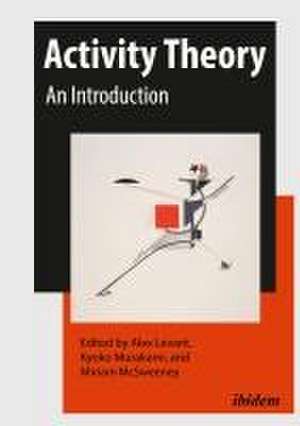
Activity Theory: An Introduction
Editat de Alex Levant, Kyoko Murakami, Miriam McSweeney Contribuţii de David Bakhurst, Andy Blunden, Mikael Brunila, Juliano Camillo, Seth Chaiklin, Michael Cole, Brecht De Smet, Yrjö Engeström, Cathrine Hasse, André Machado Rodrigues, Cristiano Mattos, Bonnie Nardi, Vesa Oittinen, Juhana Rantavuori, Annalisa Sannino, Anna Stetsenko, Katsuhiro Yamazumien Limba Engleză Paperback – 11 mar 2024
Preț: 333.75 lei
Preț vechi: 398.63 lei
-16%
Puncte Express: 501
Carte disponibilă
Livrare economică 14-28 noiembrie
Livrare prin curier în România Termenul estimat este afișat lângă disponibilitate.
Transport gratuit de la 400.00 lei Plată online sau ramburs, în funcție de opțiunile comenzii.
Retur gratuit în 14 zile Comandă securizată și suport în română.
Specificații
ISBN-13: 9783838216508
ISBN-10: 3838216504
Pagini: 422
Dimensiuni: 148 x 210 x 23 mm
Greutate: 0.55 kg
Ediția:Nouă
Editura: Ibidem
Colecția ibidem
Locul publicării:Hannover, Germany
ISBN-10: 3838216504
Pagini: 422
Dimensiuni: 148 x 210 x 23 mm
Greutate: 0.55 kg
Ediția:Nouă
Editura: Ibidem
Colecția ibidem
Locul publicării:Hannover, Germany
Recenzii
This book is a timely and highly relevant contribution to psychology and associated fields, offering an excellent, comprehensive, and long-awaited introduction to Activity Theory. By bridging past and present and connecting theory with practical applications, it demonstrates the scope and rich potential of Activity Theory as a theoretical framework for the challenges and complexities of the human lifeworld in the 21st century. It is a brilliantly orchestrated book with lots to offer for the newcomer to Activity Theory as well as the experienced theorist or practitioner.—Sofie Pedersen, Department of People of Technology, Roskilde University, Denmark
Structured in multiple parts to address the rich and lengthy history, the current trends, and possible futures—this collection has a great deal to recommend for both those new to and already familiar with the trans-disciplinary study of human activity. Introduced from the beginning by the editors’ framing of a human activity as a developmental dialectic of ideal and material, inherently social, and yet hidden in plain sight all around us, the contributors expertly explain the many ways this is so. Indeed, having gathered together so many of the international figures who have led or otherwise contributed to the varied perspectives that constitute the study of activity today, the volume offers a timely staging ground for yet another round of expansion and creativity.—Peter H. Sawchuk, Department of Leadership, Higher and Adult Education, University of Toronto, Canada
This book presents a comprehensive and insightful collection of contributions authored by well-recognized and respected scholars known for their substantial advances in the realm of studying and implementing Activity Theory. Within its pages, the historical background to the emergence of Activity Theory comes to light, accompanied by its profound theoretical underpinnings. The volume goes on to highlight the diverse applications of Activity Theory across a wide range of disciplines, while also considering potential avenues for its future development. In doing so, it encourages critical reflection on the potential effectiveness of Activity Theory in addressing the pressing societal challenges of our time.—Manolis Dafermos, Professor of Epistemology of Psychology, University of Crete, Greece
This book brings together chapters from some of the foremost scholars working within a broad understanding of Activity Theory. The collection combines insights arising in detailed theoretical approaches with examples of how people’s use of Activity Theory can lead to radical societal change. It particularly showcases some fascinating recent developments in the theory, making it an important contribution to the field.—Anne Edwards, Professor Emerita, University of Oxford
Activity Theory — An Introduction, edited by Alex Levant, Kyoko Murakami, and Miriam Sweeny, takes on the ambitious task of providing an overview of a field that is now more popular but also more heterogeneous than ever. For those more familiar with the tradition, the volume offers an overview of current fields of application as well as some interesting historical and conceptual details. However—and this does not count against the volume—it also highlights the fact that there is still a lot of theoretical work to be done if activity theory is ever to be a more or less unified and philosophically sophisticated approach to human development, learning, and education.—Theo Hickfang, Wolfson College, Oxford, United Kingdom
Structured in multiple parts to address the rich and lengthy history, the current trends, and possible futures—this collection has a great deal to recommend for both those new to and already familiar with the trans-disciplinary study of human activity. Introduced from the beginning by the editors’ framing of a human activity as a developmental dialectic of ideal and material, inherently social, and yet hidden in plain sight all around us, the contributors expertly explain the many ways this is so. Indeed, having gathered together so many of the international figures who have led or otherwise contributed to the varied perspectives that constitute the study of activity today, the volume offers a timely staging ground for yet another round of expansion and creativity.—Peter H. Sawchuk, Department of Leadership, Higher and Adult Education, University of Toronto, Canada
This book presents a comprehensive and insightful collection of contributions authored by well-recognized and respected scholars known for their substantial advances in the realm of studying and implementing Activity Theory. Within its pages, the historical background to the emergence of Activity Theory comes to light, accompanied by its profound theoretical underpinnings. The volume goes on to highlight the diverse applications of Activity Theory across a wide range of disciplines, while also considering potential avenues for its future development. In doing so, it encourages critical reflection on the potential effectiveness of Activity Theory in addressing the pressing societal challenges of our time.—Manolis Dafermos, Professor of Epistemology of Psychology, University of Crete, Greece
This book brings together chapters from some of the foremost scholars working within a broad understanding of Activity Theory. The collection combines insights arising in detailed theoretical approaches with examples of how people’s use of Activity Theory can lead to radical societal change. It particularly showcases some fascinating recent developments in the theory, making it an important contribution to the field.—Anne Edwards, Professor Emerita, University of Oxford
Activity Theory — An Introduction, edited by Alex Levant, Kyoko Murakami, and Miriam Sweeny, takes on the ambitious task of providing an overview of a field that is now more popular but also more heterogeneous than ever. For those more familiar with the tradition, the volume offers an overview of current fields of application as well as some interesting historical and conceptual details. However—and this does not count against the volume—it also highlights the fact that there is still a lot of theoretical work to be done if activity theory is ever to be a more or less unified and philosophically sophisticated approach to human development, learning, and education.—Theo Hickfang, Wolfson College, Oxford, United Kingdom