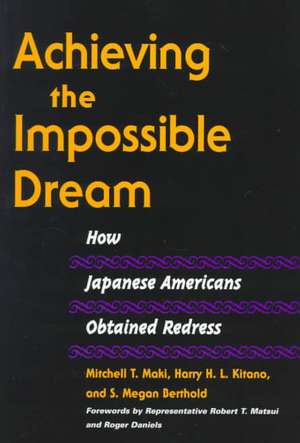
Achieving the Impossible Dream: HOW JAPANESE AMERICANS OBTAINED REDRESS: Asian American Experience
Autor Mitchell T Maki, Harry H Kitano, S Megan Berthold Cuvânt înainte de Robert T Matsuien Limba Engleză Paperback – 25 iun 1999
Din seria Asian American Experience
-
 Preț: 193.11 lei
 - 23%
 Preț: 621.88 lei
 - 23%
 Preț: 601.30 lei
 -
 Preț: 140.58 lei
 -
 Preț: 287.06 lei
 - 11%
 Preț: 696.57 lei
 - 14%
 Preț: 697.35 lei
 - 24%
 Preț: 696.57 lei
 - 11%
 Preț: 695.83 lei
 - 11%
 Preț: 697.35 lei
 -
 Preț: 250.57 lei
 - 10%
 Preț: 700.44 lei
 - 11%
 Preț: 695.83 lei
 -
 Preț: 250.57 lei
 -
 Preț: 216.62 lei
 - 11%
 Preț: 697.35 lei
 -
 Preț: 214.44 lei
Preț: 217.47 lei
Puncte Express: 326
Carte disponibilă
Livrare economică 11-25 noiembrie
Livrare express 28 octombrie-03 noiembrie pentru 35.19 lei
Livrare prin curier în România Termenul estimat este afișat lângă disponibilitate.
Transport gratuit de la 400.00 lei Plată online sau ramburs, în funcție de opțiunile comenzii.
Retur gratuit în 14 zile Comandă securizată și suport în română.
Specificații
ISBN-13: 9780252067648
ISBN-10: 0252067649
Pagini: 344
Dimensiuni: 152 x 229 x 28 mm
Greutate: 0.51 kg
Editura: University of Illinois Press
Colecția University of Illinois Press
Seria Asian American Experience
ISBN-10: 0252067649
Pagini: 344
Dimensiuni: 152 x 229 x 28 mm
Greutate: 0.51 kg
Editura: University of Illinois Press
Colecția University of Illinois Press
Seria Asian American Experience
Recenzii
Myers Outstanding Book Award, Gustavus Myers Center for the Study of Bigotry and Human Rights in North America, 2000
"An excellent summary of groups, individuals and events involved in the redressmovement. It offers a broad overview that makes sense of a wide-ranging and multi-faceted campaign unfolding slowly over several decades. . . . A major contribution to Asian American studies and U.S. history, one which is destined to become a classic resource and reference text."--Stan Shikuma, Pacific Reader
"[Makes] an invaluable contribution to the literature in Asian American studies by shedding light on the complex legislative process to enact the Civil Liberties Act of 1988, as well as the social, political, and economic maturity of the Japanese American community that achieved the impossible dream of obtaining redress from the United States government."--John N. Tsuchida, Journal of American History
"Valuable for its documentation of how 'relocated' Japanese Americans, their relatives, and political leaders gained apology and reparations from the United States government. . . . The real strength of the book, however, is the clear exposition of the many forces throughout the years that worked for and against redress for wartime internment. For researchers and others wanting to delve even more thoroughly into the history, the authors have provided a comprehensive bibliography, a set of endnotes, and an excellent index."--Carol Ann Traut, MultiCultural Review
"A useful case study of a successful national lobbying effort. The authors conducted many illuminating interviews and show a good grasp of the published literature."--Choice
"The story of the incarceration of Japanese Americans and the subsequent Japanese American redress movement involves the worst and best of what our country has to offer. Mitchell Maki, Harry Kitano, and Megan Berthold have written an informative account of the Japanese American community's quest for justice."—Senator Daniel K. Inouye
"The story of the Japanese American redress movement involved the victimization of an American community; the strength and courage of that community to raise its voice to demand justice; the legislative and judicial battles that made that demand a reality; and most important, the healing and reconciliation that occurred within individuals and a community and between a nation and its people. . . . Through archival documents, public statements, and personal stories, Achieving The Impossible Dream tells this very important story. It is must reading for all Americans who cherish the Constitution and all that it promises."—Norman Y. Mineta, former U.S. congressman
"An excellent summary of groups, individuals and events involved in the redressmovement. It offers a broad overview that makes sense of a wide-ranging and multi-faceted campaign unfolding slowly over several decades. . . . A major contribution to Asian American studies and U.S. history, one which is destined to become a classic resource and reference text."--Stan Shikuma, Pacific Reader
"[Makes] an invaluable contribution to the literature in Asian American studies by shedding light on the complex legislative process to enact the Civil Liberties Act of 1988, as well as the social, political, and economic maturity of the Japanese American community that achieved the impossible dream of obtaining redress from the United States government."--John N. Tsuchida, Journal of American History
"Valuable for its documentation of how 'relocated' Japanese Americans, their relatives, and political leaders gained apology and reparations from the United States government. . . . The real strength of the book, however, is the clear exposition of the many forces throughout the years that worked for and against redress for wartime internment. For researchers and others wanting to delve even more thoroughly into the history, the authors have provided a comprehensive bibliography, a set of endnotes, and an excellent index."--Carol Ann Traut, MultiCultural Review
"A useful case study of a successful national lobbying effort. The authors conducted many illuminating interviews and show a good grasp of the published literature."--Choice
"The story of the incarceration of Japanese Americans and the subsequent Japanese American redress movement involves the worst and best of what our country has to offer. Mitchell Maki, Harry Kitano, and Megan Berthold have written an informative account of the Japanese American community's quest for justice."—Senator Daniel K. Inouye
"The story of the Japanese American redress movement involved the victimization of an American community; the strength and courage of that community to raise its voice to demand justice; the legislative and judicial battles that made that demand a reality; and most important, the healing and reconciliation that occurred within individuals and a community and between a nation and its people. . . . Through archival documents, public statements, and personal stories, Achieving The Impossible Dream tells this very important story. It is must reading for all Americans who cherish the Constitution and all that it promises."—Norman Y. Mineta, former U.S. congressman
Notă biografică
Mitchell T. Maki is the is the president and CEO of the Go For Broke National Education Center. Harry H. L. Kitano was a professor emeritus of social welfare and sociology at UCLA and the author of The Japanese Americans: The Evolution of a Subculture. S. Megan Berthold is an associate professor and the Director of Field Education at the University of Connecticut.
Cuprins
Foreword by Representative Robert T. Matsui ix
Foreword by Roger Daniels xiii
Acknowledgements xv
Introduction 1
1. Theoretical Perspectives 9
2. Historical Factors prior to World War II 20
3. World War II (1941-45) 33
4. The Postwar Decades (1945-69) 51
5. The Genesis of the Modern Redress Movement (1970-78) 64
6. The Commission on Wartime Relocation and Internment of Civilians (1979-82) 85
7. Other Efforts at Redress 117
8. The Continuing Legislative Battle (1983-86) 137
9. The Aligning of the One-hundredth Congress (1987-88) 161
10. The President's Signature and the Fight for Appropriations 189
11. Delivering on the Promise 213
12. Lessons of a Movement 228
Notes 243
Works Cited 279
Index 291
Illustrations follow page 50
Foreword by Roger Daniels xiii
Acknowledgements xv
Introduction 1
1. Theoretical Perspectives 9
2. Historical Factors prior to World War II 20
3. World War II (1941-45) 33
4. The Postwar Decades (1945-69) 51
5. The Genesis of the Modern Redress Movement (1970-78) 64
6. The Commission on Wartime Relocation and Internment of Civilians (1979-82) 85
7. Other Efforts at Redress 117
8. The Continuing Legislative Battle (1983-86) 137
9. The Aligning of the One-hundredth Congress (1987-88) 161
10. The President's Signature and the Fight for Appropriations 189
11. Delivering on the Promise 213
12. Lessons of a Movement 228
Notes 243
Works Cited 279
Index 291
Illustrations follow page 50