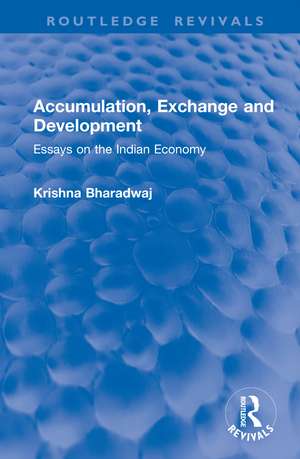
Accumulation, Exchange and Development: Essays on the Indian Economy: Routledge Revivals
Autor Krishna Bharadwajen Limba Engleză Hardback – 30 noi 2026
The first section addresses analytical and theoretical issues in development, advocating for the classical political economy's accumulation approach over the dominant neo-classical framework. The second section examines India's agrarian economy, introducing Bharadwaj's seminal concept of "interlinked markets" and demonstrating how diverse production and exchange processes integrate into the macroeconomy. The final section critiques India's developmental strategy, questioning its focus on commodities and technology while sidelining labour as the core of accumulation.
With a new foreword accompanying this reissue, Accumulation, Exchange and Development remains essential reading for scholars of economic theory, political economy, and development economics.
Din seria Routledge Revivals
-
 Preț: 337.77 lei
 - 9%
 Preț: 1329.58 lei
 - 9%
 Preț: 1332.92 lei
 -
 Preț: 334.61 lei
 - 9%
 Preț: 1329.13 lei
 -
 Preț: 340.35 lei
 -
 Preț: 331.26 lei
 -
 Preț: 330.56 lei
 - 9%
 Preț: 1328.58 lei
 - 9%
 Preț: 1650.78 lei
 -
 Preț: 331.62 lei
 - 9%
 Preț: 1353.30 lei
 -
 Preț: 332.63 lei
 -
 Preț: 314.21 lei
 - 8%
 Preț: 437.60 lei
 -
 Preț: 314.42 lei
 -
 Preț: 319.14 lei
 - 9%
 Preț: 1149.18 lei
 - 5%
 Preț: 308.82 lei
 - 9%
 Preț: 981.60 lei
 - 9%
 Preț: 1331.10 lei
 - 9%
 Preț: 1328.90 lei
 -
 Preț: 359.67 lei
 - 9%
 Preț: 6718.93 lei
 -
 Preț: 466.95 lei
 -
 Preț: 332.93 lei
 - 9%
 Preț: 1328.05 lei
 -
 Preț: 415.66 lei
 -
 Preț: 328.42 lei
 -
 Preț: 331.26 lei
 -
 Preț: 324.38 lei
 -
 Preț: 322.28 lei
 - 14%
 Preț: 680.54 lei
 -
 Preț: 332.96 lei
 - 14%
 Preț: 649.36 lei
 -
 Preț: 238.51 lei
 -
 Preț: 329.60 lei
 -
 Preț: 330.98 lei
 - 14%
 Preț: 988.50 lei
 - 11%
 Preț: 379.69 lei
 - 9%
 Preț: 1628.13 lei
 - 18%
 Preț: 983.06 lei
 - 9%
 Preț: 1330.09 lei
 -
 Preț: 372.87 lei
 - 9%
 Preț: 809.58 lei
 - 9%
 Preț: 967.93 lei
 -
 Preț: 425.61 lei
 - 9%
 Preț: 1329.44 lei
 - 9%
 Preț: 1328.58 lei
 - 9%
 Preț: 3516.85 lei
Preț: 693.32 lei
Preț vechi: 906.23 lei
-23% Precomandă
Puncte Express: 1040
Carte nepublicată încă
Livrare prin curier în România Precomanda se expediază când titlul devine disponibil.
Transport gratuit pentru acest produs Plată online sau ramburs, în funcție de opțiunile comenzii.
Retur gratuit în 14 zile Comandă securizată și suport în română.
Doresc să fiu notificat când acest titlu va fi disponibil:
Se trimite...
Specificații
ISBN-13: 9781041443100
ISBN-10: 1041443102
Pagini: 404
Dimensiuni: 156 x 234 mm
Ediția:1
Editura: Taylor & Francis
Colecția Routledge
Seria Routledge Revivals
Locul publicării:Oxford, United Kingdom
ISBN-10: 1041443102
Pagini: 404
Dimensiuni: 156 x 234 mm
Ediția:1
Editura: Taylor & Francis
Colecția Routledge
Seria Routledge Revivals
Locul publicării:Oxford, United Kingdom
Public țintă
PostgraduateCuprins
Appreciation About the Author Foreword to the Reissue Part I: The Accumulation View 1. Production and Exchange in Theories of Price Formation and Economic Transition 2. Analytics of Agriculture- Industry Relation 3. Alternative Analytical Paradigms in Theories of Development Part II: Processes of Production and Exchange in the Agrarian Economy 4. Notes on Farm Size and Productivity 5. On The So-Called Technical Relations in Agriculture 6. Tenure Real Conditions and Mode of Exploitation: A Study of Some Villages in Orissa (with P.K. Das) 7. A View on Commercialization in Indian Agriculture and the Development of Capitalism 8. Towards a Macroeconomic Framework for a Developing Economy: The Indian Case Part III: The Course of Development 9. Agricultural Price Policy for Growth: The Emerging Contradictions 10. On The Formation of the Labour Market 11. Paradigms in Development Theory: Plea for a ‘Labour-ist’ Approach Bibliography Index
Recenzii
“Krishna Bharadwaj … was known in the West mainly for her work in the fields of classical economics and the emergence of marginalism. But in the East she enjoyed a wide reputation for her original contributions on Indian agriculture. In her own mind, these two seemingly heterogeneous subjects were closely connected. For the classical theory provided a framework to represent production with a surplus; specific theories, varying according to institutions and other historical data, would explain effective demand, employment and the distribution of surplus … [The] student who has pondered Bharadwaj’s examples will know how to emphasize her methods in the most diverse conditions.”
Bertram Schefold
Professor Emeritus, Faculty of Economics and Business, Goethe University, Frankfurt, Germany
“Krishna Bharadwaj was … always emphasizing the significance of power and questioning precepts of marginalist economics … The republication of these essays is greatly to be welcomed, because even though some of them were written almost fifty years ago, they are of enduring significance – for the exposition, for example, of the crucial idea of ‘compulsive involvement in markets’ and of its implications for understanding of the way in which capitalism developed in the rural economy of India.”
John Harriss
Professor Emeritus, School of International Studies, Simon Fraser University, Canada; and Fellow, Royal Society of Canada
“. . . [Bharadwaj’s] is the earliest and perhaps as yet the clearest statement of interlinked markets; what subsequent mathematical formulations In terms of principal-agent contracts have achieved are explicit characterisations of special cases.”
Badal Mukhopadhyay
Formerly Director, Delhi School of Economics, University of Delhi
“Bharadwaj holds that neither the ‘trickle-down’ view on development nor the ‘welfarist’ view on poverty alleviation appears to be viable as long-term strategies …”
The Pakistan Development Review
Bertram Schefold
Professor Emeritus, Faculty of Economics and Business, Goethe University, Frankfurt, Germany
“Krishna Bharadwaj was … always emphasizing the significance of power and questioning precepts of marginalist economics … The republication of these essays is greatly to be welcomed, because even though some of them were written almost fifty years ago, they are of enduring significance – for the exposition, for example, of the crucial idea of ‘compulsive involvement in markets’ and of its implications for understanding of the way in which capitalism developed in the rural economy of India.”
John Harriss
Professor Emeritus, School of International Studies, Simon Fraser University, Canada; and Fellow, Royal Society of Canada
“. . . [Bharadwaj’s] is the earliest and perhaps as yet the clearest statement of interlinked markets; what subsequent mathematical formulations In terms of principal-agent contracts have achieved are explicit characterisations of special cases.”
Badal Mukhopadhyay
Formerly Director, Delhi School of Economics, University of Delhi
“Bharadwaj holds that neither the ‘trickle-down’ view on development nor the ‘welfarist’ view on poverty alleviation appears to be viable as long-term strategies …”
The Pakistan Development Review
Notă biografică
Krishna Bharadwaj was the founder professor at Centre for Economic Studies & Planning of Jawaharlal Nehru University (JNU), New Delhi since 1972 till her sudden demise in early 1992. An outstanding scholar and economic theorist, she was well known for her appraisal of the foundations of economic theories, and original contributions to development theory. She was a major participant in the discourse on economic theory after Piero Sraffa’s revival of political economy. In addition to serving as Dean, School of Social Sciences, JNU, she held numerous visiting positions abroad, notably at MIT, Cambridge University (UK), University of Manchester, and Stanford University. In 1979, she received the V.K.R.V. Rao National Award for Eminent Social Scientist. Bharadwaj’s major publications include Themes in Value and Distribution – Classical Theory Reappraised; Essays on Piero Sraffa (edited jointly with Bertram Schefold); Production Conditions in Indian Agriculture; and Classical Political Economy and Rise to Dominance of Supply and Demand Theories.
Descriere
First published in 1994, Accumulation, Exchange and Development presents eleven essays by Professor Krishna Bharadwaj, exploring production structures, India's agrarian economy, and development contradictions. Advocating labor-centric accumulation, Bharadwaj critiques neo-classical approaches and introduces "interlinked markets."