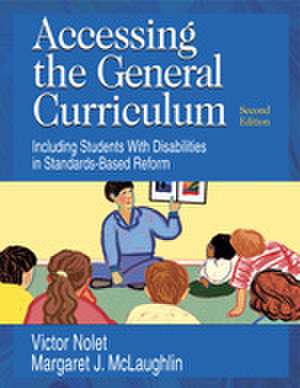
Accessing the General Curriculum: Including Students With Disabilities in Standards-Based Reform
Editat de Victor Nolet, Margaret J. McLaughlinen Limba Engleză Electronic book text – 14 oct 2013
Preț: 183.41 lei
Puncte Express: 275
Indisponibil temporar
Doresc să fiu notificat când acest titlu va fi disponibil:
Se trimite...
Specificații
ISBN-13: 9781452208978
ISBN-10: 1452208972
Pagini: 144
Dimensiuni: 216 x 279 mm
Ediția:Second Edition
Editura: SAGE Publications
Colecția Corwin
Locul publicării:Thousand Oaks, United States
ISBN-10: 1452208972
Pagini: 144
Dimensiuni: 216 x 279 mm
Ediția:Second Edition
Editura: SAGE Publications
Colecția Corwin
Locul publicării:Thousand Oaks, United States
V-ar putea interesa
-
 I Can't Do That!John LingPreț: 379.73 lei
 -
 Preț: 397.02 lei
 -
 Intensive InteractionDave Hewett-15%Preț: 548.30 lei645.05 lei
 -
 Educating Students on the Autistic SpectrumMartin Hanbury-15%Preț: 550.76 lei647.95 lei
 -
 The ADHD Book of ListsSandra F RiefPreț: 230.21 lei
 -
 -20%Preț: 123.09 lei154.32 lei
 -
 -21%Preț: 123.07 lei154.96 lei
 -
 -26%Preț: 198.91 lei269.23 lei
 -
 -26%Preț: 211.33 lei286.21 lei
 -
 -21%Preț: 92.60 lei117.01 lei
 -
 -21%Preț: 91.62 lei116.67 lei
 -
 -21%Preț: 163.55 lei207.02 lei
 -
 -21%Preț: 150.04 lei189.43 lei
 -
 -20%Preț: 165.88 lei208.03 lei
 -
 The Inclusion ToolkitSarah H. HerbertPreț: 332.72 lei
 -
 The New Social Story Book(TM)Carol GrayPreț: 271.63 lei
Recenzii
"Offers
suggestions
on
how
educators
can
provide
all
learners
with
the
opportunity
to
meet
standards
through
accommodating,
modifying,
and/or
implementing
alternative
achievement
goals."
Cuprins
Introduction
Acknowledgments
1. Access to the General Curriculum: Why it is More Important Than Ever Before
The IDEA and Access to the General Curriculum
The No Child Left Behind Act
The Link Between "Standards" and "Curriculum"
A New Way to Think About Special Education
2. The Nature of Curriculum
Multiple Types of Curriculum
The Core Elements of Curriculum
What is the Purpose of Curriculum?
Curriculum Involves a Domain
Curriculum and Time
Finding the General Curriculum
Chapter Summary
3. The Learning-Teaching Connection
Learning Research and Implications for Teaching
Help Students Develop Meaningful Patterns of Information
Creating Experts
Teach to Improve Your Student's Memory
Help Students Attend to What You Want Them to Learn
Make Effective Use of Practice
Make Effective Use of Scaffolding
Help Students Manage Their Own Learning
Teach for Transfer and Generalization
The Learning-Teaching Connection
4. Assessment That Supports Access to the General Curriculum
Assessment and Decision-Making
What Will Typical Students Be Expected to Do During the Timeframe Addressed by the IEP
What is the Student's Present Level of Performance in the General Curriculum?
In What Ways is the Student's Disability Impacting Performance?
Is the Student Making Progress in the General Education Curriculum?
5. Access to Curriculum and the Individual Education Program
Curriculum Access on a Continuum
Universal Design for Learning
Multiple Means of Representation
Accommodations
Modifications
Accommodations and Modifications and Assessment
Special Education and Related Services
6. A Decision-Making Process for Creating IEPs That Lead to Curriculum Access
Step 1: Instructional Assessment
Step 2: Choosing the Standards and Identifying Supports
Step 3: Creating IEP Goals, Objectives, and Benchmarks
The Relationship Between Objectives and Benchmarks
References
Index
Acknowledgments
1. Access to the General Curriculum: Why it is More Important Than Ever Before
The IDEA and Access to the General Curriculum
The No Child Left Behind Act
The Link Between "Standards" and "Curriculum"
A New Way to Think About Special Education
2. The Nature of Curriculum
Multiple Types of Curriculum
The Core Elements of Curriculum
What is the Purpose of Curriculum?
Curriculum Involves a Domain
Curriculum and Time
Finding the General Curriculum
Chapter Summary
3. The Learning-Teaching Connection
Learning Research and Implications for Teaching
Help Students Develop Meaningful Patterns of Information
Creating Experts
Teach to Improve Your Student's Memory
Help Students Attend to What You Want Them to Learn
Make Effective Use of Practice
Make Effective Use of Scaffolding
Help Students Manage Their Own Learning
Teach for Transfer and Generalization
The Learning-Teaching Connection
4. Assessment That Supports Access to the General Curriculum
Assessment and Decision-Making
What Will Typical Students Be Expected to Do During the Timeframe Addressed by the IEP
What is the Student's Present Level of Performance in the General Curriculum?
In What Ways is the Student's Disability Impacting Performance?
Is the Student Making Progress in the General Education Curriculum?
5. Access to Curriculum and the Individual Education Program
Curriculum Access on a Continuum
Universal Design for Learning
Multiple Means of Representation
Accommodations
Modifications
Accommodations and Modifications and Assessment
Special Education and Related Services
6. A Decision-Making Process for Creating IEPs That Lead to Curriculum Access
Step 1: Instructional Assessment
Step 2: Choosing the Standards and Identifying Supports
Step 3: Creating IEP Goals, Objectives, and Benchmarks
The Relationship Between Objectives and Benchmarks
References
Index
Descriere
Featuring
updated
strategies
for
fitting
special
education
into
frameworks
created
by
standards
and
assessments,
this
indispensable
resource
shows
teachers
how
to
achieve
expected
results
with
all
students.