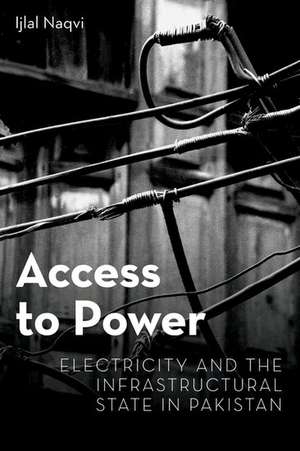
Access to Power: Electricity and the Infrastructural State in Pakistan: MODERN SOUTH ASIA SERIES
Autor Ijlal Naqvien Limba Engleză Hardback – 16 dec 2022
Preț: 523.89 lei
Preț vechi: 749.63 lei
-30%
Puncte Express: 786
Carte disponibilă
Livrare economică 06-17 noiembrie
Livrare prin curier în România Termenul estimat este afișat lângă disponibilitate.
Transport gratuit pentru acest produs Plată online sau ramburs, în funcție de opțiunile comenzii.
Retur gratuit în 14 zile Comandă securizată și suport în română.
Specificații
ISBN-13: 9780197540954
ISBN-10: 0197540953
Pagini: 208
Ilustrații: 10 b/w line drawings; 2 tables
Dimensiuni: 239 x 163 x 20 mm
Greutate: 0.46 kg
Editura: Oxford University Press
Colecția OUP USA
Seria MODERN SOUTH ASIA SERIES
Locul publicării:New York, United States
ISBN-10: 0197540953
Pagini: 208
Ilustrații: 10 b/w line drawings; 2 tables
Dimensiuni: 239 x 163 x 20 mm
Greutate: 0.46 kg
Editura: Oxford University Press
Colecția OUP USA
Seria MODERN SOUTH ASIA SERIES
Locul publicării:New York, United States
Recenzii
Access to Power is a conceptually sophisticated analysis of how different kinds of consumers at the national, city and individual levels negotiate with Pakistan's long-faltering energy sector. Based on a wide range of interviews, it offers rare insights into the changing interstices of state and society in Pakistan." -Ayesha Jalal, Mary Richardson Professor of History and Director, Center for South Asian and Indian Ocean Studies, Tufts University
Building on the emerging field of critical infrastructure studies, but embedding these concerns within longstanding discussions of state formation, this fascinating book shows us why the Pakistani state's presence is unevenly distributed within and across urban and national territory. Among Naqvi's most provocative findings is his claim that state failures to stem predation in the electricity sector are directly influenced by social formations that provide their own networks of production and consumption, both licit and illicit, thus relegating the formal administrative institutions of the state to a secondary role, particularly at the scale of the city. Electricity demands emanating from cities are central to the scalar dynamics of national governance even as they undermine state capacity locally." -Diane E. Davis, Charles Dyer Norton Professor of Regional Planning and Urbanism, Graduate School of Design, Harvard University
An interesting discussion of an important topic. Naqvi takes access to electricity as a lens on state-building in Pakistan. His extensive research, including years of fieldwork, takes us inside Pakistani state bureaucracies and cautions against equating formal rights with substantive access." -Monica Prasad, Professor of Sociology, Northwestern University
Access to Power unpacks the riddle of why so many efforts to reform the electricity sector in Pakistan have failed and why electricity remains such an unequally distributed service. Moving beyond the good governance literature, Naqvi locates power and politics at the center of his inquiry and through a nested analysis that moves from the national to the local methodically exposes the distributional conflicts and strategic actions that shape uneven state capacity. If many have called for disaggregating the state, Naqvi actually delivers. This is sociology at its best and a must read for anyone interested in understanding development as a contested process." -Patrick Heller, Professor of Sociology and International Affairs, Brown University
Access to Power by Ijlal Naqvi is a fascinating book, focusing primarily on the tremendous electricity shortage in Pakistan as a glaring example of a deficient governmental structure, a situation common in South Asian states.
Building on the emerging field of critical infrastructure studies, but embedding these concerns within longstanding discussions of state formation, this fascinating book shows us why the Pakistani state's presence is unevenly distributed within and across urban and national territory. Among Naqvi's most provocative findings is his claim that state failures to stem predation in the electricity sector are directly influenced by social formations that provide their own networks of production and consumption, both licit and illicit, thus relegating the formal administrative institutions of the state to a secondary role, particularly at the scale of the city. Electricity demands emanating from cities are central to the scalar dynamics of national governance even as they undermine state capacity locally." -Diane E. Davis, Charles Dyer Norton Professor of Regional Planning and Urbanism, Graduate School of Design, Harvard University
An interesting discussion of an important topic. Naqvi takes access to electricity as a lens on state-building in Pakistan. His extensive research, including years of fieldwork, takes us inside Pakistani state bureaucracies and cautions against equating formal rights with substantive access." -Monica Prasad, Professor of Sociology, Northwestern University
Access to Power unpacks the riddle of why so many efforts to reform the electricity sector in Pakistan have failed and why electricity remains such an unequally distributed service. Moving beyond the good governance literature, Naqvi locates power and politics at the center of his inquiry and through a nested analysis that moves from the national to the local methodically exposes the distributional conflicts and strategic actions that shape uneven state capacity. If many have called for disaggregating the state, Naqvi actually delivers. This is sociology at its best and a must read for anyone interested in understanding development as a contested process." -Patrick Heller, Professor of Sociology and International Affairs, Brown University
Access to Power by Ijlal Naqvi is a fascinating book, focusing primarily on the tremendous electricity shortage in Pakistan as a glaring example of a deficient governmental structure, a situation common in South Asian states.
Notă biografică
Ijlal Naqvi is Associate Professor of Sociology and Associate Dean for Curriculum and Teaching at the School of Social Sciences of Singapore Management University. He is interested in how states work on an everyday basis and draws on the fields of development sociology and urban studies in his research. Before becoming an academic Ijlal worked as a business consultant in the US and for the Pakistani government. Ijlal earned his Ph.D. from the University of North Carolina at Chapel Hill, has a MA in Law and Diplomacy from the Fletcher School at Tufts University, and a BA from Middlebury College.
Cuprins
- Acknowledgments
- Chapter 1: Introduction
- Part I: The National Level of Analysis
- Chapter 2: The Inter-Provincial Unevenness of the Infrastructural State
- Chapter 3: Pathologies of Development Practice
- Part II: The City
- Chapter 4: The Administration of Losses
- Chapter 5: Negotiating Formality in Islamabad's Katchi Abadis
- Part III: Individual Level of Analysis
- Chapter 6: Governance as an emergent compromise
- Chapter 7: Money, Violence, and Connections: The Culture of Power
- Chapter 8: Conclusion
- References
- Index