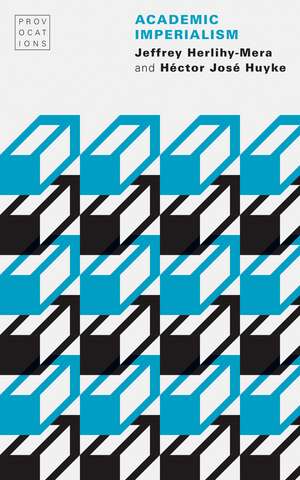
Academic Imperialism: Provocations
Autor Jeffrey Herlihy-Mera, Héctor José Huykeen Limba Engleză Paperback – apr 2027
Bringing attention to how these failures intensify the profound crises and systemic problems at their institution, the University of Puerto Rico–Mayagüez, Academic Imperialism critiques how prestige exceptionalism restricts knowledge, opportunity, and accountability across the academy.





Preț: 248.78 lei
Precomandă
Puncte Express: 373
Carte nepublicată încă
Livrare prin curier în România Precomanda se expediază când titlul devine disponibil.
Transport gratuit de la 400.00 lei Plată online sau ramburs, în funcție de opțiunile comenzii.
Retur gratuit în 14 zile Comandă securizată și suport în română.
Doresc să fiu notificat când acest titlu va fi disponibil:
Se trimite...
Specificații
ISBN-13: 9781496242181
ISBN-10: 1496242181
Pagini: 212
Ilustrații: 3 tables
Dimensiuni: 127 x 203 mm
Editura: Nebraska
Colecția University of Nebraska Press
Seria Provocations
Locul publicării:United States
ISBN-10: 1496242181
Pagini: 212
Ilustrații: 3 tables
Dimensiuni: 127 x 203 mm
Editura: Nebraska
Colecția University of Nebraska Press
Seria Provocations
Locul publicării:United States
Notă biografică
Jeffrey Herlihy-Mera is a professor of humanities and founding director of the Instituto Nuevos Horizontes at the Universidad de Puerto Rico–Mayagüez. Among his books are Decolonizing American Spanish and After American Studies: Rethinking the Legacies of Transnational Exceptionalism. Héctor José Huyke is a professor of philosophy at University of Puerto Rico–Mayagüez. He teaches philosophy of technology, modern and contemporary ethics, and existentialism. His most recent books are Elogio a las cercanías and Tras otro progreso, both critiques of contemporary technological culture.
Cuprins
Provocations
Preface: Trumpian Higher Education—Change Ideology, Keep Imperial Structure
Introduction: Imperial Provocations
1. The Imperial Context: Conquest, Language, Culture, and the Presumptions of Academic Knowledge
2. Ansiedad Imperial: Daños monolingües y lo que el inglés-centrismo oculta, silencia y destruye
3. Academic Systems of Domination: The Hiring Competition, or Designing the Status Quo
4. Exclusive Inclusion: O Incluir para Dejar Fuera
5. Research, Power, and Resource Hoarding: Funding Wealthy Institutions Is Destructive to the Humanities
6. Publishing, Privilege, Universality, and Their Exclusions
Conclusion: Universality, Imperial Failures, Decolonial Moves, Experiencing Independence
Notes
Works Cited
Recenzii
“Academic Imperialism is a combative and necessary book forcing us to think about the material conditions of academic production and the unequal distribution of institutional capital today, one that will be debated intensely and will leave no one indifferent.”—Ignacio M. Sánchez Prado, author of Strategic Occidentalism: On Mexican Fiction, the Neoliberal Book Market, and the Question of World Literature
“El presente libro, desde la singularidad Puerto Rico, plantea un abordaje sumamente valioso para, incluso, cuestionar la crítica liberal que podríamos hallar en universidades de elite como Harvard. . . . Esta contribución abre nuevas vetas de abordaje crítico en la geopolítica de la epistemología del poder imperial.”—Rafael Bautista S., pensador y escritor boliviano
“Jeffrey Herlihy-Mera and Héctor Huyke say what many of us have known to be obvious for too long: to work in academic institutions in the colony, in the Caribbean, or any place situated in the periphery of imperial power, is to constantly confront academic imperialism: a drain of resources, support, and visibility. . . . Even when in disagreement, I found the text undeniably compelling in its arguments. Academic Imperialism is an important text and a must-read for those in academia who wish to confront a long history of violent academic extractivism in the Global North, from two academics who live and work in Puerto Rico.”—Roque Raquel Salas Rivera, Puerto Rican poet, translator, and editor
“Academic Imperialism is not merely a critique of the U.S. academy, but a profound defense of other ways of knowing, speaking, and inhabiting knowledge. . . . [The authors’] argument is devastatingly precise in how it reveals academic hierarchies as inseparable from broader structures of colonialism, extraction, and cultural assimilation that permeate so much of life in the United States. What makes this work especially urgent for a U.S. readership is the translingual vision.”—Nelly Pereira, former director of external relations at Unidad Educativa Herlinda Toral in Cuenca, Ecuador
“A lethal double punch to the imperialist logic of much of U.S. higher education—both in the present Western supremacist mode and the previous corporate cosmopolitan elite focus version. . . . The solutions offered could be the blueprint for a larger progressive alliance between scholars in the mainland and on the Isla. The authors’ pointy use of Spanglish is music for the ears of the reader: Voces boricuas como (h)olas en Aguadilla devastando el idioma tedioso y Ted-Talk-like of much of today’s academic writing.”—Andrea Righi, professor of European languages at Monash University
“This is a bold and necessary book. . . . [Academic Imperialism] is not just a critique, it is an intervention. It invites readers to reconsider what counts as knowledge, who gets to produce it, and under what conditions it is legitimized. For scholars, educators, and policymakers committed to equity and intellectual integrity, Academic Imperialism is essential reading.”—Kevin Carroll, professor in the Department of Education at the University of Puerto Rico–Río Piedras
“Grounded en la realidad puertorriqueña yet resonant far beyond it, this book offers a compelling vision of scholarship rooted in reciprocidad, pluralidad, y la justicia epistémica. Urgent, courageous, and timely, Academic Imperialism is an essential contribution to contemporary debates sobre el lenguaje, la descolonización, y el futuro de la lucha sobre el conocimiento.”—Rubén Gaztambide-Fernández, professor and chair of the Department of Social Justice Education at the University of Toronto
“More than a critique, [Academic Imperialism] is a compelling provocation that challenges readers to imagine decolonial futures in which the epistemic asymmetries constitutive of higher education are dismantled, making room for more plural, reciprocal, and genuinely democratic forms of knowledge and intellectual life. Ultimately, this book is an invitation to build a conversation across languages, geographies, and experiences, to explore what becomes possible when we come together in genuine dialogue, recognize one another as epistemic equals, and collectively imagine new futures for the university beyond empire.”—José Atiles, associate professor of sociology at the University of Illinois Urbana-Champaign
“As a Taíno Indigenous language revitalization advocate, I have witnessed firsthand how knowledge production systems often privilege dominant languages and institutions while dismissing expertise rooted in lived experience and community knowledge. . . . This timely book invites readers to reconsider who gets to produce knowledge, whose perspectives are legitimized, and what is lost when academic discourse remains confined within imperial frameworks.”—Priscilla Colón, founder of Casa Areyto, an Indigenous-led organization that reclaims, preserves, and promotes the Taíno language and culture
“Jeffrey Herlihy-Mera and Héctor José Huyke have produced a polemic in the best sense, a piece of critical university studies scholarship for our late imperial age, a multilingual and multivocal de- and reconstruction of twenty-first-century academic and political culture. Academic Imperialism is at once a field guide to the postcolonial academy, a road map to a decolonial higher learning in America and beyond, and a mirror that the authors present to their readers. Scholars, students, and citizens affiliated with and invested in institutions of high, low, and whatever other stature will surely be challenged by this book.”—Scott Kushner, associate professor of communications studies at the University of Rhode Island
Descriere
Academic Imperialism critiques how prestige exceptionalism restricts knowledge, opportunity, and accountability across higher education in the United States.