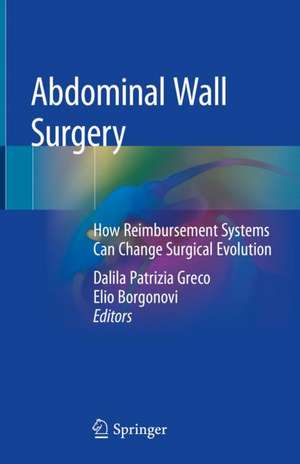
Abdominal Wall Surgery
Editat de Dalila Patrizia Greco, Elio Borgonovien Limba Engleză Hardback – 9 apr 2019
Considerăm că utilitatea practică a volumului Abdominal Wall Surgery rezidă în capacitatea sa de a oferi chirurgului clinician și managerului de spital instrumentele necesare pentru a fundamenta deciziile medicale nu doar pe criterii clinice, ci și pe eficiență economică. Într-un peisaj medical dominat de constrângeri bugetare, această lucrare, coordonată de Dalila Patrizia Greco și Elio Borgonovi, mută accentul de la tehnica pură către managementul integrat al pacientului. Subliniem faptul că volumul nu este un atlas de tehnici operatorii, ci un ghid strategic care analizează cum alegerea biomaterialelor și protocoalele de urmărire influențează costurile totale de îngrijire.
Structura cărții este riguros divizată în două părți: prima secțiune explorează anatomia, epidemiologia și modelele europene de certificare (Germania, Suedia, Spania), în timp ce a doua parte este dedicată evaluării tehnologiilor medicale (HTA) și analizei cost-beneficiu. Reținem abordarea critică asupra sistemului de rambursare bazat pe DRG („silos”), autorii propunând metode de evaluare care să includă și beneficiile indirecte pentru pacient. Clinicienii care folosesc Techniques of Abdominal Wall Hernia Repair sau Advances in Abdominal Wall Reconstruction ca referințe pentru sala de operație vor găsi în acest titlu completarea necesară pentru a înțelege „de ce” și „cu ce costuri” se realizează performanța medicală, oferind contextul administrativ care lipsește din manualele tehnice. Este o lectură esențială pentru tranziția de la medicina bazată pe dovezi (EBM) către analiza Big Data.
Preț: 819.02 lei
Preț vechi: 862.13 lei
-5%
Carte disponibilă
Livrare economică 02-16 noiembrie
Specificații
ISBN-10: 3030024253
Pagini: 248
Ilustrații: XII, 235 p. 46 illus., 34 illus. in color. With online files/update.
Dimensiuni: 160 x 241 x 19 mm
Greutate: 0.59 kg
Ediția:1st ed. 2019
Editura: Springer
Locul publicării:Cham, Switzerland
V-ar putea interesa
-
 The Unofficial Guide to PrescribingAli B.A.K. Al-Hadithi-30%Preț: 242.82 lei345.15 lei
 -
 Oh's Intensive Care ManualJonathan M. Handy-29%Preț: 691.97 lei971.74 leiRecomandat
 -
 Atlas of Abdominal Wall ReconstructionMichael J. Rosen-29%Preț: 1445.33 lei2022.42 leiRecomandat
 -
 Sabiston Textbook of Surgery: The Biological Basis of Modern Surgical PracticeDouglas Scott Tyler-29%Preț: 1167.99 lei1644.95 leiRecomandat
 -
 Kumar and Clark's Clinical MedicineDavid Randall-26%Preț: 487.69 lei658.70 leiRecomandat
 -
 Kirk's General Surgical OperationsRichard Novell-5%Preț: 944.50 lei994.20 lei
 -
 Principles and Practice of SurgeryO. James Garden-29%Preț: 391.49 lei548.90 lei
 -
 -28%Preț: 582.92 lei814.61 lei
 -
 -31%Preț: 1284.35 lei1857.30 lei
 -
 The Innovator's Prescription: A Disruptive Solution for Health CareClayton Christensen-10%Preț: 124.08 lei137.58 lei
 -
 Surgery of Complex Abdominal Wall DefectsRifat Latifi-5%Preț: 942.66 lei992.27 lei
 -
 DoctoredCharles PillerPreț: 113.35 lei
 -
 -5%Preț: 589.77 lei620.80 lei
 -
 BSAVA Manual of Canine and Feline Abdominal SurgeryJacqui D. Niles-5%Preț: 850.24 lei894.98 lei
 -
 The General Surgeon: Recollections from Four ContinentsMoshe Schein MD FACS FCS-5%Preț: 131.14 lei138.04 lei
 -
 -24%Preț: 590.60 lei776.09 lei
 -
 Principles of Coding and Reimbursement for SurgeonsMark Savarise-5%Preț: 705.77 lei742.92 lei
 -
 Robotic Surgery for Abdominal Wall Hernia RepairRicardo Z. Abdalla-5%Preț: 627.42 lei660.44 lei
 -
 Surgical Intensive Care MedicineJohn M. O'Donnell-5%Preț: 1584.98 lei1668.40 lei
De ce să citești această carte
Această carte este indispensabilă chirurgilor cu rol managerial și factorilor de decizie din sănătate. Spre deosebire de manualele clasice, aceasta explică mecanismele economice din spatele reconstrucției peretelui abdominal. Cititorul câștigă o perspectivă clară asupra modului în care selecția corectă a biomaterialelor reduce costurile pe termen lung prin evitarea complicațiilor, oferind argumente solide pentru negocierea bugetelor și optimizarea protocoalelor de tratament.
Despre autor
Editat de experți în management sanitar și economie medicală, volumul beneficiază de viziunea Dalilei Patrizia Greco și a lui Elio Borgonovi. Elio Borgonovi este un nume de referință în managementul public și sanitar la nivel european, fiind profesor la Universitatea Bocconi din Milano. Expertiza sa în analiza sistemelor de sănătate și în evaluarea politicilor publice se reflectă în rigoarea metodologică a secțiunilor economice ale cărții, făcând legătura între practica clinică și sustenabilitatea financiară a sistemelor de sănătate moderne.
Cuprins
Notă biografică
Elio Borgonovi is Senior professor of Public Administration and Healthcare Management, Department of Social and Political Sciences at Bocconi University, Milan. He was full professor at the State Universities of Parma and Trento. Since the early 70s he has developed the field of management applied to public administration, healthcare and social services sector, for not-for-profit organizations and social enterprises. In 1978 he founded and was a director of CeRGAS (Centre for Research on Health and Social Care Management) to promote research and management education in order to support the implementation of the Italian national health system. Since 2004 he has been President there. He also founded the Public and Not-for-Profit Division at SDA (Bocconi School of Management). He is member of a number of scientific committees and advisory boards and he is an official reviewer for many journals both in Italy and abroad. He is a member of several nationaland international networks, including ASFOR (Italian Association of Schools of Management), EHMA (European Healthcare Management Association), AOM (Academy of Management – Public and Not for Profit, Healthcare Divisions), IRSPM, and EGPA.
Textul de pe ultima copertă
It is a valuable resource for clinicians, surgeons, policymakers and managers in the field.