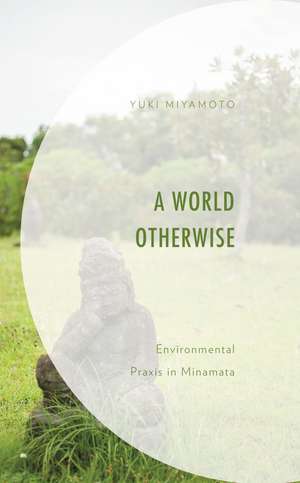
A World Otherwise: Environmental Praxis in Minamata
Autor Yuki Miyamotoen Limba Engleză Hardback – 17 feb 2021
Preț: 524.36 lei
Preț vechi: 815.43 lei
-36%
Puncte Express: 787
Carte tipărită la comandă
Livrare economică 03-17 decembrie
Livrare prin curier în România Termenul estimat este afișat lângă disponibilitate.
Transport gratuit pentru acest produs Plată online sau ramburs, în funcție de opțiunile comenzii.
Retur gratuit în 14 zile Comandă securizată și suport în română.
Specificații
ISBN-13: 9781793643605
ISBN-10: 1793643601
Pagini: 200
Ilustrații: 6 b/w illustrations;
Dimensiuni: 162 x 239 x 18 mm
Greutate: 0.42 kg
Editura: Bloomsbury Publishing
Colecția Lexington Books
Locul publicării:New York, United States
ISBN-10: 1793643601
Pagini: 200
Ilustrații: 6 b/w illustrations;
Dimensiuni: 162 x 239 x 18 mm
Greutate: 0.42 kg
Editura: Bloomsbury Publishing
Colecția Lexington Books
Locul publicării:New York, United States
Cuprins
Chapter 1: Janaka Shaba or A World Otherwise
Chapter 2: Modernization, Mercury, and Minamata
Chapter 3: The World of the Minamata Fishers: Forgiveness, Gift (nosari), and the Sugimoto Family
Chapter 4: Before Good and Evil: Ogata Masato on Spirit/Tamashii
Chapter 5: Literature of Dystopia: Ishimure Michiko and the Fragile Power of the Precariousness
Chapter 6: Genius Loci and the Discourse of Home
Chapter 7: Hongan no Kai and Spiritual Praxis as an Environmental Ethics
Chapter 2: Modernization, Mercury, and Minamata
Chapter 3: The World of the Minamata Fishers: Forgiveness, Gift (nosari), and the Sugimoto Family
Chapter 4: Before Good and Evil: Ogata Masato on Spirit/Tamashii
Chapter 5: Literature of Dystopia: Ishimure Michiko and the Fragile Power of the Precariousness
Chapter 6: Genius Loci and the Discourse of Home
Chapter 7: Hongan no Kai and Spiritual Praxis as an Environmental Ethics
Recenzii
This important book investigates how religious worldviews influence survivors' views of industrial pollution at Minamata, one of Japan's best known cases of methylmercury contamination. Through interviews with members of the group Hongan no kai (Association of the Original Vow) and deep readings of their publications, Miyamoto integrates the voices, thoughts, and actions of those who have suffered because of Japan's industrial growth and social discrimination. Observers familiar with the ongoing disaster at the Fukushima Dai-ichi nuclear power plants and the resulting radioactive contamination will see many grim parallels here.
Yuki Miyamoto illuminates a sophisticated vision of a better world-'a world otherwise'-in compelling, approachable language. Japan's disastrous methylmercury poisoning in Minamata serves as her springboard for arguing that modernity's commitment to autonomous individuality lies behind our destruction of the natural world. Only a new environmental ethic rooted in mutuality and humility can stem the poison tide of a devastated planet.
A World Otherwise illuminates a new environmental ethics that arose out of Japan's most consequential ecopolitical movement. Framed as a study of the group Hongan no kai, Miyamoto's timely work shows how decades of political resistance to corporate and government institutions produced a philosophy that challenges the instrumentalization of environment by imagining 'a world otherwise.' The ontological vision for this 'world otherwise' emphasizes relations among human and more-than-human agents. Miyamoto deftly lays out the decades of twists and turns in thought and action that produced an ontology that situates human selves within assemblages of entities rendered invisible by modern institutions.
Yuki Miyamoto illuminates a sophisticated vision of a better world-'a world otherwise'-in compelling, approachable language. Japan's disastrous methylmercury poisoning in Minamata serves as her springboard for arguing that modernity's commitment to autonomous individuality lies behind our destruction of the natural world. Only a new environmental ethic rooted in mutuality and humility can stem the poison tide of a devastated planet.
A World Otherwise illuminates a new environmental ethics that arose out of Japan's most consequential ecopolitical movement. Framed as a study of the group Hongan no kai, Miyamoto's timely work shows how decades of political resistance to corporate and government institutions produced a philosophy that challenges the instrumentalization of environment by imagining 'a world otherwise.' The ontological vision for this 'world otherwise' emphasizes relations among human and more-than-human agents. Miyamoto deftly lays out the decades of twists and turns in thought and action that produced an ontology that situates human selves within assemblages of entities rendered invisible by modern institutions.