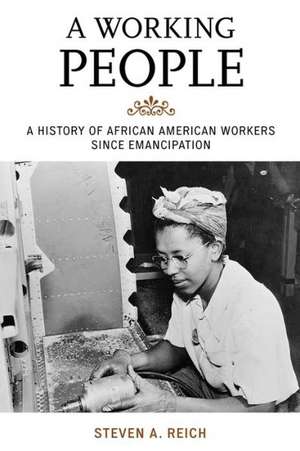
A Working People: A History of African American Workers Since Emancipation: The African American Experience Series
Autor Steven A. Reichen Limba Engleză Paperback – 19 mar 2015
Din seria The African American Experience Series
- 26%
 Preț: 177.51 lei
 - 25%
 Preț: 220.75 lei
 - 20%
 Preț: 261.88 lei
 - 25%
 Preț: 218.37 lei
 - 25%
 Preț: 219.46 lei
 - 25%
 Preț: 219.85 lei
 - 24%
 Preț: 269.36 lei
 - 25%
 Preț: 220.96 lei
 - 26%
 Preț: 267.35 lei
 - 23%
 Preț: 262.53 lei
 - 24%
 Preț: 226.14 lei
 -
 Preț: 204.44 lei
 - 17%
 Preț: 345.80 lei
 - 25%
 Preț: 221.38 lei
 - 24%
 Preț: 221.84 lei
 - 17%
 Preț: 316.02 lei
 - 24%
 Preț: 254.91 lei
Preț: 221.35 lei
Preț vechi: 293.42 lei
-25%
Puncte Express: 332
Carte tipărită la comandă
Livrare economică 05-19 decembrie
Livrare prin curier în România Termenul estimat este afișat lângă disponibilitate.
Transport gratuit de la 400.00 lei Plată online sau ramburs, în funcție de opțiunile comenzii.
Retur gratuit în 14 zile Comandă securizată și suport în română.
Specificații
ISBN-13: 9781442248618
ISBN-10: 1442248610
Pagini: 232
Ilustrații: 8 BW Photos, 8 Tables
Dimensiuni: 153 x 227 x 19 mm
Greutate: 0.36 kg
Editura: Bloomsbury Publishing
Colecția Rowman & Littlefield
Seria The African American Experience Series
Locul publicării:New York, United States
ISBN-10: 1442248610
Pagini: 232
Ilustrații: 8 BW Photos, 8 Tables
Dimensiuni: 153 x 227 x 19 mm
Greutate: 0.36 kg
Editura: Bloomsbury Publishing
Colecția Rowman & Littlefield
Seria The African American Experience Series
Locul publicării:New York, United States
Descriere
In this book, historian Steven A. Reich examines the economic, political and cultural forces that have beaten and built America's black workforce since Emancipation. From the abolition of slavery through the Civil Rights Movement and Great Recession, African Americans have faced a unique set of obstacles and prejudices on their way to becoming a productive and indispensable portion of the American workforce. Repeatedly denied access to the opportunities all Americans are to be afforded under the Constitution, African Americans have combined decades of collective action and community mobilization with the trailblazing heroism of a select few to pave their own way to prosperity. This latest installment of the African American HistorySeries challenges the notion that racial prejudices are buried in our nation's history, and instead provides a narrative connecting the struggles of many generations of African American workers to those felt the present day. Reich provides an unblinking account of what being an African American worker has meant since the 1860s, alluding to ways in which we can and must learn from our past, for the betterment of all workers, however marginalized they may be. A Working People: A History of African American Workers Since Emancipation is as factually astute as it is accessibly written, a tapestry of over 150 years of troubled yet triumphant African American labor history that we still weave today.
Cuprins
Introduction
Chronology
Chapter One
Emancipation and the Politics of Black Labor
Chapter Two
Jim Crow's Black Workers
Chapter Three
The Great Black Labor Migration
Chapter Four
A New Deal for Black Workers
Chapter Five
The Black Working-Class Movement for Civil Rights
Chapter Six
Opening the American Workplace
Documents
Selected Bibliography
Chronology
Chapter One
Emancipation and the Politics of Black Labor
Chapter Two
Jim Crow's Black Workers
Chapter Three
The Great Black Labor Migration
Chapter Four
A New Deal for Black Workers
Chapter Five
The Black Working-Class Movement for Civil Rights
Chapter Six
Opening the American Workplace
Documents
Selected Bibliography
Recenzii
Reich has structured this book wisely. He clearly understands how to frame historical arguments in a way that will encourage discussion and debate.
The title and subtitle of this book say it all. This concisely written history of African American workers recounts the slow progress and many reversals of a people willing to work but consistently denied access to decent working conditions, decent remuneration, vocational education, and the opportunity to advance on the job. In short, it is the story of a people denied the American Dream. Reich (James Madison Univ.; author of Encyclopedia of the Great Black Migration, 2006) divides the time line for his work into the post-Civil War era; the introduction of Jim Crow and the resurgence of white supremacy; the migration from the agrarian South to the industrial North; the Depression and WW II; post-WW II and Korea: and the trials and struggles of the civil rights era. A subtheme of the book is the rise and diminution of the economic rights of America's working class. Nothing of note is lacking from Reich's account. This work is a perfect supplement for classes in race and ethnicity, labor history, and diversity. Of special interest is the 'Documents' section, which contains contemporaneous narratives and interviews of those who watched these events transpire. Excellent notes and a selected bibliography. Summing Up: Highly recommended. All levels of undergraduate students; general readers.
In 1982, William H. Harris published The Harder We Run, a concise narrative of black workers since the end of slavery that has been used in scores of undergraduate labor and African American history courses. Steven Reich's A Working People is a worthy successor to Harris's outdated work. It is a didactic, accessible overview of African American workers since emancipation, which provides a solid base for general readers and suggestive research possibilities for those wishing to probe more deeply. A strong bibliographic essay and thirty-six pages of primary source documents bolster research efforts.
Understanding that political equality and meaningful civic participation required a firm economic foundation, African Americans waged their long struggle for civil rights not just at the ballot box and the realm of public accommodations but in the the workplace and union hall as well. Too often, however, the crucial economic dimension of the freedom struggle has been neglected or minimized in standard accounts. In A Working People: A History of African American Workers Since Emancipation, Steven Reich effectively redresses this problem. He offers readers a compelling, sophisticated and comprehensive account of black workers' struggles to open up jobs, achieve economic mobility, and participate fully in the nation's economy. This is an indispensible book for anyone seeking to understand the full scope of the movements for civil rights since the era of emancipation.
With this masterful synthesis, Steven Reich shows how black workers overcame tremendous barriers to shape the United States in the century following emancipation.
In this masterful synthesis, Reich shines the spotlight on African Americans as workers seeking racial and economic justice in the century and a half since the abolition of slavery. More than a labor history, Reich shows how the impulse to make a living and a life as equal and full participants in American society has been intimately connected to the larger black freedom movement. This clearly written, accessible history helps explain why the struggle for racial economic equality is not over.
The title and subtitle of this book say it all. This concisely written history of African American workers recounts the slow progress and many reversals of a people willing to work but consistently denied access to decent working conditions, decent remuneration, vocational education, and the opportunity to advance on the job. In short, it is the story of a people denied the American Dream. Reich (James Madison Univ.; author of Encyclopedia of the Great Black Migration, 2006) divides the time line for his work into the post-Civil War era; the introduction of Jim Crow and the resurgence of white supremacy; the migration from the agrarian South to the industrial North; the Depression and WW II; post-WW II and Korea: and the trials and struggles of the civil rights era. A subtheme of the book is the rise and diminution of the economic rights of America's working class. Nothing of note is lacking from Reich's account. This work is a perfect supplement for classes in race and ethnicity, labor history, and diversity. Of special interest is the 'Documents' section, which contains contemporaneous narratives and interviews of those who watched these events transpire. Excellent notes and a selected bibliography. Summing Up: Highly recommended. All levels of undergraduate students; general readers.
In 1982, William H. Harris published The Harder We Run, a concise narrative of black workers since the end of slavery that has been used in scores of undergraduate labor and African American history courses. Steven Reich's A Working People is a worthy successor to Harris's outdated work. It is a didactic, accessible overview of African American workers since emancipation, which provides a solid base for general readers and suggestive research possibilities for those wishing to probe more deeply. A strong bibliographic essay and thirty-six pages of primary source documents bolster research efforts.
Understanding that political equality and meaningful civic participation required a firm economic foundation, African Americans waged their long struggle for civil rights not just at the ballot box and the realm of public accommodations but in the the workplace and union hall as well. Too often, however, the crucial economic dimension of the freedom struggle has been neglected or minimized in standard accounts. In A Working People: A History of African American Workers Since Emancipation, Steven Reich effectively redresses this problem. He offers readers a compelling, sophisticated and comprehensive account of black workers' struggles to open up jobs, achieve economic mobility, and participate fully in the nation's economy. This is an indispensible book for anyone seeking to understand the full scope of the movements for civil rights since the era of emancipation.
With this masterful synthesis, Steven Reich shows how black workers overcame tremendous barriers to shape the United States in the century following emancipation.
In this masterful synthesis, Reich shines the spotlight on African Americans as workers seeking racial and economic justice in the century and a half since the abolition of slavery. More than a labor history, Reich shows how the impulse to make a living and a life as equal and full participants in American society has been intimately connected to the larger black freedom movement. This clearly written, accessible history helps explain why the struggle for racial economic equality is not over.