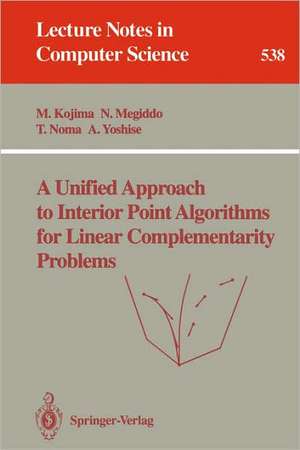
A Unified Approach to Interior Point Algorithms for Linear Complementarity Problems
Autor Masakazu Kojima, Nimrod Megiddo, Toshihito Noma, Akiko Yoshiseen Limba Engleză Paperback – 25 sep 1991
Preț: 365.47 lei
Puncte Express: 548
Carte tipărită la comandă
Livrare economică 27 noiembrie-11 decembrie
Livrare prin curier în România Termenul estimat este afișat lângă disponibilitate.
Transport gratuit de la 400.00 lei Plată online sau ramburs, în funcție de opțiunile comenzii.
Retur gratuit în 14 zile Comandă securizată și suport în română.
Specificații
ISBN-13: 9783540545095
ISBN-10: 3540545093
Pagini: 120
Ilustrații: VIII, 112 p.
Dimensiuni: 155 x 235 x 7 mm
Greutate: 0.2 kg
Ediția:1991
Editura: Springer
Locul publicării:Berlin, Heidelberg, Germany
ISBN-10: 3540545093
Pagini: 120
Ilustrații: VIII, 112 p.
Dimensiuni: 155 x 235 x 7 mm
Greutate: 0.2 kg
Ediția:1991
Editura: Springer
Locul publicării:Berlin, Heidelberg, Germany
V-ar putea interesa
-
 Core Maths for the BiosciencesMartin B. Reed-19%Preț: 428.73 lei527.88 lei
 -
 It's a Nonlinear WorldRichard H Enns-15%Preț: 479.96 lei564.67 lei
 -
 Analysis for Applied MathematicsWard Cheney-15%Preț: 616.89 lei725.76 lei
 -
 Perturbation Analysis of Optimization ProblemsJ Frederic Bonnans-18%Preț: 1404.85 lei1713.23 lei
 -
 Models and Algorithms for Biomolecules and Molecular NetworksBhaskar Dasgupta-9%Preț: 746.85 lei820.71 lei
 -
 Graph Theoretic Methods in Multiagent NetworksMehran Mesbahi-19%Preț: 561.52 lei693.23 lei
 -
 Feedback Control in Systems BiologyCarlo Cosentino-18%Preț: 897.22 lei1094.17 lei
 -
 College Geometry: A Unified DevelopmentDavid C. Kay-18%Preț: 924.93 lei1127.96 lei
 -
 Linear Mixed Models for Longitudinal DataGeert Verbeke-18%Preț: 909.25 lei1108.83 lei
 -
 Information and Coding TheoryGareth A. JonesPreț: 353.46 lei
 -
 Preț: 407.16 lei
 -
 Preț: 441.47 lei
 -
 Preț: 403.56 lei
Public țintă
ResearchCuprins
Summary.- The class of linear complementarity problems with P 0-matrices.- Basic analysis of the UIP method.- Initial points and stopping criteria.- A class of potential reduction algorithms.- Proofs of convergence theorems.