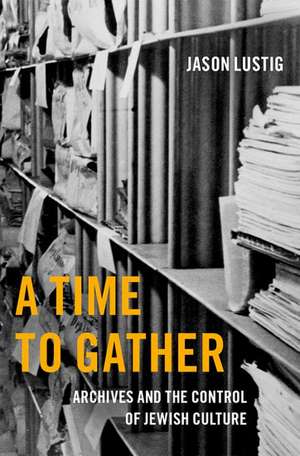
A Time to Gather: Archives and the Control of Jewish Culture: Oxford Series on History and Archives
Autor Jason Lustigen Limba Engleză Hardback – 23 mar 2022



Preț: 525.16 lei
Preț vechi: 753.15 lei
-30%
Puncte Express: 788
Carte disponibilă
Livrare economică 05-10 noiembrie
Livrare prin curier în România Termenul estimat este afișat lângă disponibilitate.
Transport gratuit pentru acest produs Plată online sau ramburs, în funcție de opțiunile comenzii.
Retur gratuit în 14 zile Comandă securizată și suport în română.
Specificații
ISBN-13: 9780197563526
ISBN-10: 019756352X
Pagini: 276
Dimensiuni: 246 x 165 x 31 mm
Greutate: 0.52 kg
Editura: Oxford University Press
Colecția OUP USA
Seria Oxford Series on History and Archives
Locul publicării:New York, United States
ISBN-10: 019756352X
Pagini: 276
Dimensiuni: 246 x 165 x 31 mm
Greutate: 0.52 kg
Editura: Oxford University Press
Colecția OUP USA
Seria Oxford Series on History and Archives
Locul publicării:New York, United States
Recenzii
A Time to Gather offers a fascinating and highly stimulating account on the centrality and function of the archive in the ruptured 20th century Jewish history. Based on an impressive range of empirical records the book provides epistemological and historical substance to the often acclaimed 'archival turn' in the Humanities.
George Orwell famously wrote that 'he who controls the past controls the future.' Jason Lustig's pathbreaking and deeply researched new study tells the story of how the archives from which we study modern Jewish history were formed by leaders who sought to shape this history following their own nationalist assumptions. Lustig deftly moves from Europe to Israel to America and back again, tracing the competing efforts to build the ultimate 'total archive' and thereby shape the future of the Jews by controlling the relics of its past. There is simply no study like it.
With incredible depth of research and force of analysis, Lustig draws readers' attention to the stuff—the 'epistemic things'—that allow them to know their pasts. He argues that the process of creating an archive is as much about preserving the past as it is about making a claim on the present and future. Leading the reader across the twentieth century, from Germany to Jerusalem to Cincinnati and New York and, finally, to the cloud, Lustig tells the story of how modern Jews gathered their past to make sense of an era of destruction and tumult.
Jason Lustig's seminal new book A Time to Gather: Archives and the Control of Jewish Culture seeks to document the history of Jewish archiving in the 20th century as a history of community archiving, with all the attendant questions this raises for the relation between archives, power, control, identity and, of course, community. As he notes in the introduction, his book "excavates archives as battlegrounds over control of Jewish culture".
Archives have a history beyond their contents...Jason Lustig's A Time to Gather: Archives and the Control of Jewish Culture demonstrates this process in a compelling way.
Lustig's book marks an essential contribution to our understanding of what the act of collecting and preserving historical records truly signifies.
A Time to Gather will spur further scholarly interest in Jewish archives as an object of historical investigation that can provide valuable insights into Jewish social, cultural, and political history.
This book offers an engaging survey of several Jewish archival collections that will be useful to advanced graduate students and scholars, as well as librarians and archivists who utilize and are the stewards of Jewish archival materials.
George Orwell famously wrote that 'he who controls the past controls the future.' Jason Lustig's pathbreaking and deeply researched new study tells the story of how the archives from which we study modern Jewish history were formed by leaders who sought to shape this history following their own nationalist assumptions. Lustig deftly moves from Europe to Israel to America and back again, tracing the competing efforts to build the ultimate 'total archive' and thereby shape the future of the Jews by controlling the relics of its past. There is simply no study like it.
With incredible depth of research and force of analysis, Lustig draws readers' attention to the stuff—the 'epistemic things'—that allow them to know their pasts. He argues that the process of creating an archive is as much about preserving the past as it is about making a claim on the present and future. Leading the reader across the twentieth century, from Germany to Jerusalem to Cincinnati and New York and, finally, to the cloud, Lustig tells the story of how modern Jews gathered their past to make sense of an era of destruction and tumult.
Jason Lustig's seminal new book A Time to Gather: Archives and the Control of Jewish Culture seeks to document the history of Jewish archiving in the 20th century as a history of community archiving, with all the attendant questions this raises for the relation between archives, power, control, identity and, of course, community. As he notes in the introduction, his book "excavates archives as battlegrounds over control of Jewish culture".
Archives have a history beyond their contents...Jason Lustig's A Time to Gather: Archives and the Control of Jewish Culture demonstrates this process in a compelling way.
Lustig's book marks an essential contribution to our understanding of what the act of collecting and preserving historical records truly signifies.
A Time to Gather will spur further scholarly interest in Jewish archives as an object of historical investigation that can provide valuable insights into Jewish social, cultural, and political history.
This book offers an engaging survey of several Jewish archival collections that will be useful to advanced graduate students and scholars, as well as librarians and archivists who utilize and are the stewards of Jewish archival materials.
Notă biografică
Jason Lustig is a Lecturer and Israel Institute Teaching Fellow at the Schusterman Center for Jewish Studies at the University of Texas at Austin. He is the host and creator of the Jewish History Matters podcast. He was previously a Harry Starr Fellow in Judaica at Harvard University's Center for Jewish Studies and a Gerald Westheimer Early Career Fellow at the Leo Baeck Institute.
Cuprins
- Introduction
- 1. Archival Totality in the Gesamtarchiv der deutschen Juden
- 2. Ingathering the Exiles of the Past? Bringing Archives to Jerusalem
- 3. An Archive of Diaspora at the 'Jerusalem on the Ohio'
- 4. Making the Past into History: Jewish Archives and Postwar Germany
- 5. Digitization, Virtual Collections, and Total Archives in the Twenty-First Century
- Conclusion
- Notes
- Bibliography
- Index